During a decade of service at the Vatican Secretariat of State, I was constantly perplexed by the Holy See’s unwillingness or inability to utilize already existing ecclesial structures for effective governance. As the Cardinals meet in Rome over the next few days, it’s worth taking a hard look at some recent ways in which the Church has been operating.
A financial problem? Establish a new commission to solve it. Then create another one to oversee the work of that one.
A question about deaconesses? Appoint a group of experts to study it (2014). Then appoint another to study it again (2020), all the while ignoring the International Theological Commission’s comprehensive study on the permanent diaconate in 2002.
Perhaps most baffling was Pope Francis’s establishment of a “Pontifical Commission for Reference on the Organization of the Economic-Administrative Structure of the Holy See,” a body designated to collaborate with a Council of Cardinals that had already been crafted by his predecessor Benedict XVI.
Ballooning bureaucracy is a sure sign of organizational dysfunction, something the Roman Curia has suffered from for years. One way of curtailing it is to reinvigorate the very body whose canonical purpose is to “assist the Roman Pontiff. . .in the daily care of the universal Church.” (Code of Canon Law, 349)
There are two reasons for the underutilization of the College of Cardinals: (1) a lack of appreciation for the connection between the occasional task of the College of Cardinals in electing a new pontiff and its ongoing role of assisting him in the daily care of the universal Church; and (2) a misconception of what constitute “serious questions” (quaestiones maioris momenti) and “grave affairs” (graviora negotia).
Regarding the first, non-residential Cardinals (i.e., those not assigned to permanent curial positions in Rome) understandably find it frustrating when their role of caring for the universal Church is limited to casting ballots in the Sistine Chapel. It would be reasonable for them to expect some follow-through so that they can accompany the man they’ve chosen in the work of implementing the vision they expressed for the Church during the General Congregations preceding the Conclave.
As for residential Cardinals, I always found it odd that the Holy Father “grants” them audiences in a way no less formal than any other visitor he happens to receive. The Holy See’s daily bulletin announces consultations with heads of dicasteries, as if the pope were meeting a run-of-the-mill ambassador or some external dignitary.
The Cardinals’ consultative role could be exercised more efficiently – if not more pleasantly and fraternally – through occasional phone calls and lunch meetings. The Holy Father should have the numbers of all 252 Cardinals saved in his cellphone contacts, and each of them should have a direct line to him. It would be a healthy step toward the kind of collegiality that could underpin whatever synodality he has in mind. I have anxious memories of escorting lost Cardinals through the Apostolic Palace as they hopelessly tried to find whatever office they were supposed to visit that day.
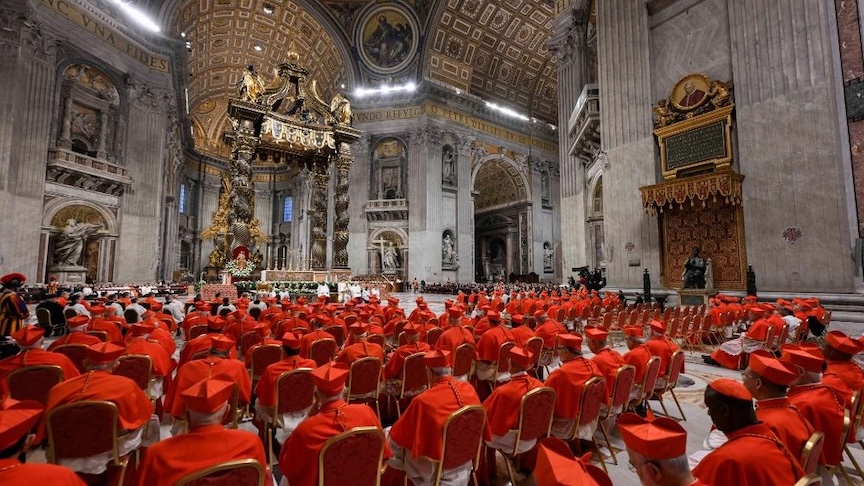 Cardinals gathered at the most recent Consistory, December 7, 2024 [source: Vatican Media]
The second problem is a gross overestimation of what constitutes a “serious question” or “grave affair” (cf. canons 349 and 352). When I worked in the Curia, I took that to mean practically anything that couldn’t be routinely resolved through the policies and procedures of the Roman Curia.
Yet every time I suggested that some specific matter would best be handled by a Consistory, my colleagues would dismiss it as not “serious” or “grave” enough. In their minds, “serious” or “grave” meant sexual abuse, financial fraud, or public scandal. In my mind, it meant anything worth consulting your closest collaborators about, precisely because they know better than you how to treat it.
From my experience in the Secretariat of State, non-residential Cardinals were always a step ahead and could have prevented major flubs (such as the Bishop Williamson affair in 2009). Before the ink was dry on Summorum Pontificum in 2007, key Cardinals were already asking if and how the liturgical calendars of the Ordinary and Extraordinary Forms might be synchronized.
I suspect this is a perfect example of what Cardinal Archbishops of major archdioceses can and will bring forward as a “serious question” in this week’s Consistory. Similarly, several Cardinals whose wisdom I highly admire have been badgering the Holy See for decades about the prudence of transferring Holy Days of Obligation to Sundays. That shows you where their hearts and minds are.
If the Church and the Successor of Peter are to make better use of the College, there must be an explicit acknowledgment that “serious questions” and “grave affairs” are in no way limited to crises and catastrophes.
Given the homework Pope Leo assigned to the Cardinals in preparation for the January 7-8 gathering, this Extraordinary Consistory offers a golden opportunity to reinvigorate the role of the College in governing the universal Church.
The fact that Predicate Evangelium (“On the Roman Curia and Its Service to the Church in the World”) is on the reading list indicates that the Holy Father is taking seriously the question of who is working for whom. After all, Book 2 of the Code of Canon Law covers the Roman Curia (Chapter 4) only after the College of Cardinals (Chapter 3), and the latter – for better or worse – only after the Synod of Bishops (Chapter 2). Chapter 1 is naturally devoted to the Roman Pontiff and the College of Bishops, as it should be.
A Vatican official once assured Pope John XXIII that it would be absolutely impossible to begin the Second Vatican Council in 1963. “Fine,” il papa buono answered. “We’ll open it in 1962.”
Similarly, it’s not too early for Pope Leo XIV to pave a synodal path by first reinvigorating the College of Cardinals’ active role in guiding the universal Church.