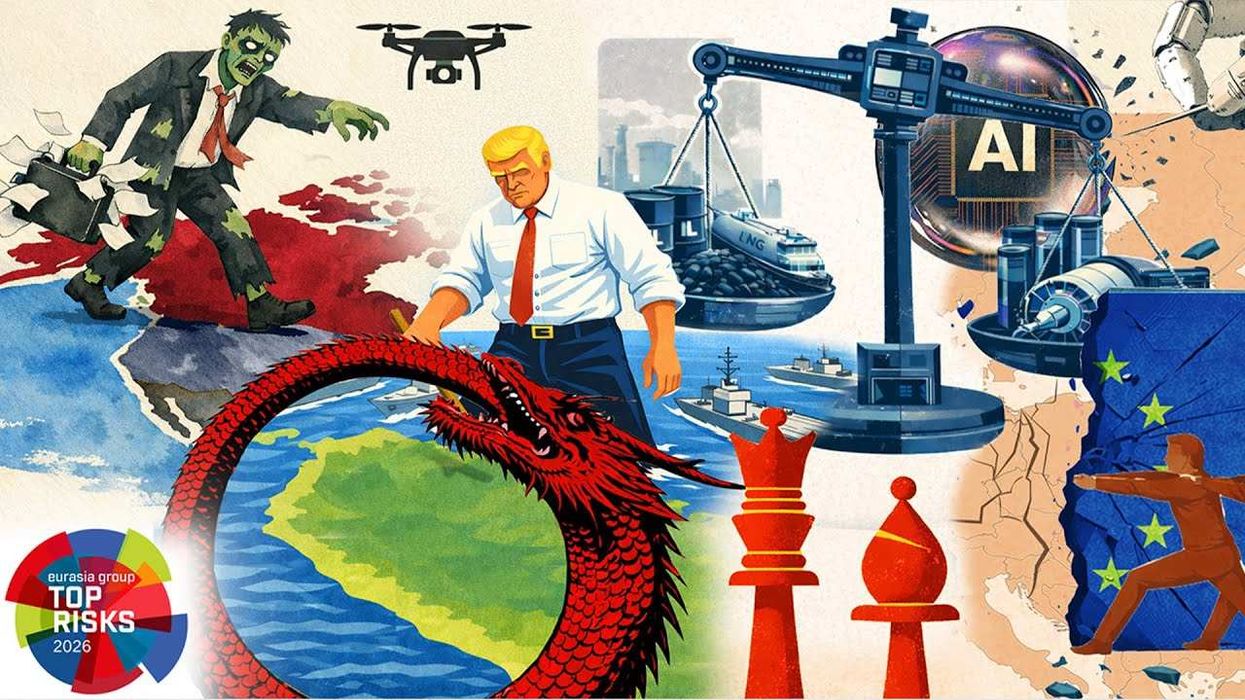
With the global order under increasing strain, 2026 is shaping up to be a tipping point for geopolitics. From political upheaval in the United States to widening conflicts abroad, the risks facing governments, markets, and societies are converging faster—and more forcefully—than at any time in recent memory.
To break it all down, journalist Julia Chatterley moderated a wide-ranging conversation with Ian Bremmer, president of Eurasia Group and GZERO Media, and a panel of Eurasia Group experts, to examine the findings of their newly-released Top Risks of 2026 report.
One theme dominates the discussion: the United States itself. From an accelerating political revolution at home to a more aggressive projection of power abroad, Washington has become the single biggest driver of global risk. That shift is playing out vividly in the Western Hemisphere, where dramatic developments in Venezuela signal a renewed U.S. willingness to shape political outcomes closer to home.
Along with Ian Bremmer, the Eurasia Group panel included Gerald Butts, Vice Chairman; Risa Grais-Targow, Director, Latin America; Cliff Kupchan, Chairman; and Mujtaba (Mij) Rahman, Managing Director, Europe. Their discussion also digs into the wars in Ukraine and the Middle East, rising instability among U.S. allies in Europe, intensifying U.S.-China competition, and the growing geopolitical consequences of artificial intelligence—all against the backdrop of a world with fewer guardrails and weaker global leadership.
As Bremmer argues, these risks are not isolated. They are symptoms of a deeper transformation: a GZERO world, where power is unconstrained, alliances are fragile, and no single country can—or will—stabilize the international system.
Watch the full conversation, recorded as a livestream on January 5, 2026, and explore what the year ahead may hold