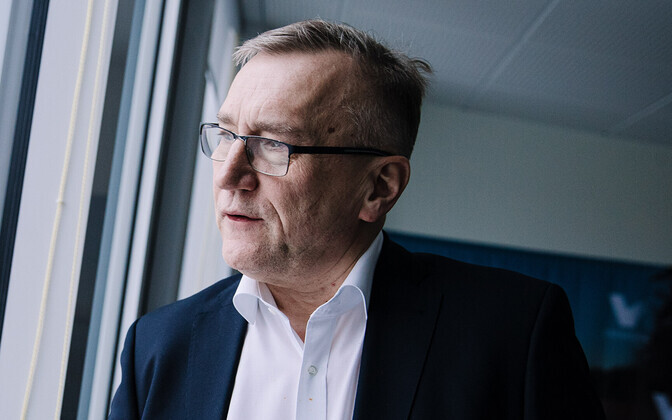
Former Prime Minister Juhan Parts (Isamaa) said Estonia’s foreign policy leaders have been too hasty in reacting to U.S. intervention in Venezuela.
Mild turbulence in Estonia’s foreign policy positions has arisen in the past over United Nations votes concerning Palestine. More recent cases include President Alar Karis’ visit to Kazakhstan and, most recently, statements on U.S. military involvement in Venezuela. While Foreign Minister Margus Tsahkna (Eesti 200) emphasized that no tears should be shed over the removal of dictator Nicolás Maduro, Chair of the Riigikogu Foreign Affairs Committee Marko Mihkelson (Reform) stressed that such a move undermines international law.
“I believe we first need to clarify the facts about what’s actually happening in the Western Hemisphere. Perhaps these emphases stem from reacting too hastily, without real information. To me, these seem like initial emotional outbursts and I wouldn’t extrapolate them to a broader level,” said former Prime Minister Juhan Parts.
“When it comes to the Israel-Palestine issue, it has been discussed in Estonia. In my view, there’s been a bit of erratic behavior in those various UN votes and I would criticize that. This wavering, where it’s one thing today and another tomorrow, should be avoided and we need to establish what our consistent positions are,” Parts continued.
“The third example is Kazakhstan — well, I only know what the papers reported. It seems to me that perhaps the Ministry of Foreign Affairs overreacted. They’re scolding the ambassador. What is that supposed to mean?” Parts asked.
According to Parts, Estonia has overreacted in part to the Venezuela issue.
“If we look at the broader international picture, here we have an illegal dictator being arrested. That’s a positive development. Now people are trying to generalize this as if it sets a precedent — but no such precedent exists. It seems to me there’s a kind of attempt to preempt the supposed evil thought patterns of other bad actors. Why should Estonian foreign policy be involved in that? The United States, still a free democracy, detains a dictator and prepares to try him and people call it illegal…” Parts remarked.
He also dismissed arguments about concern for international law as unconvincing.
“I’m not even referring specifically to Mihkelson or Tsahkna. Just look at the range of international experts. What we’re seeing here, to some extent, is an ideological fault line that has developed between the current U.S. administration and its opponents. That’s where the ideological labeling starts,” Parts said.
He noted that international law has always been in flux.
“Sorry, but if we have a situation where a member of the UN Security Council is consistently committing an act of aggression and nearly succeeds in imposing its narrative on the free world — so much so that everyone begins operating within that narrative — what international law are we talking about? In that sense, international law is both evolving and being devalued at the same time. Of course, it must be defended and advocated for as much as possible. But in the specific case of Venezuela, drawing broad conclusions like that is, in my view, unprofessional,” Parts said.
He also expressed doubt that the legal basis for the Venezuela case had been thoroughly examined.
“If we take the UN Charter today, I think the sun would set before we could finish listing all the cases where international law is toothless and essentially nonfunctional,” he added.
“There’s a kind of wishful thinking comfort zone that has taken root in Western society. Many international organizations are full of lofty declarations and charters, but reality is something else. The UN is a good example — its beautiful principles don’t align with how things actually work,” said Parts.
He added that American domestic politics is shaped by ideological conflict and political propaganda. “We need to distinguish between what is real policy and what isn’t.”
“When you look at U.S. actions — the removal of Syria’s dictator, the Iran issue, the resolution of the Gaza conflict in the Middle East, certain pariah states in Latin America — a pattern of consistency emerges. Trying to scare us into thinking Russia might suddenly stop adhering to international law is laughable. Russia hasn’t been abiding by international law to begin with,” said Parts.
“In terms of Estonian foreign policy, I think we need to take a deep breath before saying anything. Yes, the world is changing. But does every change have to be interpreted as some kind of apocalyptic turning point? I don’t think that’s a wise way to react,” he added.
Parts also disagreed with claims that the U.S. no longer wishes to engage in international cooperation. Nor does he believe that the U.S. and Europe are no longer allies.
“I wouldn’t dare make such assertions. What are they even based on? There has been intense dialogue with European partners on the Ukraine issue. There has been a strong effort to help Europe reemerge as an influential geopolitical player on the world stage — no longer under the American security umbrella,” said Parts.
He declined to comment in detail on possible U.S. involvement in Greenland.
“It’s unpleasant. I’d rather set the Greenland rhetoric aside for now. What does it even mean? Is it some kind of negotiation tactic? I assume that both Denmark and the United States are engaged in discussions beyond just the public statements — that diplomacy is also at work. The real issue here is unclear to me and it’s very difficult to comment on,” Parts concluded.
—