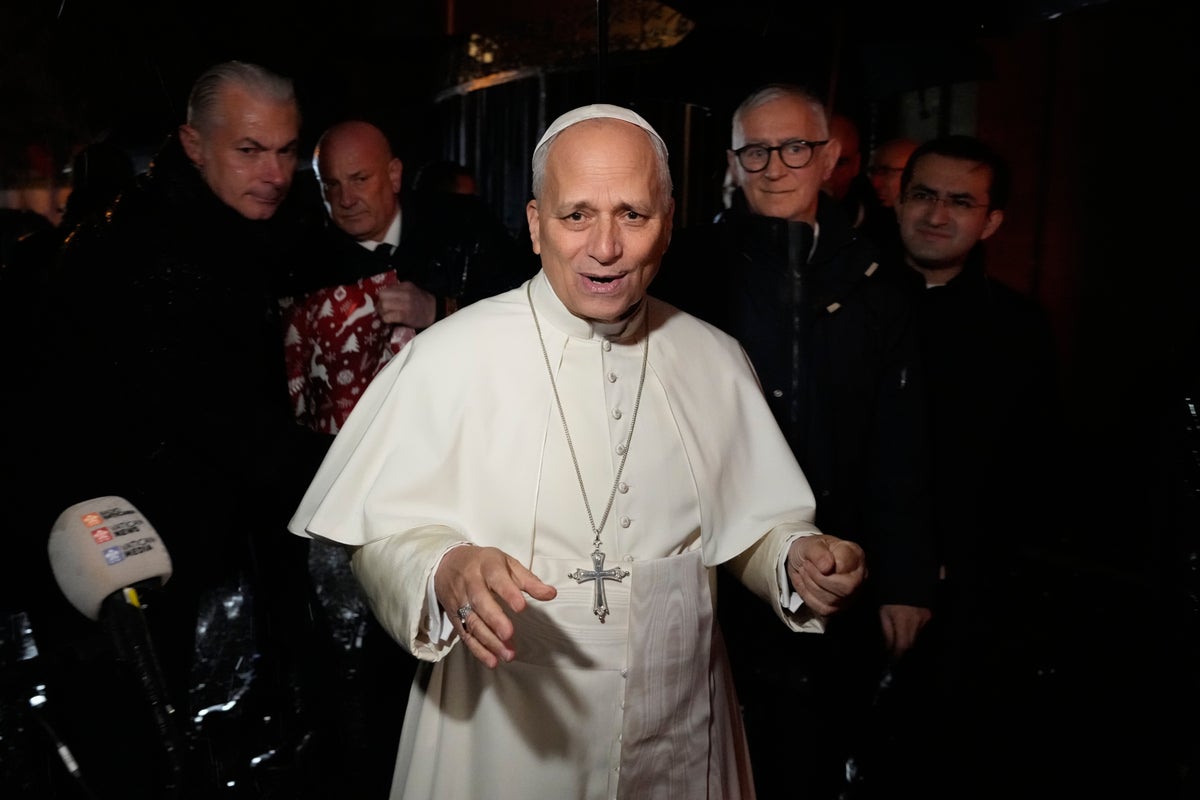
When the cardinals of the Roman Catholic Church gathered behind closed doors last year to elect a successor to Pope Francis, pundits the world over produced lists of likely candidates for the papal throne. If there was one thing the experts were agreed on, it was that an American did not have a chance. Given the US superpower status, it was assumed that the Conclave – the gathering of scarlet-clad cardinals – would not want to extend its influence still further by choosing an American pope.
Yet the Conclave did precisely that, selecting Chicago-born Cardinal Robert Prevost – now Pope Leo XIV. As for American hegemony, there is no sense that Leo is in the pocket of Donald Trump. Quite the reverse. Despite conservative American Catholics believing one of their own would mark a step change from the radical Latin American Pope Francis, Leo has continued the papal warnings about climate change, shown empathy for the poorest in the world, and renewed calls for peace.
For Pope Leo, however, the defining moment of his pontificate – and of his relationship with his American homeland – is now likely to be Venezuela. Calling out Donald Trump on the legality and morality of a US military incursion will take courage. The signs so far are encouraging – but the moment has come for Leo’s voice to be louder, stronger and angrier.
In early December, the Pope warned that the US was preparing a military incursion into Venezuela. On Sunday, he used his traditional lunchtime address to speak out – though in restrained diplomatic language. There was talk of respect for human rights, for national sovereignty, for justice.
Yet there was also a hint of something else – something more emotional – when he told the crowd that he carried a “soul full of concern” for Venezuelans. What happens in Latin America is personal for this pope. While it is correct to describe Leo as the first American pope, he is also a Peruvian pontiff.
As Robert Prevost, he spent eight years as a bishop in northern Peru, became a Peruvian citizen, and ministered to Venezuelan refugees making their way through Ecuador and Colombia in search of safety – beyond the reach of Maduro and away from the economic collapse of their homeland. Not only does he know the Venezuelan people well, but so do two of his most senior aides. Cardinal Pietro Parolin – as secretary of state, effectively the deputy pope – served as papal ambassador to Venezuela. Another, Edgar Peña Parra, is himself a Venezuelan archbishop.
None will be under any illusions about Maduro. Their focus, however, will be the people of Venezuela – not Trump’s plans for US oil barons to profit from the country’s vast natural resources.
As pope, Leo has two powerful tools when it comes to peace – a priority he has named from the outset. The first is his public voice. Nobody else commands a global platform quite like the pope’s. The second is Vatican diplomacy, with its well-informed network of nuncios around the world and its seat at international tables such as the UN, where it enjoys permanent observer status, with the right to attend, speak and influence the General Assembly.
There is ample precedent for Rome acting as a bridge between warring parties. During the Obama administration, the Vatican played a significant role in restoring ties between the US and Cuba. At a Vatican seminar on diplomacy I chaired in Rome in October, another of Leo’s lieutenants, the British Archbishop Sir Paul Gallagher, recalled its role in brokering the 1984 peace treaty between Chile and Argentina over the Beagle Channel. There was talk, too, of the Vatican’s quiet peace-building during the Troubles in Northern Ireland. At the same seminar, former security minister MP Tom Tugendhat praised the Holy See for speaking out on global conflict “with prophetic clarity”.
That is what the Pope must do now. For both sovereign Argentina and for international law, Leo can be their most important ally – without an army.