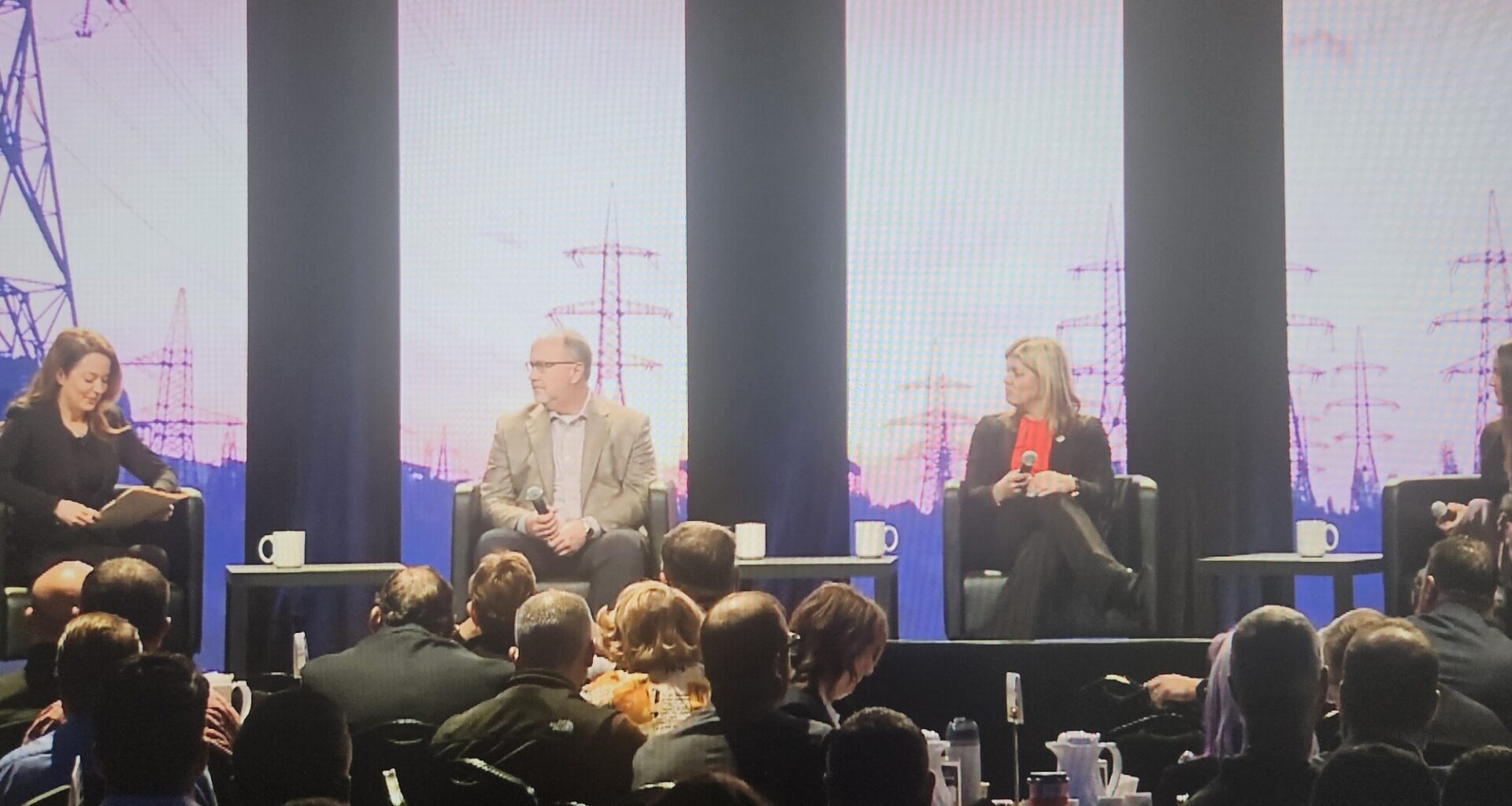
WEST FARGO, N.D. – Energy is at the foundation of innovation, whether that’s artificial intelligence (AI), manufacturing or even new business development, according to Bria Shea, president for Xcel Energy’s North Dakota, South Dakota and Minnesota region.
“Energy is a critical part of a decision on where to locate. Are they going to be reliable? Are they affordable? It is at the heart of it all,” she said.
Shea and other energy leaders took part in a panel discussion on the future of energy at the Midwest Energy Summit at the West Fargo Fairgrounds on Wednesday, Nov. 19.
Laura Laltrello, chief operating officer at Applied Digital, emphasized the growing demand for high-power, high-density data centers for high-performance computing and the safety required to grow at such a fast scale. The company started out using 9-kilowatt server racks, and is now installing 130-kilowatt racks in Ellendale, North Dakota, with the next generation expected to be 300 kilowatts in about two years.
“We’re going to be moving from 300-kilowatt probably to one megawatt. And we’ll be moving from AC power to DC power,” Laltrello said. “That amount of change has not happened in the energy industry since power lines were first installed in the last hundred years. That change is being inflicted upon all of us and all of you to figure out how you deal with the regulations of an industry that has to be well regulated, because it’s very dangerous and you’ve got to keep people safe and you’ve got to keep people secure. But what’s creating that demand is coming at you very fast.”
Texas-based Applied Digital operates AI data centers near Jamestown and Ellendale, with another planned outside Harwood, North Dakota.
The challenge for companies like Xcel Energy and Minnkota Power Cooperative is to transition the energy system, update the grid for an aging infrastructure and meet these new demands, which are all happening at once.
Shea said that although it’s a challenge, there are also opportunities, including gaining new customers and increasing sales, while allowing the sharing of fixed costs across a greater number of customers.
Panel moderator Stacy Dahl, vice president of External Affairs for Minnkota Power, emphasized that natural gas presents the strongest growth opportunity, offering flexibility and more efficient construction within today’s permitting environment.
Mark D. Anderson, vice president of Business Development and Marketing for WBI Energy, a subsidiary of MDU Resources Group, spoke about the oil and natural gas pipelines that are crucial to moving those resources outside of North Dakota to new markets.
“By all accounts, natural gas production is forecast to continue to grow. So what becomes very important is that natural gas production, as it grows, has the ability to access markets, which requires pipelines,” Anderson said. “As you think about that growth over time, we’re going to need more takeaway capacity from the Bakken and to ensure that natural gas can flow and the crude oil can then also flow.”
He said the company has proposed a Bakken East pipeline project that would originate in western North Dakota in Mackenzie County, near the heart of the Bakken, and extend eastward, ultimately to a spot near Mapleton, North Dakota, where it would connect with existing infrastructure. This would allow natural gas production to reach as much as the state as possible.
“We were very excited earlier this summer when the state of North Dakota selected our project for firm capacity support,” he said.
Policy pivots from the Biden administration to the Trump administration, particularly on fossil fuels, are affecting how energy companies are approaching growth. Having a stable regulatory environment is important, especially to interstate companies, which deal with a host of regulators.
“One of the principal regulators we have to work with is the Federal Energy Regulatory Commission (FERC),” Anderson said. “We have a long history of working successfully with FERC. As we go about building a new pipeline, we need to ultimately get an authorization from the FERC to allow us to begin construction. So at the moment, at the federal level, we’re very much feeling tailwinds.”
Shea agreed that regulatory stability is critical from both a planning perspective and from an investor perspective.
“That isn’t to say that we cannot adjust as things change. We certainly are doing that right now,” Shea said. “We’re seeing tax credits change significantly at the federal level. That is not changing our long-term strategy, but it’s changing some timing of some things.”
In addition to servicing customers in the Dakotas and Minnesota, Xcel also operates in Colorado, Michigan, Wisconsin, New Mexico and Texas, and each state has its own regulatory commission. Numerous county and city ordinances also come into play.
“All of those come into our planning processes, and I think in particular, when I think about Minnesota policies versus the Dakota policies, they are increasingly divergent. But I think at the end of the day, all three of those particular states have the same priorities and that is to be affordable and reliable. I think that is where our robust planning process can meet all of the needs of our customers,” Shea said.
Panelists shared their thoughts on priorities the region can focus on to continue supporting innovation and development in the next decade.
Laltrello suggested streamlining regulatory requirements, creating data center-friendly policies, being careful and thoughtful about building responsibly and creating jobs to help the Midwest grow. Shea noted continuing conversations with regulators and communities to figure out how to meet today’s opportunities and move with speed. Anderson said maintaining reasonable, predictable policy and regulation, and having close collaborations will help ensure the region capitalizes on all the upcoming opportunities.
The keynote address on policy and national security was given by Richard Goldberg, senior adviser with the Foundation for Defense of Democracies and a leading national voice on policy and national security. He said a three-part mandate is needed to achieve U.S. energy dominance: being able to produce and distribute abundant, low-cost and reliable energy to every region of the country; the U.S. must become a major net exporter of energy and energy technologies; and be the country that can generate enough power to run advanced AI data centers to win the global AI competition, particularly against China.