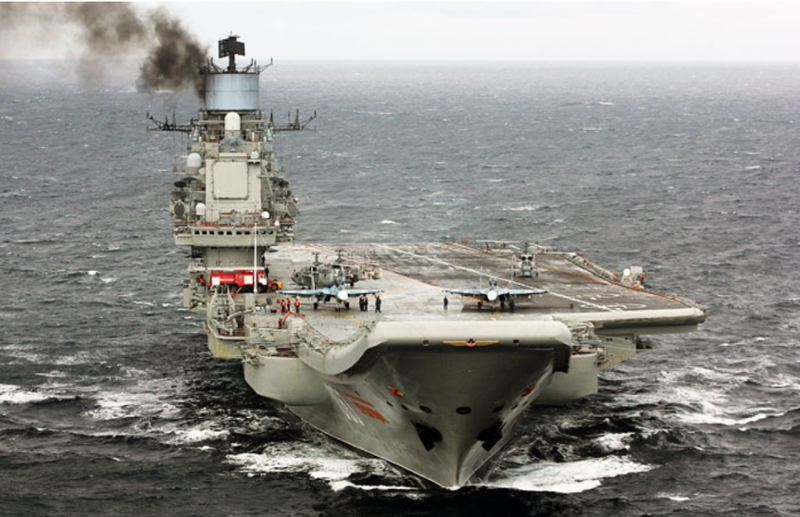
Russia’s only aircraft carrier and the current Navy flagship, the Admiral of the Fleet of the Soviet Union Kuznetsov, has been out of service since 2017. Plans to refurbish the aging ship and get it in fighting order have stalled, leading to discussions on what could come next.
In an interview, retired Russian naval officer Konstantin Sivkov dismissed claims that the costs for maintaining the carrier account for 80 percent of the Russian Navy’s budget.
Despite being launched 40 years ago, Sivkov maintains that keeping the Admiral Kuznetsov afloat is only following the United States’ example: the aircraft carrier USS Nimitz was launched 50 years ago and remains in service.
The Admiral Kuznetsov was launched in 1985. The ship’s overall length is 1,000 feet, and it has a maximum speed of about 33 miles per hour. Onboard, the Admiral Kuznetsov carries aircraft, helicopters, and anti-ship cruise missiles. It also leaves behind a thick smoke trail visible from afar, due to its burning low-cost fuel.
The vital role of the Admiral Kuznetsov is summarized by Sivkov: “If it is destroyed, it will reduce our Navy’s potential by a third.” Having an aircraft carrier is key to controlling both the seas and the skies. Aircraft from the carrier can escort and defend Russian naval units and other aviation operations.
Opponents of keeping the ship afloat note that its large, outdated systems are susceptible to modern weapons. Unmanned aircraft could easily target the carrier and destroy it and its aerial supports.
Retrofitting the Admiral Kuznetsov is likely to be more difficult with Russia’s War on Ukraine diverting funds. It is far from a priority, as its repairs have delayed its expected return to service in 2022. Mishaps have plagued repair efforts: the floating dock where it was being renovated sank in 2018, it was damaged by a falling crane, and two fires broke out onboard, causing two fatalities.
If the Admiral Kuznetsov slips beneath the waves, it may take with it a large portion of Russia’s naval potential, redefining how Russia projects its military power in the sea and sky.