
In a global economy still rocked by tariffs, sanctions, and export controls, supply chains are becoming fault lines, and interdependence is now increasingly seen as creating new vulnerabilities instead of ushering in the promise of shared prosperity. In 2025, the global consensus on the need to act on climate change seems to be eroding further, as irreversible tipping points have already been crossed. It also underscored the fragility of international trade through abrupt unilateral decisions taken by great powers. This did not begin with the new wave of US protectionism; this merely exacerbated existing fears and uncertainties. Long before the word ‘tariff’ re-entered the lexicon of modern discourse, these risks were already a major concern, driven largely by export controls that exposed the pernicious vulnerabilities of single-country dependence.
China dominates the processing and refining of most critical minerals, including lithium, cobalt, graphite, and rare earths. These minerals are especially critical for the green energy transition, forming essential components of associated climate technologies such as wind turbines, solar panels, and EV batteries. In the race for green hydrogen, China also dominates global electrolyser supply. Unsurprisingly, these factors have led other nations to urgently seek more stable, diversified arrangements.
In a global economy still rocked by tariffs, sanctions, and export controls, supply chains are becoming fault lines, and interdependence is now increasingly seen as creating new vulnerabilities instead of ushering in the promise of shared prosperity.
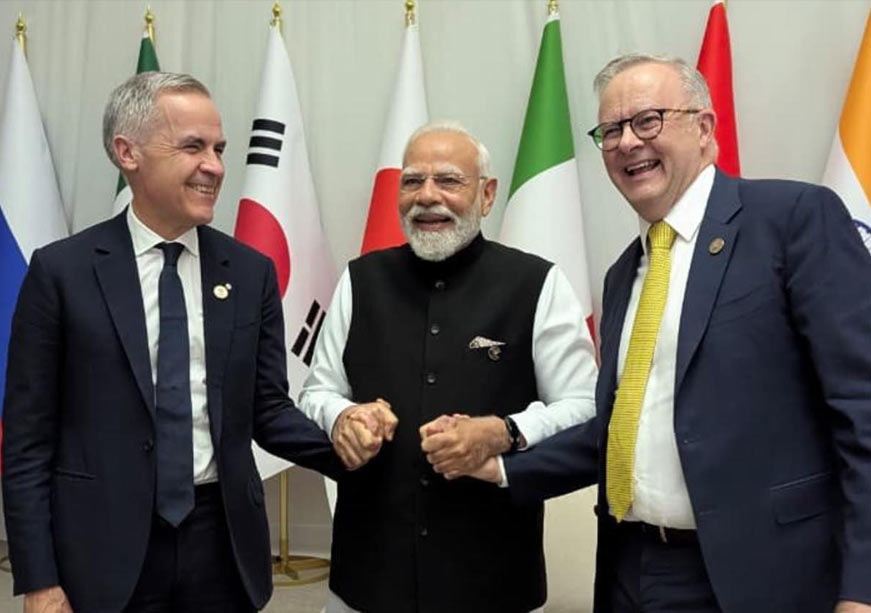
The announcement of the Australia–Canada–India Technology and Innovation (ACITI) trilateral demonstrates the belief that the promise of shared prosperity is still possible, even in times of trade turbulence. The trilateral does not serve as a direct response to the actions of either China or the US. However, this partnership offers an alternative path to transnational cooperation that could help derisk green supply chains and accelerate the advancement of technology. To truly have an impact, all partners must prioritise climate technology and renewable energy over short-term gains.
The ACITI trilateral identifies clean energy, critical minerals, and long-term economic security as its key strategic priorities, while also including AI. Many minilateral and plurilateral partnerships in the past have made ambitious promises in broad strokes but often fail to deliver on those commitments. It remains to be seen whether this partnership will differ from previous efforts. What measures are needed to ensure that it makes an impact and is not just forgotten after a few impressive press releases?
Setting Priorities
Many of these questions will be answered in early 2026, when officials are set to meet and the first working groups are to be formed. But this much is clear: its success will depend on keeping the scope and targets lean enough to be viable and on prioritising resources towards technology that centres people and the planet above short-term profit.
A myopic focus on producing technology for profit not only comes at the expense of essential technology; it also directly contributes to further environmental damage.
The specific framing of the AICITI partnership as a tech trilateral implicitly recognises the benefits of maintaining a sharp focus and maximising impact. A tactful design would begin with a narrow, explicitly climate-focused mandate: supply chains for green tech, joint clean energy pilots and scaling with interoperable standards. It is crucial, then, to strategically narrow the ACITI trilateral’s scope and focus to technology that addresses pressing climate concerns above all else. While manufacturing more smartphones or creating yet another generative AI (Gen-AI) model may seem lucrative in the short term, these products compete with climate and critical technologies that rely on the same scarce resources. A myopic focus on producing technology for profit not only comes at the expense of essential technology; it also directly contributes to further environmental damage.
Leveraging Shared Strengths for the Green Transition
The priority of the AICITI trilateral should, therefore, be securing crucial supply lines and advancing technology with the embedded purpose of increasing positive environmental and social impact across the value chain. Terms such as ‘tech-for-good’ are frequently used buzzwords but often lack substance. Through this partnership, the three nations have the opportunity to create a new, traceable pathway for climate tech that plays a crucial role in securing our future.
The shared climate focus of the ACITI trilateral reflects a similar intentionality across all three partners. Australia is still the global leader in lithium output, while Canada is investing heavily in green technology through dedicated funds and policy tools. India can contribute a significant demand for green technology at scale. Harnessing these shared strengths will be invaluable, as India strives toward an ambitious 500 Gigawatt (GW) renewable energy target by 2030.
Resilience and responsibility need to be hardwired into the partnership, ensuring that resources are allocated with environmental concerns and long-term benefits in mind. Importantly, partners must prioritise technology that centres climate action and social good above all else.
Critical minerals and green hydrogen are the most immediate opportunities. ACITI can embed responsibility at every stage of the critical minerals chain, rather than merely expanding it. The trilateral could support joint research and pilot facilities on low‑impact extraction, water restoration, and urban mining. All partners must prioritise the recycling and recovery of lithium, cobalt, nickel, copper, and rare earths as a deliberate industrial pillar rather than an afterthought. Linking market access, finance, and technology to shared Environmental, Social, and Governance (ESG) frameworks and circular‑economy targets would help ensure that the minerals driving the green transition are sourced, used, and reused responsibly.
The ACITI trilateral can play a crucial role if it successfully delivers on advancing essential climate technology through cooperation and action. Resilience and responsibility need to be hardwired into the partnership, ensuring that resources are allocated with environmental concerns and long-term benefits in mind. Importantly, partners must prioritise technology that centres climate action and social good above all else. Given concern over the potential AI bubble, investment of excessive capital and scarce resources in AI-driven technology should be considered with caution. These should only be considered as a carefully governed, enabling layer for climate and health solutions rather than a general-purpose banner for innovation. If ACITI maintains its focus, it can form a significant part of the architecture for a cleaner, more reliable energy future.
Krishna Vohra is a Junior Fellow with the Centre for Economy and Growth at the Observer Research Foundation.
The views expressed above belong to the author(s). ORF research and analyses now available on Telegram! Click here to access our curated content — blogs, longforms and interviews.