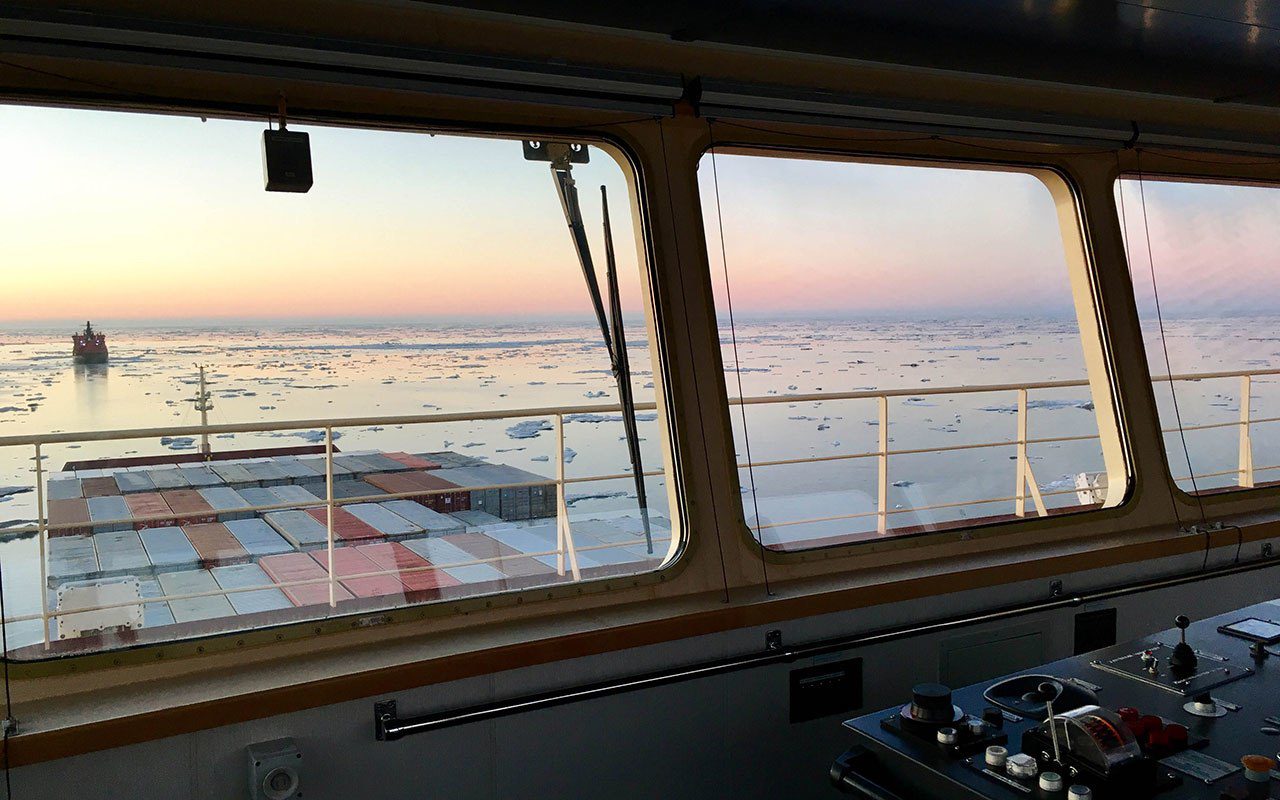
South Korea plans to send a containership through Arctic waters from Busan to Rotterdam this September, marking its first concrete step toward opening a faster northern trade route between Asia and Europe, the country’s acting oceans minister said Monday.
The government intends to deploy a 3,000-TEU vessel on the trial voyage and support the construction of icebreakers and other polar-class ships, Acting Oceans Minister Kim Sung-bum told a press briefing, according to Yonhap News Agency.
The announcement puts a firm timeline on ambitions first outlined last August, when then-minister Chun Jae-soo said South Korea would begin Arctic pilot operations “as soon as possible” to avoid falling behind regional competitors.
Kim said the project will require close coordination with Russia, which controls permitting for vessels transiting much of the Arctic corridor. The government plans to secure a ship and begin consultations with Moscow in the first half of the year, with the test run targeted for September.
The push is part of a broader strategy to turn Busan and South Korea’s southern coast into a global maritime hub by tapping shorter northern routes between Asia and Europe. President Lee Jae Myung’s administration has also committed to relocating the oceans ministry to Busan by year-end to support the effort.
China Sets the Pace
South Korea is entering an Arctic shipping arena already being reshaped by China. Chinese operators completed 14 container voyages between Asia and Europe via the Northern Sea Route in 2025, up from 11 in 2024 and seven in 2023. Cargo volumes on the route climbed to about 400,000 tons last year—2.6 times higher than in 2024—according to Russia’s nuclear icebreaker operator Rosatomflot.
One milestone came when the containership Istanbul Bridge completed the first direct container voyage between China and the United Kingdom through the Arctic in just 20 days, averaging 16.7 knots along the polar corridor.
Chinese carriers NewNew Shipping Line and Sea Legend have since signaled plans to add sailings and improve schedule reliability in 2026, despite the route’s narrow summer navigation window.
Western Caution Persists
Most Western container lines, however, remain on the sidelines. Maersk carried out a single Arctic trial in 2018 with the Venta Maersk but later ruled out regular services, citing environmental concerns, limited infrastructure, insurance hurdles, and uncertain economics.
As a result, Arctic container traffic has largely been driven by Russian and Chinese interests, underpinned by Russia’s expanding fleet of nuclear-powered icebreakers and heavy state investment in northern ports and logistics.
Overall activity on the Northern Sea Route reached a record in 2025, with authorities reporting 103 transit voyages carrying roughly 3.2 million tons of cargo—mainly crude oil, LNG, and bulk commodities.
South Korea’s September test will now determine whether it can secure a foothold in what is quickly becoming one of the world’s most geopolitically sensitive shipping lanes.

Subscribe for Daily Maritime Insights
Sign up for gCaptain’s newsletter and never miss an update
— trusted by our 107,403 members