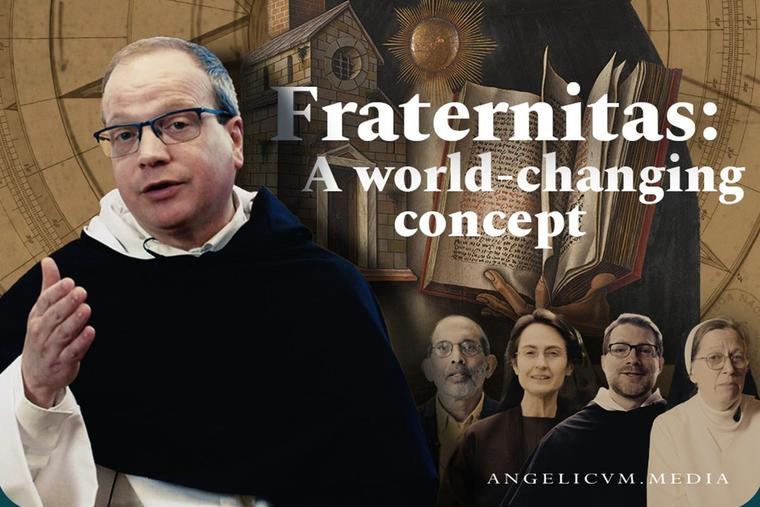
Did you know that St. Thomas Aquinas had a role in Catholic social teaching?
“Thomas Aquinas … may rightly be termed the father of Catholic social thought insofar as he explicitly articulated many of the philosophical principles that the Church advances today,” explains Dominican Father Thomas Joseph White, rector magnificus of the Pontifical University of St. Thomas Aquinas, in a video, “From Church Fathers to Aquinas: How CST Was Born” — the third episode in a new online video series from the venerable Dominican university in Rome, which is more commonly known as the Angelicum.
The richness of the Catholic Church’s social teaching (CST) — the body of doctrine that draws on Scripture, Tradition and natural law to address the moral dimensions of social, economic and political life — is being shared worldwide in a new way, thanks to two recent video series produced by the Angelicum, which claims both Pope Leo XIV and St. John Paul II as alumni.
Dominican Father Ezra Sullivan, who has lent his expertise to the series, is a professor at the Dominican-run university. The venerable university attracts curious minds from far and wide — among his students, at least 100 different nationalities are represented, Father Sullivan says.
Despite the enormous cultural differences between such a diverse group of students, the CST provides a “stable ballast,” he told the Register. Even when discussing controversial issues, his students can find “a kind of harmony” among themselves by learning about the social teaching of the Church they share and how to apply those teachings in the real world.
It’s in this spirit that the Angelicum launched a video series last year, aiming to give seekers online, even those far afield from Rome, the opportunity to learn more about CST from the Angelicum’s faculty and other noted Catholic scholars in a highly-produced-but- easily-digestible format. The university launched a 20-episode “explainer” video series in July 2025 and a second series of “video essays” in November 2025.
The first project of the university’s new digital platform, Angelicum Media, the videos are free to stream on YouTube and Instagram. Angelicum Media also has a website offering free quizzes, reading materials, links to primary sources and other educational resources.
As reported by the Register in September, the name of the first series, Fraternitas — which means “fraternity” or “brotherhood” in English — reflects the series’ focus on how family is the foundation for building a just and caring society, rooted in respect for every person and the common good.
Catholic social teaching, or thought, is a collection of ideas and practices that has been developed over time throughout the Church’s 2,000-year history. Its purpose is to analyze and address human social life in light of long-standing principles, while confronting new emerging questions or new challenges. Its modern foundation was laid in 1891, with Pope Leo XIII’s encyclical Rerum Novarum.
CST is described in the inaugural Fraternitas series video as “ever ancient, ever new” because it draws on the Church’s constant teachings about human nature, dignity and the common good while seeking to answer, in every age, fundamental questions about social order, justice, and how humans can develop concrete practices of truthfulness, charity and unity.
Dominican Father Philip-Neri Reese, professor of philosophy at the Angelicum, previously told the Register that the series aims to give a “comprehensive account of Catholic social thought,” which “came to mind precisely because it’s such an important part of our faith and it’s such a profoundly misunderstood part of our faith.”
“We want to make it clear to people what Catholic social thought is and what it isn’t,” said Father Reese, who is also director of the Angelicum Thomistic Institute, “because for many people, they think of Catholic social thought as sort of social activism just dressed up in theological language, and it absolutely isn’t.”
Catholic social teaching, he emphasized, “is part and parcel of the Catholic tradition from the very beginning of the Church.”
A Theological Renewal
The Angelicum’s two-series video project represents an effort to reach students, academics, working professionals and anyone else who could benefit from a taste of the theological renewal that is taking place at the Angelicum, the university said in a recent newsletter. The aim of the series is to provide a comprehensive overview of Catholic social teaching, including its biblical roots and Thomistic development, in a way that shows how the principles and values of CST are interconnected and mutually reinforcing. Video topics include natural rights, human dignity, subsidiarity and religious freedom.
The second video series from the Angelicum is titled “Universal Fraternity: An Idea That Could Change the World.” While the first series aims to teach the principles of CST, the second applies those principles to current problems in society, from economics to technology to international relations. The videos in the second series feature interviews with prominent academics and Church figures from around the world, composed in a video-essay format.
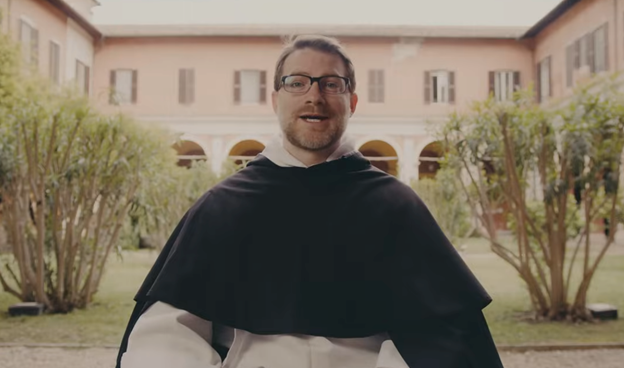 Dominican Father Ezra Sullivan has lent his expertise to the series.(Photo: Angelicum Media)
Father Sullivan, who wrote, appears in and produced a video explaining the concept of the common good, said he planned the video as a harmony between the script, music and visuals to create a piece of content that is not only engaging but also perennial — so that it can be viewed and made use of far into the future. Production on the videos is handled in partnership with a Swiss team affiliated with the University of Fribourg, which creates engaging, colorful animations to serve as visual aids to the teachers’ words.
“The focus on CST is important, because it’s one of the most controversial areas right now in Church teaching,” Father Sullivan said.
“One of the joys, in general, of creating a video series, you can be confident that people will [find] it long in the future. … People can gain interest over time,” he continued.
Evelyn Blacklock, coordinator of Angelicum Media, who oversees content, production management and postproduction, told the Register that the Angelicum — which was established in 1222 as the official Dominican studium conventuale, or house of studies(a precursor to the modern university) — brings distinctive strengths to an education series like this. The school offers a global, Rome-based perspective; a Thomistic, rigorous, comprehensive and coherent approach; and strong youthful energy among faculty and lay students worldwide.
“There are lots of people in the world who would love to have this education and formation, but they can’t just drop everything in their lives and move to Rome. … How do we take the good stuff that’s happening at the Angelicum and get it outside the four walls of the university in the format that people anywhere in the world can engage with? That’s the idea,” Blacklock said.
Since first launching the YouTube channel last July, Angelicum Media has garnered about 1.3 million total views on its videos.
“It’s hard to predict which ones people will be interested in,” Blacklock commented. “People have been especially interested in, for example, [the video] that’s about the meaning and value of human work. … It may say something about people trying to figure out the value of the work that they’re doing every day.”
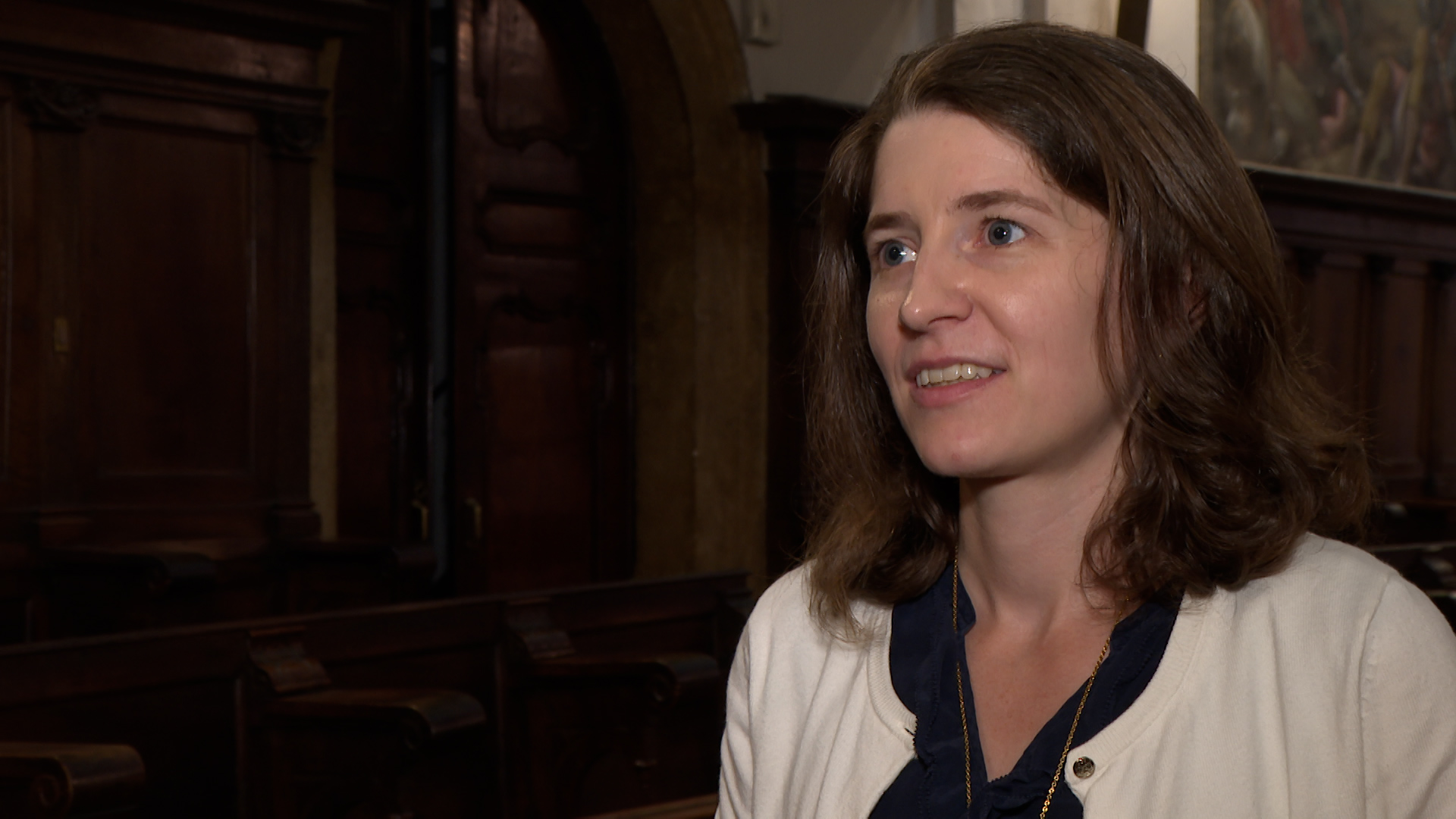 Evelyn Blacklock appears on ‘EWTN News Nightly’ on EWTN. (Photo: EWTN News Nightly )
The goal now is to spread the series further afield so that more people can start becoming introduced to CST. Currently, subtitles are available for the videos in Spanish and Italian — and Blacklock said they are hoping to subtitle the videos in a greater number of languages soon to reach even more people.
Blacklock said: “So far, the response we’ve been getting is that [this] niche did exist. And it seems like — I hope, anyway — that we helped fill it.”