Khadra Yasien Ahmed
Tuesday January 6, 2026
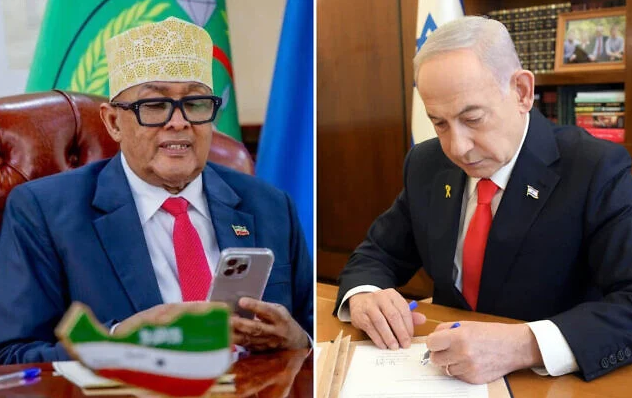
On a late December evening in 2025, flags went up across Hargeisa. Crowds poured into the streets, young people painted in green‑white‑red, fireworks crackling above the War Memorial. For many Somalilanders, Israel’s announcement that it would formally recognize Somaliland as an independent and sovereign state was the long‑awaited moment when a de facto reality—three decades of self‑rule—finally received international acknowledgment. The symbolism was irresistible: Somaliland’s flag hoisted alongside Israel’s on live television; speeches framed in the language of dignity, persistence, and “finally being seen.”
Hundreds of kilometers south, a different spectacle unfolded. In Mogadishu, thousands rallied in the national stadium and across neighborhoods, waving Somali and Palestinian flags. The message was as clear as it was defiant: Somaliland remains part of Somalia; Israel’s move is a provocation, a violation of sovereignty, and a destabilizing precedent for the Horn of Africa. Within days, Somalia condemned the decision, regional organizations reaffirmed the sanctity of Somalia’s territorial integrity, and the United Nations Security Council held an emergency discussion. For many Somalis—at home and across the diaspora—the recognition cut deeper than borders: it brushed against the sacredness of the Palestinian cause and raised the specter of forced displacement, militarization, and proxy conflict on Somali shores.
How did we get here, and how could we possibly overcome?
The long arc that made a “sudden” shock possible
To understand the emotional charge of these days, we must place Somaliland’s decades‑long path to recognition alongside Somalia’s painful state‑rebuilding and the Horn of Africa’s shifting geopolitics. Since 1991, Somaliland has run its own elections, issued its own passports, and maintained relative stability compared with the south. This performance, often cited by Somaliland’s supporters, became a core pillar of a political identity grounded in order, responsibility, and endurance. Yet recognition never came—blocked by a powerful continental norm: the African Union’s insistence on preserving colonial-era borders to prevent secessionist contagion.
For more than thirty years, then, we lived in what might be called a “managed ambiguity.” Somaliland engaged abroad without formal recognition; Somalia asserted legal unity while grappling with insurgency, institution‑building, and federalization; neighbors and partners dealt pragmatically with both. The ambiguity reduced friction. It also delayed hard choices.
Israel’s decision punctured that ambiguity. Whether read as principle (“self‑determination”), opportunism (“a diplomatic win amid isolation”), or strategy (“a Red Sea foothold”), it forced everyone—Somalilanders, federal authorities, regional powers—to move their positions into the open. That is why it felt abrupt, even though the conditions were years in the making.
The Red Sea is in the room
The second pillar of understanding is geography. Somaliland’s coastline faces the Gulf of Aden and sits just west of the Bab el‑Mandeb—the chokepoint linking the Red Sea to the Indian Ocean and, by extension, the Suez Canal to global trade. This is not just cartography; it is the circuitry of the world economy. Over the past decade, Berbera has been transformed by large‑scale port investments; Ethiopia has searched for diversified sea access; the United Arab Emirates has run logistics and security projects; Turkey and Qatar have deepened ties in Mogadishu; and the Iran‑aligned Houthis in Yemen have attacked shipping in waters opposite Berbera’s runway lights.
In this theatre, recognition is never merely symbolic. It is read through the lens of bases, airstrips, over‑the‑horizon drones, and maritime domain awareness. For analysts in capitals from Abu Dhabi to Ankara and Tel Aviv, Somaliland’s recognition looks like a potential intelligence and operational platform: close to Yemen, near the routes that carry energy and consumer goods to Europe and Asia, and at the hinge where Middle Eastern rivalries intersect with African state formation. That is why the announcement triggered not only Somali protests and Somaliland celebrations, but also statements from regional blocs and security communities. The question is not only “who is sovereign,” but “who can see—and do—what from this stretch of coast?”
Palestine as our moral compass—and our political trap
For Somalis, the Palestinian cause is Muqaddas—sacred. It is not an abstraction but a lived solidarity, shaped by our own experiences with war, displacement, and the fragile dignity of rebuilding. Against this moral backdrop, Israel’s recognition of Somaliland was never going to be received as a normal diplomatic act. Even absent formal plans or signed clauses, the perception that recognition might be linked to the displacement of Palestinians or the establishment of military facilities was enough to inflame opinion. Perception, in politics, is a force in its own right.
This is where a trap lies. If every Somali conversation about Somaliland’s status becomes a referendum on Gaza, we risk reducing complex constitutional, economic, and security questions to a single, totalizing litmus test: for or against Palestine. That framing will galvanize crowds, but it will also close the door on the granular, technical, and often unglamorous work of inter‑Somali problem‑solving. The danger is that we win the moral argument and lose the policy future.
The alternative is not to “de‑moralize” our politics. It is to insist that our solidarity with Palestinians be expressed in concrete, constructive channels—humanitarian relief, legal advocacy, political voice—while we simultaneously pursue a Somali‑led process for our own constitutional dilemmas. In other words: honor Palestine without outsourcing Somalia’s agency.
The rally‑around‑the‑flag effect—why we keep hardening each other
There is a well‑known dynamic in political psychology: external pressure often sharpens internal cohesion. In Somaliland, Israel’s recognition instantly turned into social capital for those long arguing that “the world will see us if we stay disciplined.” It rewarded a narrative of exceptionalism and resilience. In Mogadishu and across southern Somalia, the same event energized appeals to national unity, historical memory, and the legal principle that no external actor has the authority to redraw borders. Each side’s certainty is the other’s fuel.
If we add diaspora social media to this mix—where identity is performed to audiences of friends, adversaries, and algorithms—the feedback loop accelerates. Binary framings (“patriots vs. traitors,” “sellouts vs. realists”) generate engagement and silence the bridge‑builders. The people who most need to be heard—the ones prepared to argue for phased, conditional, or creative solutions—become the least likely to speak. The public square splits into two loud certainties, neither of which can govern the complexity of the Horn of Africa.
What happens if we keep going like this?
Three risks loom.
First, securitization of the coastline. If ports become bargaining chips in proxy struggles, Somalia’s littoral will be dotted with opaque agreements that prioritize military utility over commerce and community. That would pull Somali territories into rivalries that have little to do with our development needs and everything to do with other people’s wars.
Second, institutional paralysis. If Mogadishu speaks only in maximalist terms, and Hargeisa responds only with celebratory finality, the space for legal innovation shrinks. Constitutional imagination—confederations, special statuses, time‑bound arrangements, mutual vetoes, economic compacts—requires political courage, not performative certainty.
Third, empowerment of spoilers. Extremist movements thrive on grievance, occupation narratives, and elite stalemate. The more our politics becomes a morality play of total innocence and total guilt, the more oxygen we give to actors who have no interest in ports or constitutions, only in perpetual emergency.
Israel’s recognition of Somaliland fused a local question with global fault lines. It made celebration and outrage mirror each other across an old frontier. It also offered us a stark choice. We can let proxies and performances define us, or we can build a Somali‑centered process that honors our moral commitments while protecting our practical futures.
The road out is not a speech. It is a series of deliberate steps—technical, human, and cumulative—that make it easier to be Somali together, even when we disagree about the map.
Khadra Yasien Ahmed
PhD-candidate UiB, Bergen, Norway