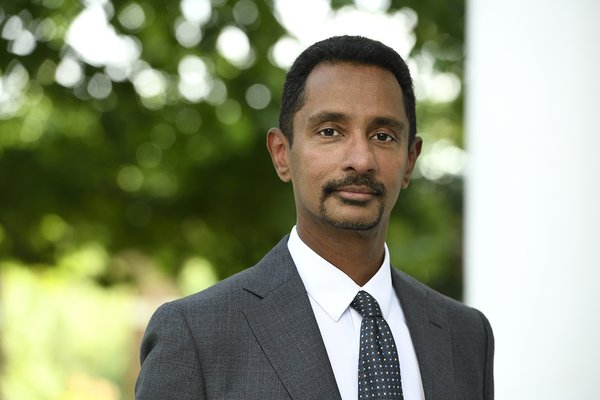
“Ray is a leader of exceptional distinction who brings a complement of qualities—as a pioneering astrophysics researcher, respected university administrator, and compelling science communicator—that together will ensure Caltech builds on its legacy of transformational research and exploration to benefit humanity,” says Caltech Board of Trustee Chair David W. Thompson (MS ’78). “The Board’s unanimous decision reflects our confidence in Ray’s ability to chart Caltech’s future—advancing our mission, inspiring our community, and elevating the Institute’s global impact.”
Jayawardhana will assume his new position on July 1, 2026.
“I am deeply honored to have been selected as Caltech’s tenth president and to join this remarkable community of trailblazers,” says Jayawardhana. “For more than a century, Caltech has achieved extraordinary and enduring impact from a deceptively simple formula: empowering brilliant minds to explore important questions with imagination and courage and making bold commitments to efforts others might consider too risky or far-fetched.
“My commitment is to stay true to Caltech’s North Star of fundamental research and exploration integrated deeply with education, while strengthening this community’s ability to pursue, share, and apply knowledge and innovations that serve and inspire humanity.”
At Caltech, Jayawardhana says he will partner with faculty and other stakeholders to advance bold, catalytic investments in innovative ventures on campus, at the Jet Propulsion Laboratory (JPL), and across the Institute’s suite of global observatories; enrich the experience of undergraduates, graduate students, and postdoctoral fellows; and expand the Institute’s engagement with the public.
“We are in a moment of inflection; one marked by dramatic change and immense possibility. It’s a moment that calls for Caltech’s distinct contributions and leadership,” Jayawardhana says, acknowledging the rapidly shifting global landscape impacting America’s research universities, from uncertainty in funding to accelerating technological and economic change. “The issues and opportunities confronting us demand our very best thinking and our deep engagement: pursuing discoveries vigorously and sharing our findings widely; tackling complex problems and engineering innovative solutions; welcoming debate and critique and fostering a robust exchange of ideas; and keeping a spirit of service at the heart of who we are and what we do.”
Jonas Zmuidzinas, the Merle Kingsley Professor of Physics and chair of the Institute’s search committee, said that from the beginning of the presidential search, the input and insights from members of the Caltech community were clear: the community was looking for a leader who is not only an accomplished scientist or engineer, but who embodies Caltech’s commitment to excellence in all ways.
“We heard that the community was looking for a strong communicator; an individual who has a record of leading with integrity, courage, and creativity; a leader who possesses the ability to be an effective steward of JPL; and someone who inspires support and confidence among philanthropic partners. We understood that we were asking for a lot and are pleased to share that in Ray, we have met—if not exceeded—our community’s expectations,” Zmuidzinas says. “Ray brings to Caltech a stellar record of academic leadership and a record of working collaboratively with the faculty, with other leaders at his institution, and with external partners to deliver outstanding results.”
A Legacy of Leadership
At Johns Hopkins, Jayawardhana oversees the university’s 10 schools as well as an expansive portfolio of interdisciplinary programs, academic centers, and core administrative and operational units. He partners closely with the president, deans, faculty, students, and staff to advance the university’s research, education, and outreach missions, and has been instrumental in launching and shaping major initiatives, most notably the Data Science and AI Institute and the School of Government and Policy, as well as elevating the Krieger School of Arts and Sciences through the expansion of select departments.
He has also stewarded significant investments in academic talent; modernized and expanded critical research infrastructure; enhanced a variety of internal funding opportunities; and advanced interdisciplinary collaboration, including through steering the next phase of the Bloomberg Distinguished Professorships (BDP) program, recruiting 14 new BDPs and selecting seven new BDP interdisciplinary research clusters through a faculty-driven process. He deepened ties between academic divisions and the Johns Hopkins Applied Physics Laboratory (APL), helping align fundamental research with applied innovation and national service.
Jayawardhana has partnered with deans and faculty leaders to bring greater clarity and rigor to university-wide tenure review and established tenure and promotion processes for multiple schools; rapidly deployed targeted funding mechanisms to sustain research continuity in response to external shifts; expanded student opportunity and success through new financial aid and support strategies; and collaborated closely with deans to achieve record-high retention and graduation rates.
Jayawardhana has also been a strong advocate for extending the university’s reach and impact beyond campus. He championed public engagement and creative pursuits, launching initiatives such as the Provost’s Fellows for Public Engagement and a university-wide Taskforce on the Arts that have reinforced the university’s role as an engaged institution whose scholarship and creativity contribute meaningfully to society. In parallel, he worked to bolster external partnerships with philanthropic, research, and cultural organizations, broadening the university’s connections and modeling a collaborative approach that connects discovery and education to real-world application
“During his tenure at Johns Hopkins, Ray partnered with me and colleagues across the university is navigating a shifting landscape in higher education while advancing our shared aspirations for the university. While we will miss Ray’s leadership and service to Johns Hopkins, we are excited for him and for the Caltech community he will soon lead,” Johns Hopkins President Ron Daniels said in a university announcement.
Daniels pointed in particular to Jayawardhana’s efforts to strengthen the university’s public facing mission and creative reach. “Through two imaginative initiatives, the Provost’s Fellows for Public Engagement and the Taskforce on the Arts, Ray opened the new avenues to connect Hopkins’ scholarship and creativity with the world, extending the university’s commitment to discovery in service of society,” he wrote.
Prior to joining Johns Hopkins, Jayawardhana served as the Harold Tanner Dean of the College of Arts and Sciences at Cornell University, as well as the Hans A. Bethe Professor and professor of astronomy. Under his leadership, the college launched a series of initiatives to position the college at the nexus of discovery and impact. These included the Klarman Fellowships for exceptional emerging researchers, New Frontier Grants to support novel research projects with potential for transformative advances, the Nexus Scholars program for undergraduate research, and the Humanities Scholars Program for select students. He also introduced a Distinguished Visiting Journalist program to recognize excellence in journalism while fostering meaningful engagement with the academy, launched the Arts Unplugged series of marquee public events, and led the $110 million renewal of the university’s iconic McGraw Hall. During his tenure, the college also undertook significant education reform, adopting a new undergraduate curriculum, introducing first-year advising seminars for all incoming students, and implementing the Milstein Program in Technology & Humanity. The college also dramatically expanded public and media engagement by the faculty and set consecutive fundraising records. Partnering with other deans and faculty leaders, Jayawardhana also developed signature initiatives on climate, AI, and quantum research.
Jayawardhana previously spent a decade on the faculty at the University of Toronto, where he held a Canada Research Chair and served as senior advisor on science engagement to the university’s president, before serving as the Dean of Science at York University. He began his career with a Miller Research Fellowship at the University of California, Berkeley, and held an assistant professorship at the University of Michigan.
He received a BS degree in astronomy and physics from Yale University and a PhD in astronomy from Harvard.
Exploring the Universe and Our Place Within It
As a scientist, Jayawardhana investigates the diversity, origins, and evolution of planets and planetary systems, as well as the formation of stars and brown dwarfs. Using the largest telescopes on the ground (including the W. M. Keck Observatory, which Caltech co-manages with the University of California) and in space (especially the James Webb Space Telescope), he and his collaborators characterize planets around other stars, or exoplanets, with an eye toward assessing the prospects for life beyond Earth. He is a core science team member for the James Webb Space Telescope’s NIRISS instrument, and his research group has led Gemini Observatory large programs on high-resolution spectroscopy of exoplanetary atmospheres.
He has co-authored 180 refereed papers in scientific journals, with over 10,000 total citations.
Jayawardhana’s interest in public engagement with science is deeply personal, stemming from a sense of wonder and curiosity about the universe that first sparked his imagination in childhood in Sri Lanka.
“Some of my earliest memories are of walking around with my father at night, looking up at the sky,” Jayawardhana recounts. “It was in those moments that my lifelong fascination with space took root, and with it my deep belief in human curiosity and audacity to reach for what once seemed beyond our grasp. That sense of awe and teeming possibility has guided me ever since.”
Jayawardhana is an acclaimed writer and science communicator who has published widely in leading outlets, with articles in The Economist, The New York Times, and The Wall Street Journal. His popular science book Strange New Worlds was the basis for The Planet Hunters television documentary on the Canadian Broadcasting Corporation. His book Neutrino Hunters won the Canadian Science Writers Association’s Book Award. Jayawardhana’s picture book for children, Child of the Universe, published by Penguin Random House, is meant to spark the same fascination with the universe that inspired him as a child. He has also delivered dozens of public lectures and made hundreds of media appearances over the years.
Among Jayawardhana’s many awards and honors are a Guggenheim Fellowship, a Radcliffe Fellowship from Harvard, the Rutherford Medal in Physics from the Royal Society of Canada, the Nicholson Medal from the American Physical Society, and the Carl Sagan Medal from the American Astronomical Society’s Division for Planetary Sciences. Asteroid 4668 Rayjay is named after him.
Jayawardhana is an avid traveler who has visited more than 60 countries and all seven continents. He has spent time at mountaintop observatories in Chile and Hawaii, collected meteorites on a 37-night expedition in Antarctica, taken a parabolic flight with the European Space Agency, chased a solar eclipse in western Mongolia, and descended into a South African mine alongside geobiologists.
Jayawardhana will succeed Thomas F. Rosenbaum, Caltech’s ninth and current president, who concludes his service as president in June 2026 after 12 years in office. Rosenbaum, a professor of physics and the Sonja and William Davidow Presidential Chair, maintained a condensed matter physics research group during his presidency, authoring several dozen research papers and mentoring graduate students and summer undergraduate research fellows throughout his tenure. He will remain on the faculty and continue this research.
“I am humbled and inspired by the leaders who’ve come before me and by the legacy of excellence and ambition that defines this unparalleled institution,” Jayawardhana says. “I look forward to helping write Caltech’s next daring chapter of discovery and innovation.”