Facebook
Twitter
LinkedIn
Pinterest
Reddit
Email
Print
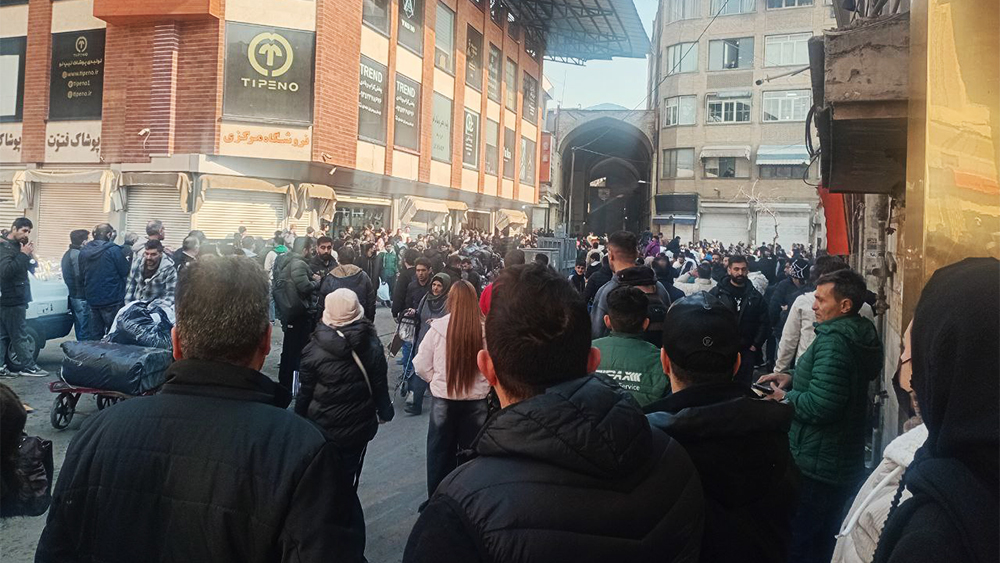 Strikes and protests in Tehran’s Bazaar (January 6, 2026)
On Tuesday, January 6, 2026, the nationwide uprising against the religious dictatorship in Iran reached a pivotal turning point on its tenth day. As protests spread to 110 cities across the country, with 32 martyrs identified so far, the events of Tuesday signaled a shift in the balance of power on the streets. While security forces ramped up brutality in the capital, they were forced into a humiliating retreat in western provinces, abandoning positions to the people.
The Battle for Tehran: A “War Zone” in the Capital
In Tehran, the commercial heart of the city became the epicenter of fierce resistance. By Tuesday morning, the Grand Bazaar, usually a hub of trade, was described by witnesses as a “war zone.” The regime deployed massive resources to break the strike, including 20 buses of troops, plainclothes units, and water cannons stationed near the Alaeddin Passage. However, these measures failed to deter the merchants and youth.
Strikes expanded significantly, paralyzing key economic sectors. The Steel Market (Ahangaran), the Home Appliances Market, and the Gold Market (Bazaar-e Talaforoushan) shuttered their doors. When security forces attempted to force shops open or disperse gatherings, they were met with organized resistance. In the Bouzarjomehri Bazaar and Galoubandak intersection, the air was thick with tear gas, making breathing nearly impossible. Yet, the youth remained, lighting fires in trash cans to neutralize the gas and setting up barricades to block the advance of suppression units.
January 6—Tehran, Iran
The crowd at the Tehran bazaar protest continues to grow despite efforts by the regime’s repressive forces to scatter the people. Protesters are chanting, “This is the year of blood, Seyyed Ali [Khamenei] will be overthrown!”#IranProtests #IranRevolution pic.twitter.com/bVolwRa0AW
— People’s Mojahedin Organization of Iran (PMOI/MEK) (@Mojahedineng) January 6, 2026
The political clarity of the movement was unmistakable in Gomrok Square. Here, protesters blocked roads and chanted a slogan that cuts to the core of the Iranian people’s demands: “Down with the oppressor, be it the shah or the mullahs.” This chant explicitly rejects the current theocratic regime while simultaneously dismissing any return to the monarchical dictatorship of the past, signaling a desire for a democratic republic.
January 6—Tehran, Iran
Protesters set up roadblocks in Gomrok square and chanted, “Down with the oppressor, be it the shah or the mullahs!” rejecting all forms of dictatorship.#IranProtests pic.twitter.com/xSObvRvVW2
— People’s Mojahedin Organization of Iran (PMOI/MEK) (@Mojahedineng) January 6, 2026
Regime Retreats in Western Iran: Abdanan Liberated
While Tehran saw entrenched urban warfare, western Iran witnessed the collapse of the regime’s local authority. In a historic development in Abdanan, Ilam Province, the sheer size and determination of the crowds overwhelmed the security apparatus. Following a massive rally at dusk, where the skies echoed with chants of “This is the year of blood, Seyyed Ali [Khamenei] will be overthrown,” security forces found themselves outnumbered and unable to contain the public anger.
Footage from the city confirms that regime forces fled the scene, allowing the people to take effective control of the streets. Protesters subsequently occupied the local police station, a symbol of the state’s repressive power in the city. The streets of Abdanan filled with celebrations and the vow of “I will kill those who killed my brother,” marking a temporary end to the regime’s rule in the area for the night.
January 6—Abdanan, western Iran
More footage of celebrations after people took control of the city from the regime’s security forces.#IranProtests #IranRevolution pic.twitter.com/WO2m4uSl0i
— People’s Mojahedin Organization of Iran (PMOI/MEK) (@Mojahedineng) January 6, 2026
Similar scenes played out in Malekshahi. A funeral ceremony for Farez Aghamohammadi and Mohammadreza Karami, two young men killed during Saturday’s crackdown, turned into a massive anti-regime demonstration. Despite the regime blocking roads to isolate the city and opening fire on the mourners, the people stood their ground. Local reports indicate that the protesters displayed immense courage, overcoming the gunfire and forcing the regime’s troops to retreat from the scene.
Crimes Against Humanity: Attacks on Hospitals and Civilians
Unable to quell the uprising through standard riot control, the regime has resorted to blind violence and war crimes. In Tehran, security forces committed a shocking violation of international humanitarian norms by targeting a medical facility. Tear gas canisters were fired directly into the grounds of Sina Hospital near Hassanabad. Witnesses reported that the gas infiltrated the wards, endangering patients, medical staff, and visitors, and severely disrupting critical hospital operations.
January 6, 2026 — Tehran
A clear violation of human rights: security forces fired tear gas into the grounds of Sina Hospital during protests near Hassanabad.
Witnesses report the gas created dangerous conditions for patients, medical staff, and visitors, disrupting hospital… pic.twitter.com/GQP7xc1Rwx
— People’s Mojahedin Organization of Iran (PMOI/MEK) (@Mojahedineng) January 6, 2026
In another act of brutality, security forces fired tear gas into a crowded metro station in Tehran. Civilians, including women and children, were trapped in the enclosed underground space, suffering from the suffocating effects of the chemical agents.
The violence escalated to lethal force in Yazdanshahr, central Iran. As the crowds chanted “Freedom, Freedom, Freedom,” security forces, frustrated by their inability to disperse the gathering, switched from tear gas to firing live ammunition at unarmed civilians.
This escalation coincides with threats from the regime’s top brass. IRGC Brigadier General Ahmadreza Radan, the commander of the State Security Force (SSF), issued a public threat on Tuesday, stating, “Every last one of these individuals will be arrested and punished at any time and in any place.” Yet, as the streets of Yazdanshahr and Tehran proved, these threats have lost their potency against a population that feels it has nothing left to lose.
Night Operations Against Regime Targets
As the regime intensifies its daylight suppression, the rebellious youth have expanded their operations under the cover of darkness on Monday night and early Tuesday morning.
In Mardabad, Yazd province, rebellious youth set fire to an IRGC Basij base responsible for dispatching forces to quell local demonstrations. Similarly, in Qazvin, northwest Iran, youth targeted the local office of the regime-affiliated Khomeini Foundation as well as another IRGC Basij base, setting them ablaze. In Fardis, Karaj, the city council building was set on fire at 2:30 AM on Tuesday. These targeted operations signal a growing trend of self-defense, striking back at the very institutions responsible for the crackdown.
January 6—Fardis (Karaj), northern Iran
Protesters target regime buildings in response to efforts by the regime’s security forces to quell demonstrations.#IranProtests #IranRevolution pic.twitter.com/BzOHQxseZ2
— People’s Mojahedin Organization of Iran (PMOI/MEK) (@Mojahedineng) January 6, 2026
“No Sign of Retreat”
The events of January 6 illustrate a regime that is losing its grip on the country. From the strikes in the bazaars of Tehran, Shiraz, and Shahrekord to the open street battles in Ilam and Isfahan, the wall of fear has crumbled.
Mrs. Maryam Rajavi, the President-elect of the National Council of Resistance of Iran (NCRI), praised the resilience of the protesters and the unity of the merchants. Addressing the intensifying situation, she noted that despite the deployment of forces since early morning, the regime “failed to contain the protests and were forced to withdraw from several locations.”
“This movement shows no sign of retreat,” Mrs. Rajavi declared, saluting the merchants and the youth who have risen “to erase Khamenei and his criminal regime from the pages of Iran’s history.” As the uprising enters its eleventh day, the resolve of the Iranian people appears stronger than the repression aimed against them.
On the tenth day of nationwide #IranProtests, anger once again erupted in Tehran’s bazaar. Chants of “Freedom, freedom, freedom” and “This is a month of sacrifice—Seyyed Ali (Khamenei) will be overthrown” echoed through the area, underscoring the determination and momentum of a… pic.twitter.com/nrlmc9HckB
— Maryam Rajavi (@Maryam_Rajavi) January 6, 2026