Hello, welcome to Politics Insider. Let’s look at what happened today.
A pair of high-profile Canadians will be headed to Greenland amid threats by Donald Trump and members of his administration to annex the autonomous Danish territory for what the U.S. President has called “national security” reasons.
Today Prime Minister Mark Carney said Governor-General Mary Simon and Foreign Affairs Minister Anita Anand will be visiting the ice-covered island in February.
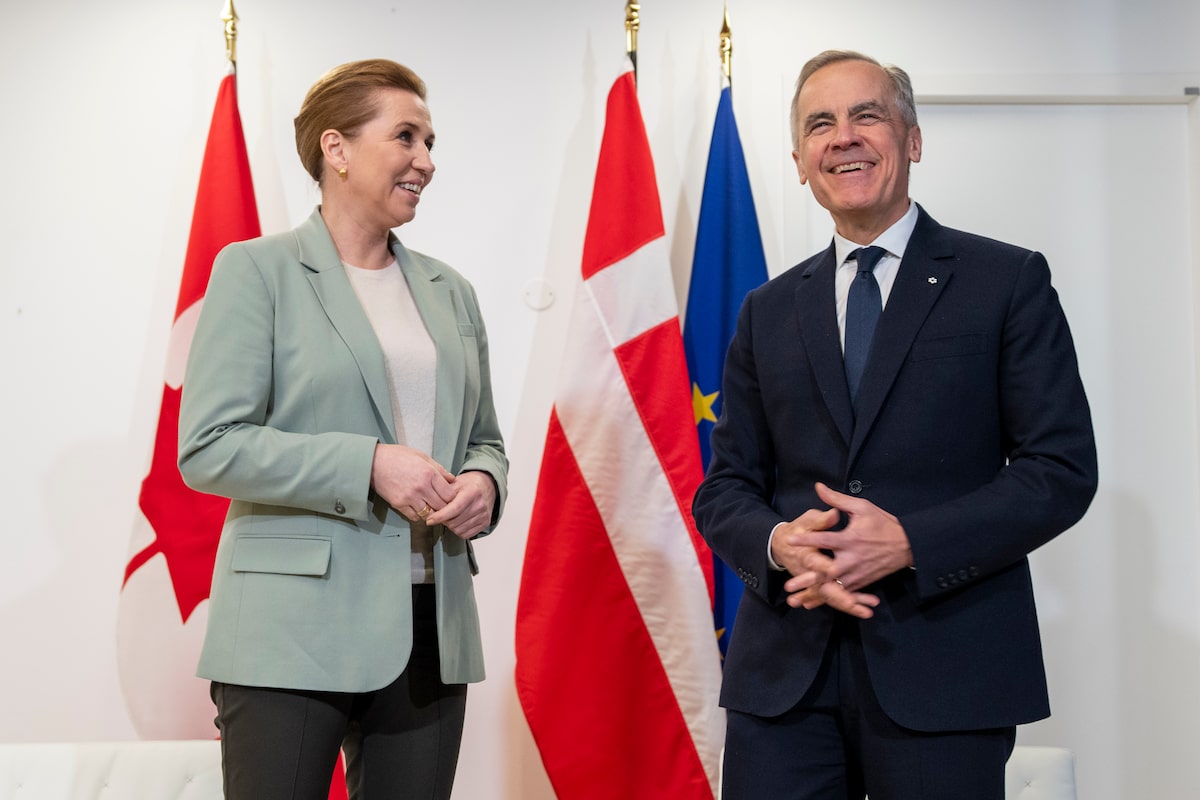
Carney made the announcement during an appearance with Danish Prime Minister Mette Frederiksen in Paris, where both are attending a meeting of the Coalition of the Willing, a group of more than 30 countries united by their support for Ukraine.
Trump has called for Greenland to become part of the United States, noting that its mineral wealth could reduce U.S. reliance on Chinese exports.
Carney said the future of Greenland and Denmark will be decided solely by the residents of both.
“I really appreciate your strong support,” Frederiksen said in response. “You are a good friend, a very close ally to not only Denmark but Europe.”
In a posting on X, Anand said she will be in Nuuk, Greenland’s capital and most populous city, in the coming weeks to officially open Canada’s consulate.
She added that the visit will “mark a concrete step in strengthening our engagement in support of Denmark’s sovereignty and territorial integrity, including Greenland.”
Rideau Hall did not have any immediate comment on the Governor-General’s plans.
Carney also downplayed concerns that Trump’s pledge to boost oil production from Venezuela will have an impact on Canada’s energy sector.
Trump has made it clear that the U.S. military action in Venezuela and the capture of President Nicolás Maduro were precursors to taking control of the country’s vast oil reserves and energy infrastructure. That could ultimately lead to a surge of Venezuelan oil on global markets, which would pose a challenge to Canadian producers.
But Paul Waldie reports Carney reiterated that Canada welcomed the removal of Maduro from office.
“It creates the possibility for democratic transition in Venezuela. We very much support that,” Carney told reporters in Paris.
Increased oil production would benefit the Venezuelan people and provide stability to the country, he added, but that won’t be a threat to Canadian oil producers.
“Canadian oil will be competitive because it is low-risk,” he said. He added that production costs in the oil sands have also started to fall along with carbon emissions through carbon capture programs.
The recent memorandum of understanding between Ottawa and Alberta on a new pipeline to the West Coast will also help open new markets for Canadian energy. “And that makes Canadian oil competitive in the medium and long term,” Carney said.
There’s an explainer here on the situation in Venezuela, the capture of Maduro and his wife and Trump’s plans.
Prime Minister Mark Carney meets with Denmark’s Prime Minister Mette Frederiksen at the Canadian Embassy in Paris on Tuesday.Christinne Muschi/The Canadian Press
What else is going on
Carney says Freeland’s decision to accept Ukraine role ‘consistent’ with plans to resign as MP: “My judgment was that taking that role would be consistent with resigning as an MP and I welcomed her doing that,” Carney said in Paris today. He was referring to Chrystia Freeland’s decision to accept a role as an economic adviser to the Ukrainian President.
Immigration Department shelves visa program: The settlement program for foreign entrepreneurs has faced accusations of misuse and has processing times of more than 10 years.
First Nation launches legal action against potential Alberta separation referendum: The Sturgeon Lake Cree First Nation says they have been treated as “chattel on the land” and argued that an independence campaign would make Alberta vulnerable to foreign interference.
Doug Ford vows to ban Crown Royal from LCBO: The Ontario Premier says he will take the popular whiskey off the province’s liquor-store shelves next month if its maker follows through on plans to close a Windsor-area bottling plant and throw about 200 people out of work.
Yves Engler’s wife applies to seek NDP leadership: Bianca Mugyenyi is seeking to enter the race after her husband was barred by the party’s vetting committee.
Quebec students must now address teachers as ‘Mr.’ and ‘Ms.’: The students returning to class after winter break will now have to use formal language to address their teachers under new rules designed to foster civility.
On our radar
Prime Minister’s Day: In Paris for a meeting of the Coalition of the Willing collective of countries supporting Ukraine, Mark Carney met with NATO Secretary-General Mark Rutte, Danish Prime Minister Mette Frederiksen and Finnish President Alexander Stubb. At the Élysée, Carney was greeted by French President Emmanuel Macron. In the evening, Carney departed for a return trip to Ottawa and was scheduled to arrive at 10:30 p.m.
Party Leaders: No schedules released for party leaders.
Ministers on the Road: International Trade Minister Maninder Sidhu will be in Qatar, Saudi Arabia and the United Arab Emirates with a Canadian senior-level business delegation from Wednesday to Jan. 14.
Quote of the Day
“This is harder than it looks.” – Pete Hoekstra, the U.S. ambassador to Canada, writes on X about his first time skating on the Rideau Canal in Ottawa this week. His post included video of his efforts.
Question period
Which prime minister’s government introduced closure in the House of Commons to end debate on an issue?
Scroll to the bottom of this newsletter for the answer.
Perspectives
Canadian energy producers face an oil glut that undermines the case for more pipelines
Plucking Mr. Maduro and his wife from their beds changed the political picture in Venezuela. It didn’t fundamentally change the economics of the energy market. Current oil prices reflect more supply than demand for crude.
— Andrew Willis, Business Columnist
Can Pierre Poilievre, all politics and no business, ever be prime minister?
Pierre Poilievre is all politics and no business, a weakness that will likely disqualify him from ever becoming prime minister. It is the leadership deficit – eschewing pragmatism, being a one-man team, failing to work with rivals in mind and allies in heart – that members of the Conservative Party of Canada must weigh later this month when they decide if he will continue as their party leader.
— John Turley-Ewart is a contributing columnist for The Globe and Mail, a regulatory compliance consultant and a Canadian banking historian.
Canada needs to be realistic about what it can get from China with its relations reset
China under Xi Jinping is powerful, proud and insecure. Canada cannot change that reality. What it can do is approach it with discipline, realism and resilience: open where possible, firm where necessary, and clear-eyed about what engagement can and cannot achieve. For a middle power, that is not timidity. It is statecraft.
— Colin Robertson is a former diplomat and host of the Canadian Global Affairs Institute’s Global Exchange podcast.
Go deeper
Got a news tip that you’d like us to look into? E-mail us at tips@globeandmail.com. Need to share documents securely? Reach out via SecureDrop.
The answer to today’s question: Robert Borden, Canada’s prime minister between 1911 and 1920, used the new rule called closure in 1912 on a naval aid bill to provide $35-million to Britain so it could build three battleships.