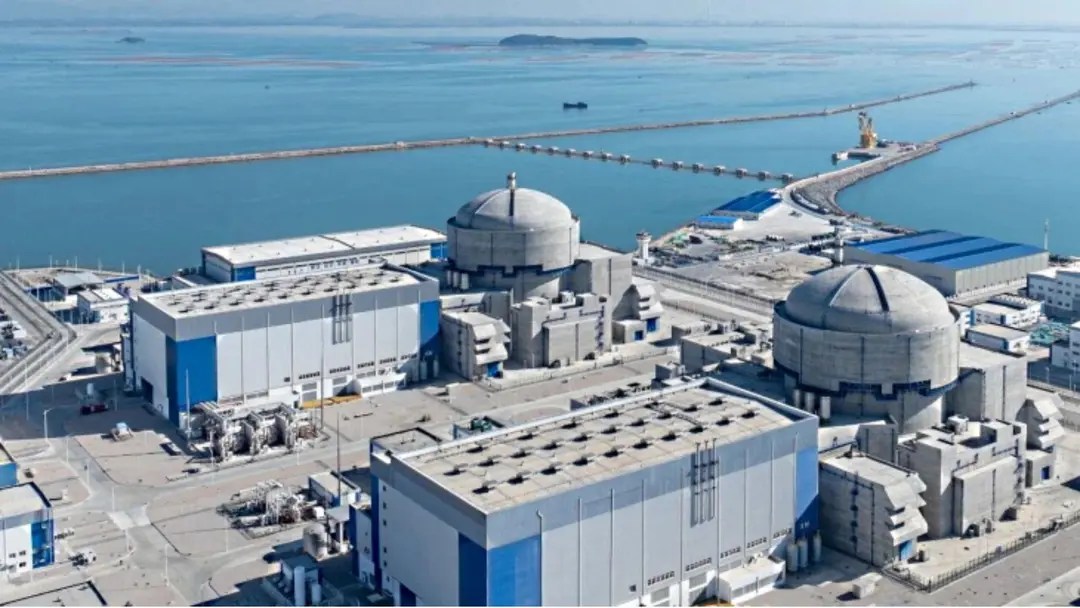
Although nuclear power plants are notorious for delays, China has broken that precedent and ensured its plants meet operational deadlines. The Zhangzhou nuclear power plant is a prime example of well-timed delivery.
The plan to build the world’s largest nuclear power base has been in the works for well over a decade. The China National Nuclear Corporation (CNNC) teamed up with China Guodian Corporation in 2011 to establish the CNNC-Guodian Zhangzhou Energy Company, with a 51-49 ownership split.
Construction licences for Units 1 and 2 were awarded in October 2019, and construction activity began swiftly within a week for Unit 1. Construction for Unit 2 began in September 2020 and was completed last year, pending commissioning tests.
Unit 1 entered commercial operation on January 1, 2025, and fuel loading for Unit 2 began in October 2025. On November 3, the unit achieved criticality and was then connected to the grid on November 22, 2025.
After completing a series of commissioning tests and a 168-hour test run, Unit 2 was cleared for commercial operations, which began on January 1. Its 1126 MWe net output adds to CNNC’s combined installed capacity of 25,000 MWe, raising it to 26,212 MWe, the institution said.
“This marks the full completion and commissioning of the first phase of the Zhangzhou nuclear power project, making an important contribution to optimising the national energy structure and achieving the ‘dual carbon’ goal,” CNNC said in a press release.
World’s largest nuclear base
The Kashiwazaki-Kariwa Nuclear Power Plant in Japan is, on paper, the largest facility with a combined installed capacity of 7,965 MW. However, since the 2011 Fukushima disaster, several reactors have been suspended or are awaiting restart approvals.
The Zhangzhou facility in China hopes to replace its Japanese counterpart at this top spot when all six reactors are built. When operational, the six units of the Zhangzhou nuclear base will generate 60 billion kilowatt hours of carbon-free energy.
While the largest nuclear power base at a single facility in the world, it is only estimated to meet 75 percent of the energy demand of the cities of Xiamen and Zhangzhou in southern Fujian.
The Zhangzhou nuclear power plant uses an indigenously built pressurised water reactor, the Hualong One. A third-generation nuclear reactor, the Hualong One, is also the world’s most-deployed nuclear reactor of its type and meets nuclear reactor safety benchmarks set by the UK and Europe.
Source: Interesting Engineering