
President Recep Tayyip Erdoğan has changed the rhetoric on Türkiye’s prolonged exclusion from the F-35 programme. He stopped casting it not as a bilateral grievance with Washington but as an issue with direct implications for NATO alliance security. The shift in tone points to a carefully adjusted repositioning rather than a change in strategic direction.
In an interview with Bloomberg, Erdoğan said Türkiye’s return to the F-35 programme would strengthen both its relationship with the United States and the collective security position of NATO. The framing marked a clear break from earlier arguments centred on unfair treatment and sunk financial costs, instead situating Türkiye’s airpower within NATO’s wider deterrence and force-planning architecture.
The interview also addressed Türkiye’s parallel effort to procure F-16 Block 70 aircraft from the United States. Erdoğan noted that price negotiations were due to be resolved. While the remark could be read as routine procurement language, the broader context suggests a more complex situation. In December 2024, Turkish Minister of Defence Yaşar Güler told lawmakers at the Turkish Grand National Assembly’s Plan and Budget Commission that approximately $1.4 billion had already been paid for the F-16 procurement programme. Delivered in a formal legislative setting, the statement effectively confirmed the payment as an official state position.
Despite this early payment, no final unit price has been agreed, no delivery timeline has been announced, and no public confirmation has been made that production has begun. More than eighteen months on, the lack of progress stands out within the framework of US Foreign Military Sales, where payments typically move in parallel with clearly defined contractual and production milestones. The prolonged impasse has prompted questions over whether the F-16 file is being intentionally kept open rather than driven toward completion.

More revealing was Erdoğan’s second observation. Emphasising that defence agreements should reflect “the spirit of alliance,” he pointed to Türkiye’s Eurofighter Typhoon procurement as a reference. The comparison was not about cost or platform capability, but about political framing. That deal advanced only after it was recast by the United Kingdom as essential to NATO’s southern flank, helping to ease resistance in Europe by elevating the issue from a bilateral transaction to an alliance requirement.
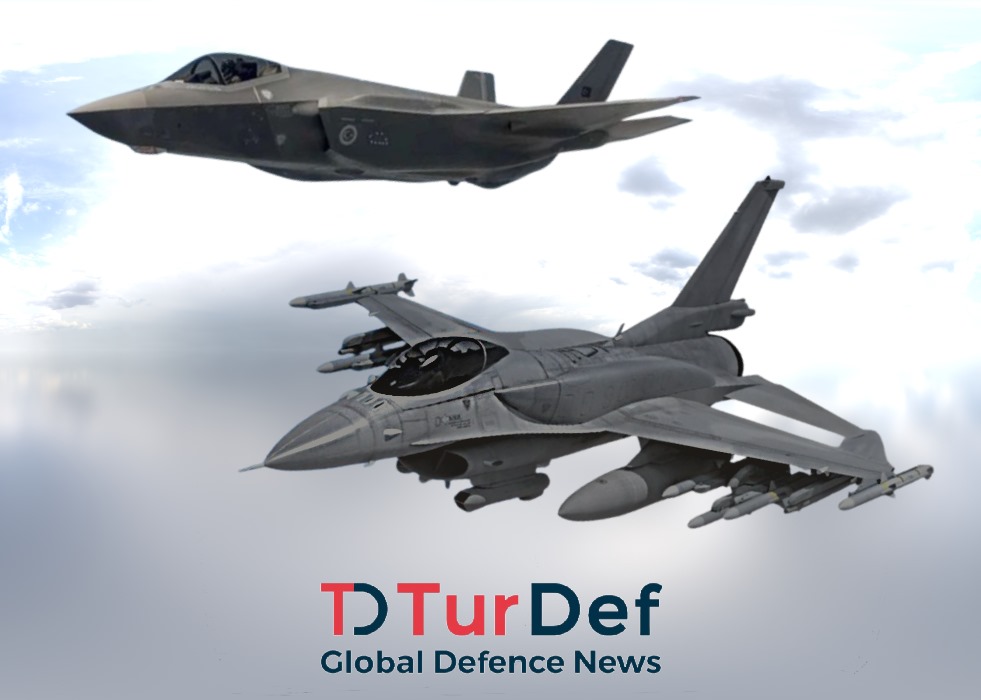
By invoking that precedent, Erdoğan appeared to deliver a broader message to Washington. From TurDef’s perspective, Ankara launched the F-16 process, demonstrated seriousness through early payment, yet allowed negotiations to stall before production, while simultaneously reopening the F-35 debate using a narrative that has already proven effective in Europe. In this reading, the F-16 talks function less as an end goal than as leverage—keeping channels open while shifting the strategic conversation toward a higher-order solution.
The handling of the S-400 issue further reinforces this approach. While reports have pointed to possible pathways for addressing the Russian air defence system impasse, the Bloomberg interview avoided explicit commitments. The confinement appears deliberate, preserving diplomatic manoeuvring space with Washington while avoiding a public narrative of compromise, either domestically or in relation to Moscow.
It is also worth recalling that Bloomberg, quoting sources familiar with the matter reported that President Erdoğan raised the possibility of Russia buying back the systems during a meeting with Russian President Vladimir Putin in Kazakhstan. That report marked the first public disclosure of such an option. The fact that both the S-400 buy back report and Erdoğan’s latest interview appeared on the same platform adds an important layer to the diplomatic context, suggesting a calibrated messaging channel designed to signal flexibility without formal public commitments.
Ultimately, Erdoğan’s message reframes the debate around capability and burden rather than criticism. Without Türkiye fully integrated into advanced fifth-generation airpower structures, NATO’s southern flank remains operationally incomplete. Yet the effectiveness of this argument may depend less on alliance logic than on politics in Washington. As the United States enters another period of strategic uncertainty, one question remains unresolved: does Donald Trump still view NATO as a strategic institution in its own right, or primarily through the lens of burden-sharing and utility—and in that calculation, is Türkiye seen as the alliance itself, or as a useful actor worth empowering?