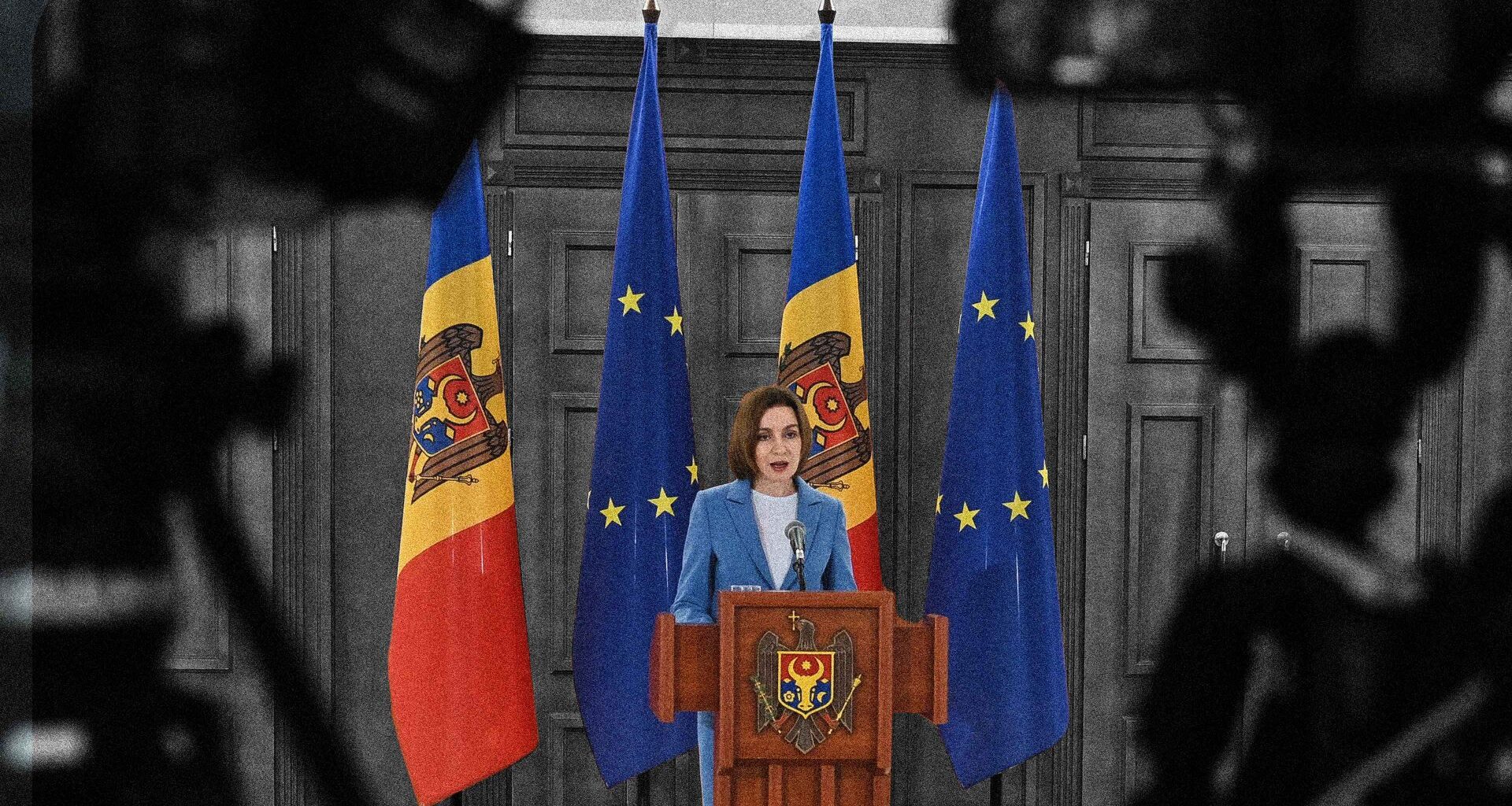
By the time you read this, all being well, I will be in Moldova. I say all being well, because as I write, I am in a remote part of the Scottish Highlands, looking out at snow-covered fields, snow-covered roads, on to which the snow is still falling. Even putting to one side my admitted bias, that Scotland is by some distance the most beautiful country on earth, it is a stunning, wondrous scene.
But I really want it to stop snowing, and I really don’t want to get snowed in, because I really, really want to get to Moldova. The traveller in me is keen because it is a country I have never visited before, and no matter how well travelled you may be – I have been luckier than most on that front – it is still always nice to add a new stamp to your passport, and see new people, places and things.
The real keenness, though, comes for the specific reason for the trip, namely to interview Moldova’s president, Maia Sandu, for The Rest Is Politics LEADING. When it came to our 2025 end-of-year round-up on the podcast, I named her my “overseas politician of the year”, and I see that the Daily Telegraph followed suit. There is not much on which I agree with the Telegraph these days, since it became a fully fledged member of the anti-Labour, right wing propaganda bandwagon. But the profile of their chosen global leader was excellent, and she was a worthy winner.
As to why we and they have taken such an interest in the leader of a country of just 2.4 million people, the Telegraph summed it up well, saying she “delivered arguably Europe’s most consequential election victory of 2025 – and dealt Vladimir Putin his biggest setback of the year.”
She is small – around five feet four inches; single – which has led to all manner of weird conspiracy theories pumped out by the Kremlin lie machine, up to and including the claim that she tried to purchase Elton John’s sperm so that she could boost the chances of giving birth to a gay child; and never much wanted to be a politician in the first place.
The trouble – for her – was that when she was pressed into being an education minister in a previous government, she turned out to be very good at it. Where she really made her name, in a country with a horrific record on the corruption front, was not merely in the tough stance she took, but in tough action, too.
She leads by example. On a salary of under $1,000 a month, she is surely the worst-paid leader in the world. At a time when the highest-profile politician in the world is clearly Making Corruption Great Again, it is great to have someone so clearly incorruptible in charge elsewhere.
She is also, clearly, very tough, having withstood an enormous Russian hybrid-war campaign – cyber-attacks, industrial-scale disinformation, massive use of AI, funding for vote-buying, training for saboteurs and protesters, bomb threats to keep people away from polling stations, a concerted effort to shut down the Electoral Commission’s recording systems as vote counting was under way – and despite the tons of roubles thrown at it, she won two elections, and a referendum to keep Moldova on the path to joining the European Union.
If the snow thaws, and I make it to Chişinău, I suspect that I will get the same message from Maia Sandu that was received on my last trip to Eastern Europe, when Poland’s deputy prime minister, Radek Sikorski, told me he did not believe that people in the UK, France and Germany really understood the full scale of Russia’s campaign against, and threat to, Europe’s democracies.
President Sandu believes one of the reasons for the scale of the campaign against Moldova, beyond its proximity to neighbouring Ukraine, is that Russia uses it as a testbed for tactics and techniques it then uses against others, us included. She saw off a vicious campaign, in part because she educated the public about the threat, and mobilised against it.
Would we do the same here? Given that we have still not got to the bottom of Russia’s role in the Brexit referendum, and the rise of Reform, I am not so sure, but hope to get some decent advice as to how to do it, when finally we all wake up.
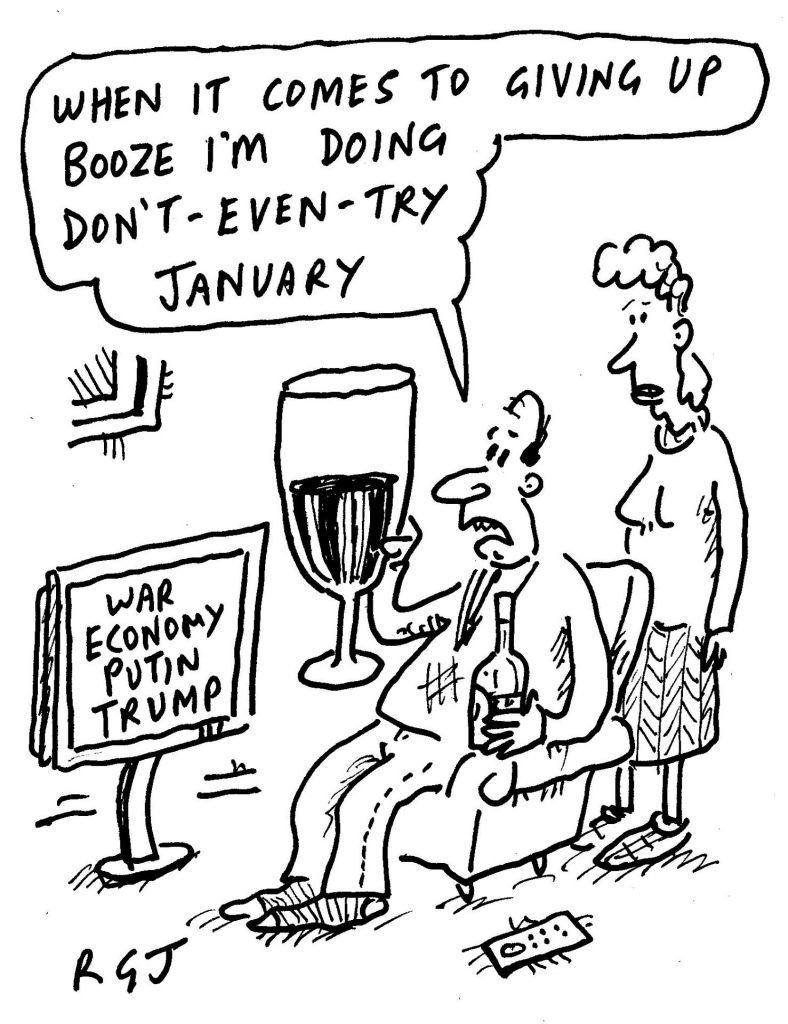 Cartoon: Don’t – even – try January
Sticking with Russia, one of the best books I read over Christmas was The Dark Side of the Earth, by Kremlin critic Mikhail Zygar. Among the gems included is a fascinating exchange between nuclear physicist Andrei Sakharov and Soviet Union president Nikita Khrushchev.
Sakharov, who developed the hydrogen bomb aged 28 – and became worried about the possible consequences – wanted the Soviets to get closer to the USA. That sent Khrushchev into an enormous rage, during which he said: “Leave the politics to us, you just make your bombs… we helped get Kennedy elected. You could say we put him in office last year.”
And there was us thinking Trump was unique.
The book’s subtitle is “How the Soviet Union collapsed but remained”, and much of the drama concerns the tangles between Mikhail Gorbachev and Boris Yeltsin. As for the man who followed Yeltsin into power, Zygar says this: “Putin had no intention of restoring the Soviet Union. He had no need for the old Soviet ideology, no interest in a bright future, justice, freedom or equality. Instead he merged American capitalism with Russian nationalism. The ideologists of the Prague spring in 1968 dreamed of ‘socialism with a human face’ – but Putin found a different formula – ‘capitalism without a human face’. No human rights, no democracy – just cynicism and brutality.”
I remain convinced that part of Trump’s attraction to Putin is jealousy at the extent to which he has cemented his power, neutered all opposition, and used a political base to build a personal fortune.
Hence this: “They carry their cynical belief in democracy and human rights like a banner. And not just in Russia – perhaps such people hold power across the world today. They boldly call tyranny ‘freedom’ and election fraud ‘voting’. They are convinced that democracy is obsolete. They speak of ‘conservatism,’ ‘traditional values’ and ‘greatness’ all the while knowing that the most comfortable stance is to believe in nothing at all.”
As Trump takes his power to a new next level with the audacious seizure of Nicolás Maduro, and the claim to run Venezuela from Washington, this particular episode of the reality TV show feels like a story with no good guys, but a story that makes Trump feel all powerful. So did Maduro once.
All three would do well to heed Zygar’s words: “In history there is no final point, no happy ending, no tragic conclusion. Yesterday’s victors may become tomorrow’s losers. The bright side can one day turn dark and then, just as suddenly, shift back again.”
I begged my daughter, Grace, not to go on BBC Celebrity Mastermind. I had witnessed too many general knowledge lapses over the years. She even had a question about me in a politics exam once… and didn’t know the answer.
But she was adamant, feeling that her comedy career would suffer no harm from prime-time exposure, regardless of how many wrong answers she gave, nor how many times she said “Pass”.
Anyway, if you were by any chance watching last Friday, you will know by now… she only went and bloody won it! Fortune favours the brave, and as she has told me all my life, dads are not always right. I will not be following in her footsteps though.