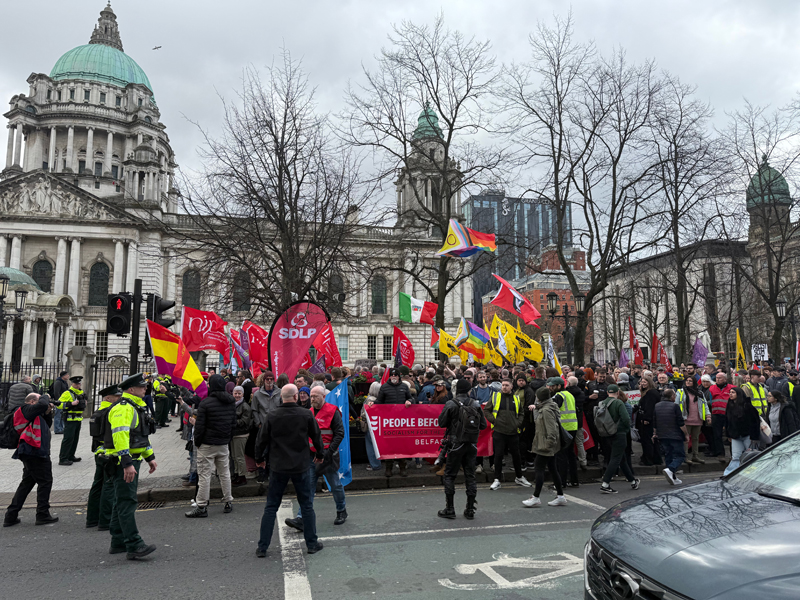
 Refugees are Welcome rally in Belfast

By Suleiman Abdulahi, Founder and CEO of Horn of Africa People’s Aid Northern Ireland (HAPANI)
We have witnessed the daily devastation in Gaza. Millions have been forced to flee Sudan, joining many others escaping long-standing conflicts elsewhere. None of this should come as a surprise. International law was established precisely because people will always need to escape war, persecution, and oppression.
What is changing, however, is the way countries traditionally seen as safe havens are now responding.
Across Europe and other established destinations, policies once focused on offering protection are increasingly shifting towards deterrence. Temporary legal statuses have become the norm. Lasting solutions are delayed or avoided entirely. Rights are reduced to the bare minimum required for survival. Uncertainty is no longer a brief phase; it is now built into the system.
This raises a serious question: are we witnessing the end of international protection, or simply the slow erosion of its true meaning?
Protection Is a Legal Duty, Not a Favour
International protection was never intended to depend on shifting political moods or public sympathy. It is a legal obligation.
When countries signed the 1951 Refugee Convention, they agreed to do more than simply avoid returning people to danger. They accepted responsibility for helping refugees rebuild their lives. This includes granting lawful residence, access to employment, social support, and the opportunity to live with dignity.
The European Convention on Human Rights strengthens these commitments. It not only forbids torture or physical abuse, but also protects individuals from degrading treatment and requires respect for family life and basic human dignity. Courts have repeatedly ruled that long periods of uncertainty, homelessness, or enforced dependence can breach these obligations.
Put simply, protection was meant to restore independence—not to leave people trapped in limbo indefinitely.
What Is Happening in 2025
In 2025, many governments still claim to respect refugee and human rights law. On paper, the system appears intact. In practice, however, protection is increasingly reduced to doing the bare minimum to keep people alive—nothing more.
Refugees are granted temporary status with no clear future. Access to employment is delayed for years. Family reunification is treated as optional. Many people remain in hotels or temporary accommodation for extended periods, unable to plan their lives or contribute to society.
These systems may comply with the letter of the law, but they risk breaching its spirit. Someone who is not sent back to danger but is denied dignity, stability, and opportunity is protected in name only.
International protection was never meant to be a waiting room.
Shifting Responsibility Beyond Borders
This weakening of protection is compounded by policies that shift responsibility onto others.
Agreements between the European Union and countries outside Europe have resulted in people being intercepted, detained, or stranded in unsafe conditions out of public sight. Yet courts have made it clear that states cannot evade their legal duties by acting beyond their own borders.
In cases such as Hirsi Jamaa v Italy, the European Court of Human Rights ruled that human rights obligations apply even when states act abroad. More recently, EU courts have confirmed that agencies like Frontex must abide by the law and can be held accountable for unlawful expulsions.
Border control does not remove the obligation to protect rights.
Courts as the Last Line of Defence
As governments narrow the scope of protection through policy, courts are increasingly left to uphold the law.
In 2025, the Court of Justice of the European Union ruled that Denmark’s “ghetto law”, which targeted areas with large non-Western populations, may be discriminatory and unlawful. This judgment sent a clear message: even politically sensitive policies must respect equality and human rights.
Such rulings are not obstacles to democracy. They remind us that legal commitments cannot be set aside simply because they become politically inconvenient.
Why This Matters for Everyone
The consequences of these changes extend well beyond refugees themselves.
Firstly, international law is weakened. If states only comply in appearance, not in substance, treaties like the Refugee Convention risk becoming symbolic rather than binding.
Secondly, uncertainty creates dependency. Preventing people from working or settling increases long-term costs to the public and leads to social exclusion. Delay is not cheaper—it is ultimately more expensive.
Thirdly, public debate becomes more divisive. When protection is presented as a threat rather than a duty, it fosters fear, division, and mistrust.
There are also global consequences. When wealthier nations withdraw from their responsibilities, the burden falls on poorer and less stable countries. Responsibility does not disappear—it is merely shifted elsewhere.
This Is Not Inevitable
International protection has survived world wars and mass displacement. Its greatest threat today is not irrelevance, but deliberate narrowing.
People will always flee conflict and persecution. The real question for 2025 is whether countries that once led the way in international protection are still prepared to respect both the letter and the spirit of the law.
Protection that restores dignity, stability, and hope is not outdated. In a world of growing instability, it is more important than ever.
If international protection becomes associated with uncertainty and delay, its authority will gradually fade. If it is renewed as a practical system for rebuilding lives, it stands as one of the greatest achievements of modern international law.
The choice is not between control and compassion. It is between effective protection and the gradual abandonment of a system the world will surely need again—perhaps sooner than we expect.
