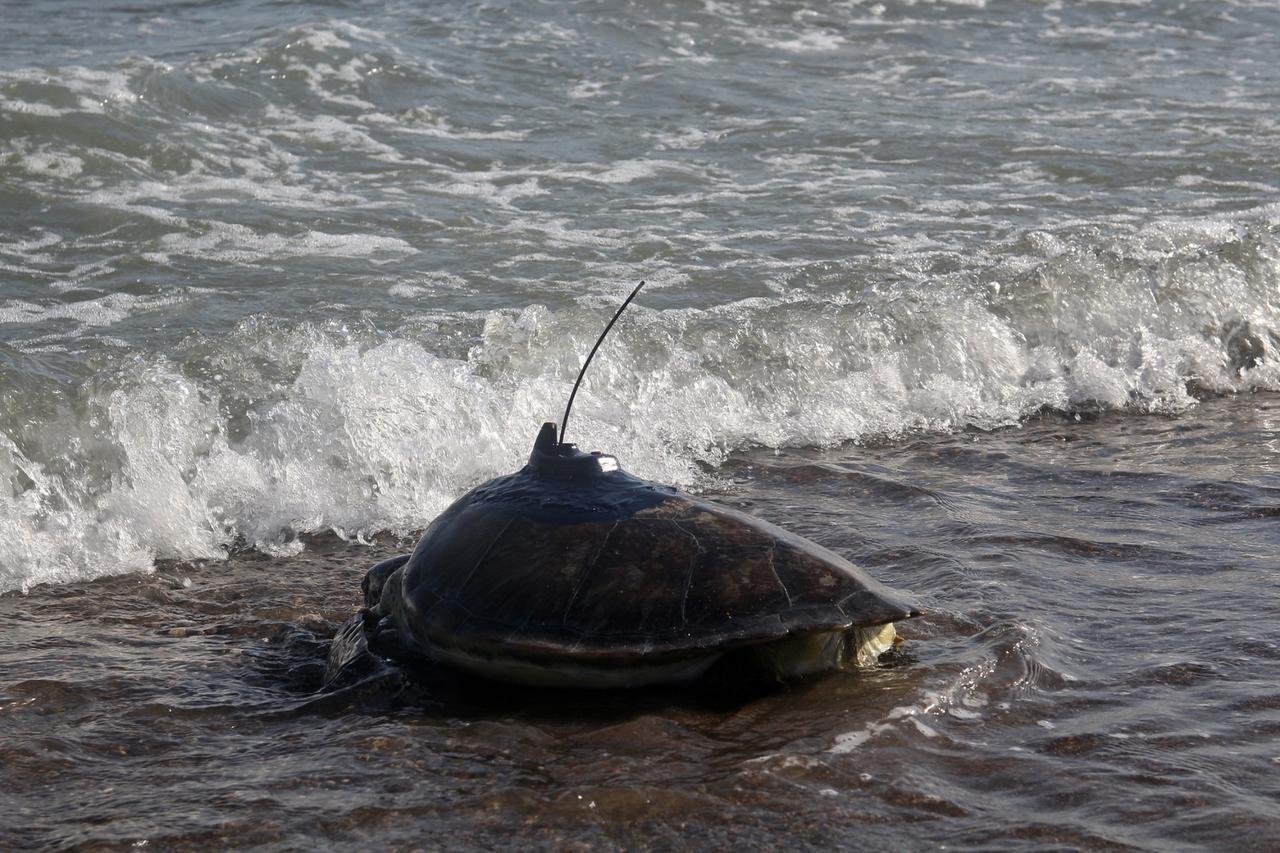
Green sea turtle released into the Mediterranean Sea 50 days ago with a satellite device from Mersin, Türkiye, August 2, 2024. (AA Photo)
January 07, 2026 04:05 AM GMT+03:00
A satellite-tracked loggerhead sea turtle named Tuba has once again chosen the Aegean and Mediterranean seas over long-distance migration, offering researchers rare, long-term insight into how marine turtles use coastal waters around Türkiye. Now on her second monitored journey, Tuba has so far covered around 10,000 kilometers (6,214 miles) while remaining largely within the region, according to scientists overseeing the project.
A rare second journey under satellite monitoring
Tuba, a female Caretta caretta (loggerhead sea turtle), was first released with a satellite transmitter in August 2019 from Iztuzu Beach in Mugla, a globally known nesting site for the species. Loggerhead turtles are large, long-lived marine reptiles found in temperate and subtropical seas, and are listed as vulnerable due to habitat loss and other human-related pressures.
During her first monitored migration, Tuba became the first sea turtle from Türkiye to be tracked continuously from the Eastern Mediterranean as far as the Adriatic Sea. Researchers followed her movements for nearly four years as she swam past Greece and along the coasts of Malta, Italy, Bosnia and Herzegovina, Albania, Montenegro, and Croatia, logging a total distance of about 25,000 kilometers (15,534 miles). That journey made her the longest-tracked turtle in the program and provided data well beyond initial expectations.
Returning to sea from Iztuzu Beach
After coming back to Iztuzu Beach to nest, Tuba was fitted with a new satellite device and released again on Aug. 9, 2024, as part of a project run by the Sea Turtle Research, Rescue and Rehabilitation Center, known as DEKAMER. The work is carried out with support from the TUI Care Foundation, an international organization backing conservation and sustainable tourism initiatives.
Professor Yakup Kaska, head of DEKAMER and a faculty member at Pamukkale University’s Biology Department, said researchers were eager to see whether Tuba would set off along the same route as before or head in a different direction. Instead of leaving the region, she stayed close to home, circling waters off Rhodes and then moving around Bodrum, particularly south of Karaada, an island off Türkiye’s southwestern coast.
An extended tour of regional waters
Kaska explained that since her release in August, Tuba has logged roughly 10,000 kilometers by following a winding path rather than a straight line. While the direct distance covered would be closer to 2,000 kilometers, her movements show repeated loops and detours, a pattern typical of foraging behavior. He described the route as almost a full Mediterranean tour, adding that it would not be wrong to say she has visited nearly all of the Aegean islands.
Most notably for scientists, Tuba has remained largely within Türkiye’s territorial waters, highlighting the importance of these seas as long-term habitats rather than just transit zones. Kaska said the team expects her to complete the first year of this second journey entirely within the Mediterranean and Ege, though it remains unclear whether she will nest again soon or eventually head out on another long migration.
Why long-term tracking matters
Data from the new satellite tag are expected to help answer key questions about whether individual turtles repeat their migration routes or adjust them over time. According to Kaska, satellite monitoring plays a crucial role in showing how sea turtles make use of marine areas and which routes they favor, information that is essential for conservation planning across national borders.
For now, Tuba continues to swim familiar waters, turning her second monitored journey into a detailed case study of regional movement rather than a repeat of her earlier, far-reaching voyage.

January 07, 2026 04:05 AM GMT+03:00