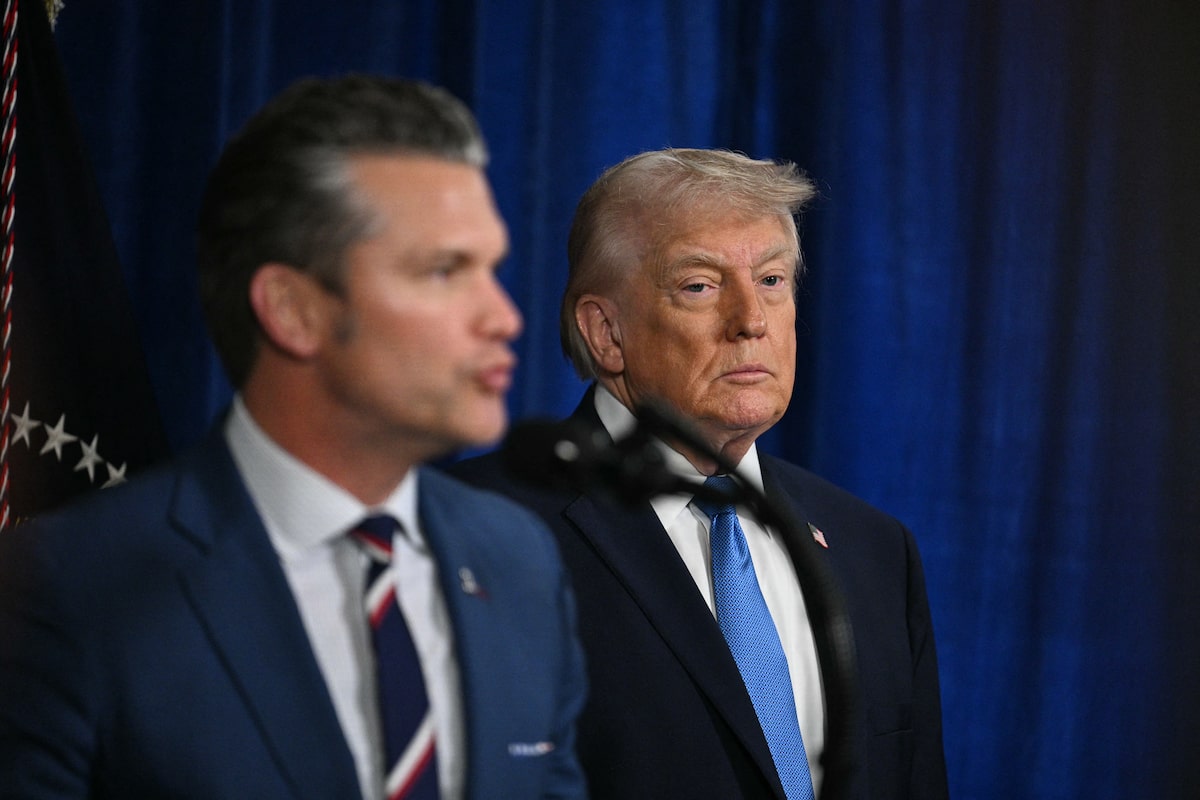
U.S. President Donald Trump looks on as Defense Secretary Pete Hegseth speaks to the press following US military actions in Venezuela, at his Mar-a-Lago residence in Palm Beach, Florida, on Jan. 3.JIM WATSON/AFP/Getty Images
Donald Trump’s military strike on Venezuela, his designs on Greenland and his government’s declaration of ownership over the Western Hemisphere together represent an existential challenge to Canada, Bob Rae, this country’s former ambassador to the United Nations said Tuesday.
Mr. Rae said in an interview that Canadians would be mistaken in thinking they’re not “on the menu” too, meaning “the American government doesn’t take Canada’s sovereignty seriously.”
A former interim leader of the federal Liberal Party who retired as an MP in 2013, Mr. Rae said the sequence of events over the last few days “has been extraordinary and unprecedented.”
He said what’s happened underscores the need for Canadians to unite as a country, to boost domestic economic growth by removing barriers to internal commerce, to diversify trade away from the United States, and to strengthen foreign relationships with other allies. Prime Minister Mark Carney’s government has set a goal of doubling non-U.S. trade in a decade and reducing internal trade barriers.
Analysis: What the raid on Venezuela teaches us about the Trump administration
After Mr. Trump launched a military strike on Venezuela to remove leader Nicolás Maduro, whom he brought to the United States to face charges, he warned of further interventions in Colombia, Cuba and Mexico and, on Sunday, repeated his desire to take control of Greenland. The U.S. State Department also publicly declared that the Western Hemisphere, which stretches from the Arctic to the bottom of South America, is “our hemisphere.”
Stephen Miller, the White House deputy chief of staff, later told CNN it’s the formal position of the United States that it should take control of Greenland and he predicted nobody would launch a military conflict with the U.S. over the future of the Arctic island. The territory, an autonomous part of the Kingdom of Denmark, is rich in deposits of natural resources, including oil, natural gas and rare earth minerals.
Mr. Rae said Canada is facing a more difficult situation than anything it has confronted since the Second World War.
“I think the challenges we face are existential,” he said.
“And I think Canadians need to understand that our neighbour has desires and ambitions and goals under the current administration that no other administration in American history has had – and that this poses a genuine challenge for all Canadians and for the future of our country,” Mr. Rae said.
In November, he retired as Canada’s ambassador to the United Nations in New York after five years on the job.
In December, the Trump administration released its national-security strategy, which reasserted American dominance over the Western Hemisphere. It revived the 19th-century Monroe Doctrine, which the United States has invoked to defend interventions in Latin America for more than 100 years.
“Everybody sort of took great comfort that he didn’t mention much about Canada in the strategy,” Mr. Rae said. However, he said if you look at the way the doctrine has been described, both by Mr. Trump and by his officials, “the wording in the document itself is directed at us as much as it is at others.”
He said that taken together, the Trump strategy represents a “more expansionist view of America’s claim to putting itself first throughout the entire hemisphere than we’ve ever seen before.”
Opinion: Returning to Venezuela is too risky for U.S. oil majors, despite Trump’s phantasm
It suggests that Americans believe they can lay claim to whatever resources they want, Mr. Rae said, urging Canadians to read the Trump national-security strategy.
“What do you think that means when it comes to resources, when it comes to water, when it comes to a whole number of issues?” he said. “The claim that is being made for the primary interest of the United States for the entire hemisphere is deeply problematic for Canada and deeply problematic for any other sovereign country.”
Mr. Rae said he was pleased to see Mr. Carney’s statements in Paris Tuesday when he met with the Danish Prime Minister and affirmed Canada’s support for the sovereignty and territorial integrity of Denmark, including Greenland.
In January, 2025, shortly before taking office for his second term, Mr. Trump, who has repeatedly talked of Canada becoming the 51st state, said he would be willing to use “economic force” to coax Canada into a political union with the United States. In February that year, then-prime minister Justin Trudeau told an economic summit that he believed Mr. Trump was sincere in his desire to annex Canada, in part to gain access to its critical minerals.