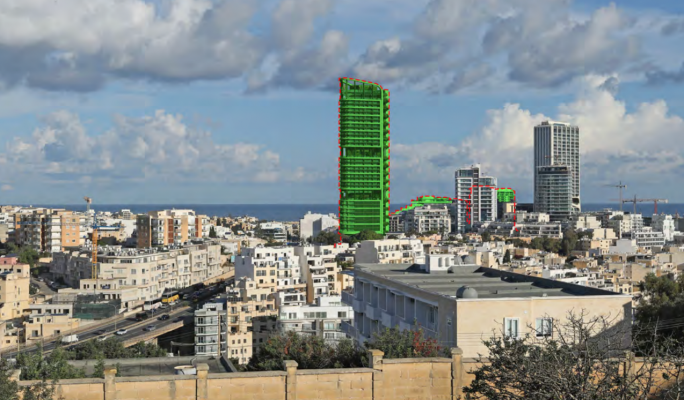
A new visual impact assessment has been published to assess the visual impact of the additional seven floors on an already approved development in Paceville proposed by Paul Xuereb, as part of an addendum to an Environment Impact Assessment conducted in 2021.
If approved by the Planning Authority, Xuereb’s Project Landmark development would become Malta’s tallest building. The application also seeks to expand the project’s footprint from 3,400 to 4,120 square metres, extend the underground parking, and redesign the façade. The mixed-use development includes residential units, a hotel, offices, retail outlets, and a landscaped public open piazza.
The visual assessment is based on twelve photomontages taken from viewpoints including Ibraġġ, Ta’ Giorni, Sliema, St Julian’s, Pembroke, Għargħur, Valletta, Kalkara, Mdina, Birgu and Isla. According to the study, visual impact varies depending on distance, terrain and the sensitivity of the receiving landscape.
In long-distance views from Għargħur’s “Top of the World” and the Kalkara belvedere, only the upper section of the tower is visible, described as “a new detail on the skyline”. Views from Valletta towards Manoel Island are assessed as having a moderate impact due to the tower’s visibility along The Strand. Although barely visible from Kalkara, the impact is still rated moderate to major because of the sensitivity of Valletta’s historic skyline. The tower is not expected to affect views of Valletta from Vittoriosa.
As anticipated, impacts are far more pronounced from closer viewpoints in Sliema, Ibraġġ, Pembroke and St Julian’s, where the tower would visually reinforce an emerging high-rise cluster. The assessment highlights cumulative effects, noting that the tower would cluster with existing tall developments such as Mercury Towers and Pender Gardens. Mitigation measures include a slender building profile and the use of neutral, muted colours to reduce perceived massing in long-distance views.
The increased height will also result in longer shadows, particularly when the sun is low. Residential areas in Swieqi are expected to experience shadowing from dawn until around 10am during spring and summer, while streets in Paceville, including Triq Lourdes, would be affected between 9am and midday in March and September.
The development is projected to generate an annual average daily traffic flow of between 760 and 915 vehicles, broadly in line with the previously approved estimates. Traffic impacts are linked to a proposed Infrastructure Malta road upgrade in Swieqi, which is still awaiting approval. The scheme would remove the need for access via Triq Santu Wistin, easing pressure on Triq Mikiel Anton Vassalli.
The project includes 366 parking spaces, exceeding the estimated demand of 333, alongside mitigation measures such as a green transport plan, improved pedestrian links and cycling facilities. The original project was approved with a condition obliging the developer to present a green transport plan to reduce traffic by 40% during peak hours.