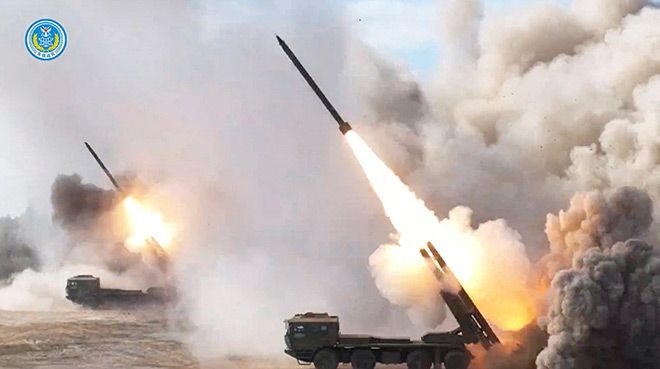
Toward the end of 2025, the Chinese military again conducted a training exercise that encircled Taiwan and included escalation in what was carried out.
That heightened regional tension and cannot be accepted.
It marked the first military exercise around Taiwan since April 2025 and the fourth in which the island was surrounded.
The training area also approached much closer to the main Taiwan island than in past exercises.
It appears that China wants to regularly conduct such training twice a year.
According to Taiwan’s national defense ministry, about 200 Chinese military aircraft were confirmed taking part in the exercise. China fired a total of 27 long-range rockets to the north and southwest of Taiwan and also deployed ships and drones.
A Chinese military spokesman said the objectives of the exercise were to seal off and control ports and local waters and described the exercise as a “severe warning to those in Taiwan calling for independence as well as outside forces interfering in the region.”
Chinese President Xi Jinping’s administration is seeking Taiwan unification and has strengthened pressure on Taiwanese President Lai Ching-te.
Beijing also criticized as inappropriate interference the sale of weapons to Taiwan by the United States.
China did not issue an international notification about the training exercise area it had designated until the last minute, which disrupted the schedules of commercial airlines.
Flights between the main Taiwan island and the outlying islands of Kinmen and Matsu were canceled.
While international flights, such as between Taiwan and Japan, were not canceled, flight routes had to be partially changed.
Immediately after the exercise, Xi said in his New Year greeting that the historic trend toward homeland unification could not be prevented because the blood of comrades in China and Taiwan was thicker than water.
If he is confident enough about unification to refer to Taiwanese citizens as comrades, why did he resort to military force to apply pressure?
There are contradictions in the messages issued by the Xi government toward Taiwan and its actual actions.
China has always claimed that Taiwan was a domestic issue.
But with the U.S. attack on Venezuela in the wake of Russia’s invasion of Ukraine, China may feel the move serves as a tailwind because it will likely weaken criticism from the international community about using force to change the status quo.
There are concerns that China will further accelerate its strengthening of tactical capabilities against Taiwan.
To counter the Chinese exercise, naval vessels from Europe, the United States and Japan passed through the Taiwan Strait.
The danger of an unexpected incident is gradually heightening.
Now is the time for the relevant nations to think about how to maintain stability in East Asia.
While China has showed off its military force, its basic policy toward Taiwan since the era of reform and an open-door policy is to achieve peaceful unification.
That likely remains unchanged since stable diplomatic relations contribute to sustained economic development.
–The Asahi Shimbun, Jan. 7