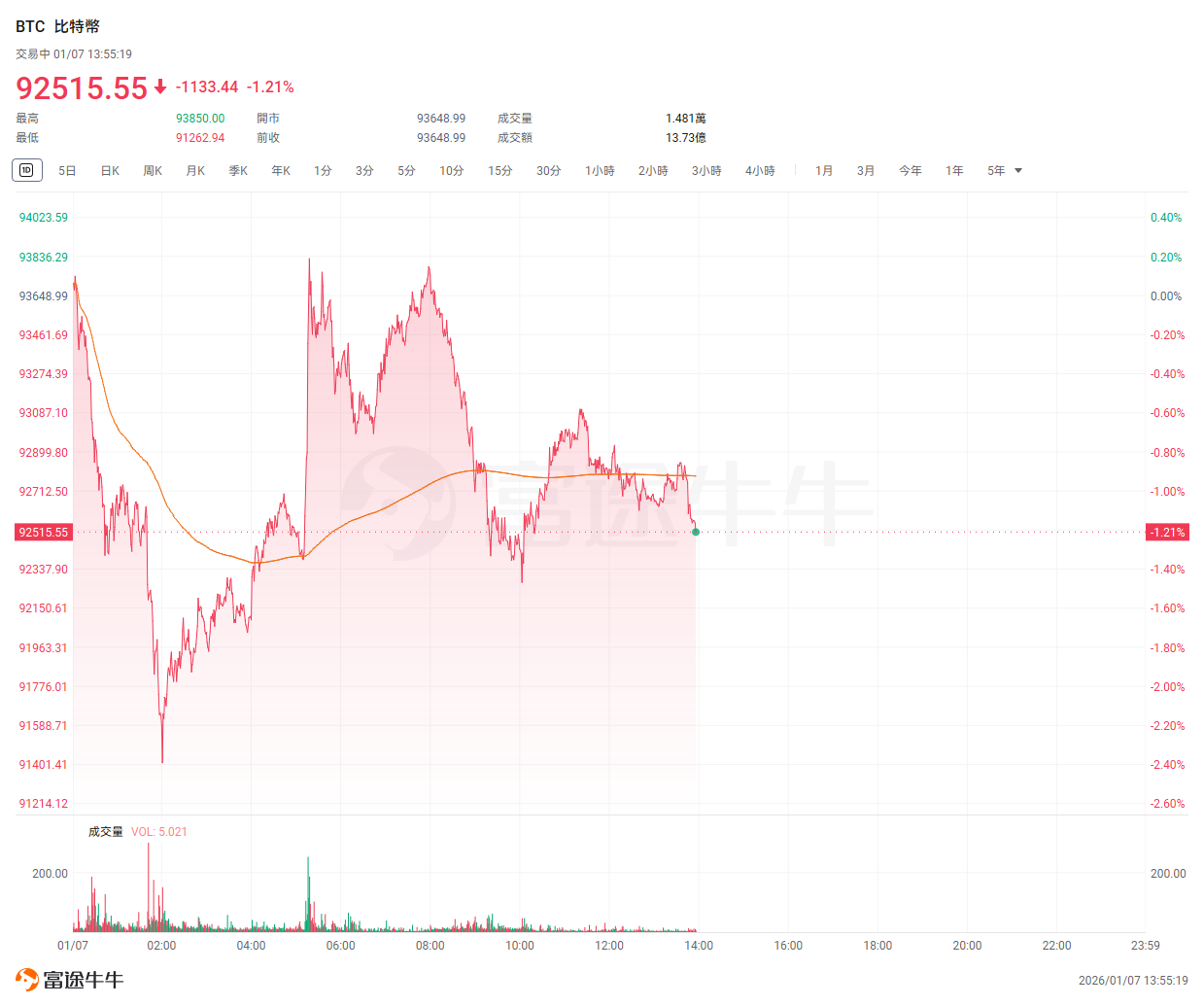
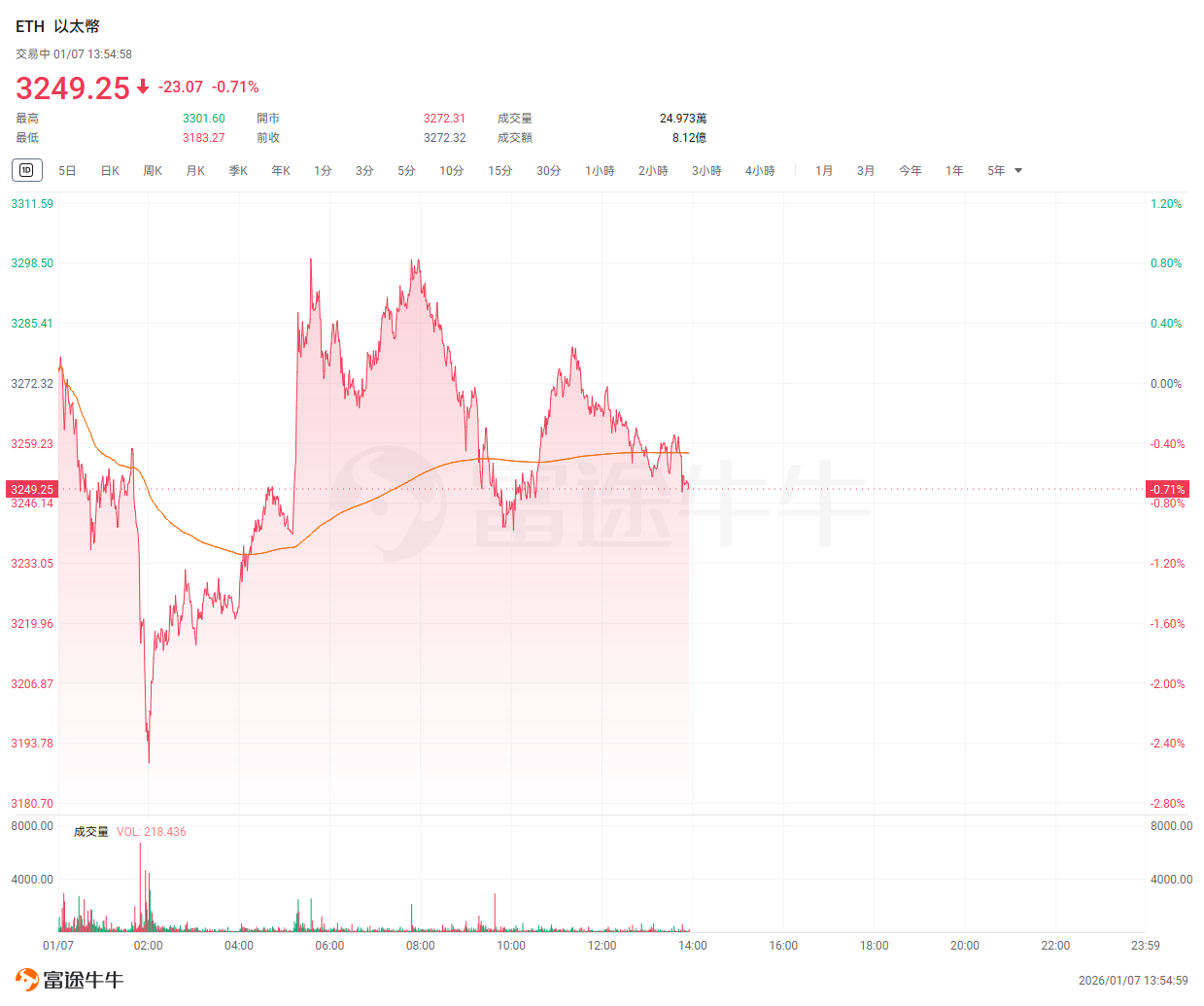
January 7: Cryptocurrency market volatility continues. As of the time of writing, $Bitcoin (BTC.CC)$ fell by 1.21%, trading at $92,515.55; $Ethereum (ETH.CC)$ dropped by 0.71%, trading at $3,249.25.
According to $MSCI Inc (MSCI.US)$ announced on its official website that MSCI decided not to exclude ‘Digital Asset Treasury Companies’ (DATCOs) during the February 2026 index review. The existing inclusion list will remain unchanged. This decision addresses institutional investors’ concerns regarding certain DATCOs sharing characteristics with investment funds. MSCI will initiate a broader market consultation targeting non-operating companies to establish more consistent inclusion criteria. During this period, these companies will not undergo adjustments in share count or inclusion factors, nor will there be additions or changes in size segments. The list will be dynamically updated based on disclosures. Companies including $Strategy (MSTR.US)$ will retain their index positions temporarily.
The 2026 People’s Bank of China Work Conference was held from January 5th to 6th, reviewing the work of 2025. It highlighted active promotion of global financial governance reforms and improvements in 2025, along with enhanced financial management and service levels. Efforts included precise governance of fraudulent and gambling-related ‘funds chains,’ strengthening regulation of virtual currency trading, ensuring cash supply, and optimizing the digital yuan management framework. Key priorities for 2026 include enhancing cross-border RMB infrastructure, reinforcing virtual currency oversight, and continuing crackdowns on related illegal activities. Emphasis is placed on advancing technological management and innovation while promoting steady development of the digital yuan.
A comprehensive bill aimed at fully regulating the cryptocurrency industry, advanced by the Senate Banking Committee, is expected to make progress in the new year, despite an uncertain outlook, a glimmer of optimism remains.
According to informed sources, Democratic and Republican members met on Tuesday to discuss the bill, with Tim Scott, the Republican Senator from South Carolina and Chairman of the Senate Banking Committee, actively pushing for a hearing this month to revise and vote on the bill. Punchbowl News reported on Tuesday that Scott informed lawmakers and staff that he would hold a markup session for the Cryptocurrency Market Structure Act by January 15, regardless of whether it garners bipartisan support. Scott later confirmed in an interview with Breitbart News that his committee would hold the markup session on January 15.
In the Breitbart News interview, Scott stated: “I believe we must proceed with public record-keeping and voting; therefore, next Thursday, we will vote on the market structure bill. Over six months of relentless efforts have ensured that every member of the committee has access to multiple draft versions.” However, insiders noted that as of Tuesday, the bill might still lack sufficient support within either party.
ChainCatcher reports that Patrick Liou, Director of Institutional Business at Gemini, released five major predictions for 2026.
First, Bitcoin’s four-year cycle is over, with ETFs and institutional adoption making the market more mature. Volatility has decreased from a historical 80% to 25-40%, with drawdowns limited to just 30% rather than the previous 75-90%. Second, cryptocurrency will become a bipartisan issue in the 2026 U.S. midterm elections, with the CLARITY Act expected to make progress. Third, prediction markets in crypto will expand significantly, as Polymarket’s growth attracts players like Coinbase. Fourth, digital asset reserve companies will consolidate for survival; MicroStrategy’s Q4 losses last year and MSTR’s stock price plunging 60% highlight this pressure. Fifth, at least one country will sell part of its gold reserves to purchase Bitcoin, with Germany, Sweden, and the Czech Republic already publicly discussing BTC as a reserve asset. Liou believes that 2026 will be driven by institutions, policy, and sovereign capital rather than speculative cycles.
According to Bloomberg, Monica Long, President of Ripple, reiterated that the company has no plans for an IPO, citing a strong balance sheet and a preference for growth through mergers and acquisitions and product expansion. In November 2025, Ripple completed a $500 million financing round, valuing the company at approximately $40 billion, with investors including Fortress Investment Group and Citadel Securities. In 2025, Ripple completed four acquisitions (Hidden Road, Rail, GTreasury, Palisade), with a total transaction value nearing $4 billion. As of November last year, Ripple Payments had processed over $950 billion in cumulative transactions, with its USD stablecoin RLUSD becoming a core component of its payments and institutional business.
U.S. community banks are jointly pushing to close a “loophole” in the GENIUS Act. The Community Bankers Council under the American Bankers Association sent a letter to the Senate urging that the ongoing crypto market structure legislation explicitly prohibit affiliates or partners of stablecoin issuers (such as exchanges) from offering users yield/interest to prevent stablecoins from indirectly paying interest through third parties. The group noted that although the GENIUS Act already bans stablecoin issuers from directly paying interest, some exchanges continue to offer rewards to users holding stablecoins on their platforms, which could undermine the deposit-taking and lending capabilities of community banks. Previously, the Banking Policy Institute also made a similar argument, stating that failure to address the loophole could lead to a deposit outflow of up to $6.6 trillion.
Bitcoin mining hardware manufacturer $Canaan (CAN.US)$ has launched a 3 MW pilot project in Manitoba, Canada, aiming to use waste heat generated from Bitcoin mining for greenhouse agriculture. Through liquid-cooled mining machines, thermal energy will be recovered to provide auxiliary heating for tomato greenhouses. In collaboration with Bitforest Investment, 360 Avalon liquid-cooled servers have been deployed, with a closed-loop heat exchange system channeling heat into the greenhouse boiler system. Canaan estimates that approximately 90% of the electrical energy consumed can be converted into usable thermal energy, reducing both energy consumption and costs while helping to cut carbon emissions.
According to DocumentingBTC, an anonymous address has been mining continuously every day since November 2016 up to the present. All rewards, totaling 4,165 BTC (approximately $375 million), have been deposited into the same wallet. For eight years, no transfers or sales of any coins have occurred. The balance of this address has steadily increased and remains completely untouched, representing an extreme “diamond hand” level commitment to long-term Bitcoin holding.
SharpLink Gaming earned 438 ETH in staking rewards last week, bringing its cumulative total to over 10,000 ETH
According to $SharpLink Gaming (SBET.US)$ Official disclosures indicate that the company earned 438 ETH last week through Ethereum staking, valued at approximately $1.4 million at current prices, raising its cumulative staking rewards to 10,657 ETH. The company reiterated its unchanged strategy: 100% of assets held in ETH and 100% allocated for staking.
ChainCatcher reports $Coinbase (COIN.US)$ Coinbase stated that proposed amendments to the GENIUS Act might weaken the United States’ position in the global expansion of digital payments. At the same time, the strategic introduction of interest-bearing features for the digital yuan represents a shift that will place new pressure on US policymakers. An interest-bearing framework could attract yield-seeking users, potentially reshaping the competitive landscape and making the digital yuan a clearer competitor to stablecoin products.
Coinbase warned that restricting reward options for stablecoins could reduce their competitiveness. Internal lobbying efforts have also heightened tensions. Coinbase maintains that the leading position of stablecoins supports the strength of the US dollar and emphasized that policy adjustments must consider international dynamics. US lawmakers now face a decision that could influence the direction of the next phase of digital payments.
According to CoinDesk reports, $Walmart (WMT.US)$ has launched Bitcoin and Ethereum trading services through its OnePay application, enabling millions of shoppers to convert cryptocurrencies for everyday retail spending.
According to CoinDesk, Bitcoin plummeted to nearly $80,000 in late November 2025. At that time, the ratio of profitable short-term holders’ supply to unprofitable short-term holders’ supply fell to historical levels consistent with major or partial bear market bottoms. Glassnode data shows that on November 24, this ratio dropped to 0.013. Each time this level was reached in the past, it marked a local bottom or absolute low point in a bear market, including in 2011, 2015, 2018, and 2022.
Glassnode defines short-term holders as investors who have held Bitcoin for less than 155 days. During the November trough, the 7-day moving average of the supply held by profitable short-term holders fell to approximately 30,000 Bitcoins, while that of unprofitable holders surged to 2.45 million, the highest since the FTX collapse in November 2022, when Bitcoin bottomed out near $15,000. Since early 2026, Bitcoin has rebounded to about $94,000, rising more than 7%.
During this period, the supply held by unprofitable short-term holders fell to 1.9 million, while that of profitable holders rebounded to 850,000, making the ratio approximately 0.45. Historically, when this ratio approaches 1, it tends to break out and continue expanding, with Bitcoin prices also showing a tendency to rise continuously. Currently, the ratio is below 0.5%, indicating that the metric still has significant room for expansion before reaching equilibrium. Market tops typically occur when this ratio rises to near 100.
According to OnchainLens monitoring, $Circle (CRCL.US)$ In the past 24 hours, Circle has again minted 1 billion USDC on Solana. As of now, Circle has minted a total of 1.75 billion USDC on Solana in 2026.
Solana announced on the X platform that in 2025, $Solana (SOL.CC)$ The data performance has been outstanding in multiple aspects, with several indicators reaching record highs. In terms of application revenue, applications built on Solana generated $2.39 billion in revenue, marking a 46% year-over-year increase; among them, seven applications achieved revenues exceeding $100 million. Regarding network performance, network revenue (REV) reached $1.4 billion, growing 48 times over two years; non-voting transaction volume amounted to 33 billion, up 28% year-over-year; the average number of daily active wallets was 3.2 million, reflecting a 50% year-over-year increase; the average transaction fee dropped to $0.017, with the median falling to $0.0011.
In the asset domain, stablecoin supply at year-end reached $14.8 billion, more than doubling year-over-year and setting a new historical high; the scale of stablecoin transfers hit $11.7 trillion, increasing sevenfold over two years; equity-like assets were listed on Solana, with a supply reaching $1 billion and trading volume amounting to $651 million; net inflows into Solana ETFs reached $1.02 billion. On decentralized exchanges (DEX), trading volume reached $1.5 trillion, up 57% year-over-year; SOL stablecoin trading volume hit $782 billion, more than doubling year-over-year; twelve DEX platforms recorded trading volumes exceeding $10 billion.
In meme coins and launch platforms, meme coin trading volume totaled $482 billion, a 10% year-over-year decline but an 80-fold increase over two years; six launch platforms recorded trading volumes surpassing $1 billion; revenue from launch platforms doubled year-over-year to $762 million; eight launch platforms earned over $1 million; these platforms created 11.6 million tokens, more than doubling year-over-year. Among trading platforms, DEX aggregators facilitated $922 billion in trading volume, doubling year-over-year; specialized trading platforms generated $940 million in revenue, up 44% year-over-year; ten trading platforms earned over $10 million, with three surpassing $100 million; trading platforms processed $108 billion in trading volume, reflecting a 66% year-over-year increase.
According to the official blog, stablecoin issuer Tether announced the introduction of Scudo—a new accounting unit for its tokenized gold product, Tether Gold (XAU₮)—aimed at making gold accessible as a payment method for everyone. Tether defines one Scudo as one-thousandth of a troy ounce of gold (or one-thousandth of XAU₮), enabling clearer price labeling, easier transfers, and more intuitive use of gold’s value for Tether Gold users.
Users no longer need to send or price assets using complex fractional decimals of XAU₮ but can instead transact in whole or partial Scudo units. This makes gold more practical as a store of value and convenient as a medium of exchange. Tether Gold remains fully backed by physical gold stored in secure vaults, with ownership verifiable on-chain via Tether’s asset tracking tools. Scudo does not alter the structure or backing of XAU₮ but provides a simpler way to measure and trade gold value, especially amid rising prices.
According to NADA NEWS, Japan officially adopted the Crypto-Asset Reporting Framework (CARF) released by the Organisation for Economic Co-operation and Development (OECD) starting January 1, 2026. This framework is a new mechanism designed to enable tax authorities worldwide to share information on crypto-asset transactions. Japan introduced this system through tax reform decisions, with the National Tax Agency publishing informational materials for users ahead of implementation in December last year and advancing preparations for information collection through exchanges.
Affected by this regulation, Japanese cryptocurrency exchange Coincheck sent a notification to all users on January 6, requesting submission of their ‘tax residency country’ and other related information. Other exchanges in Japan will also progressively implement information collection procedures. Existing users who opened accounts prior to December 31, 2025, are required to submit their information by December 31, 2026, while users opening accounts after January 1, 2026, must complete the declaration during the account registration process. Failure to submit the required information within the specified timeframe or providing false details may result in penalties under applicable regulations.
According to DL News, $Coinbase (COIN.US)$ David Duong, Global Head of Investment Research at Coinbase, has issued a warning that the long-term security of Bitcoin is heading into uncharted territory as advancements in quantum computing are outpacing the cryptocurrency industry’s projections. Duong believes that although a direct attack on Bitcoin is not imminent, the quantum threat has evolved from a theoretical possibility to a tangible structural risk—wallets holding approximately one-third of the Bitcoin supply use publicly visible encryption output formats, making them highly vulnerable to brute-force attacks. Duong stated that quantum computers pose two types of risks.
One is economic: if quantum machines become powerful enough, they could mine Bitcoin blocks far more efficiently than current levels, potentially distorting the network’s incentive mechanisms. The second risk is more immediate: quantum computers could derive private keys from exposed public keys, enabling attackers to steal funds from vulnerable addresses. Duong wrote, “Given current scale limitations, quantum mining remains a lower-priority concern, while signature security is the core issue.” Quantum computing is still in its infancy. Researchers have long been divided on whether and when quantum computers might threaten Bitcoin’s cryptographic technology.
According to market reports, $Morgan Stanley (MS.US)$ submitted S-1 application documents for Solana Trust and Bitcoin Trust to the U.S. Securities and Exchange Commission (SEC), respectively.
$Coinbase (COIN.US)$ Brian Armstrong, founder of Coinbase, responded on X to user questions regarding his continued sale of COIN stock by stating: “Yes, I sold some. But after 13 years of entrepreneurship, wouldn’t it be crazy if I still had 99.999% of my net worth tied to a single stock? So this was an inevitable choice. However, the majority of my net worth is still in COIN, and I am very optimistic about the future. Meanwhile, I’ve also used part of the proceeds to help establish more companies.”
Editor/Joe