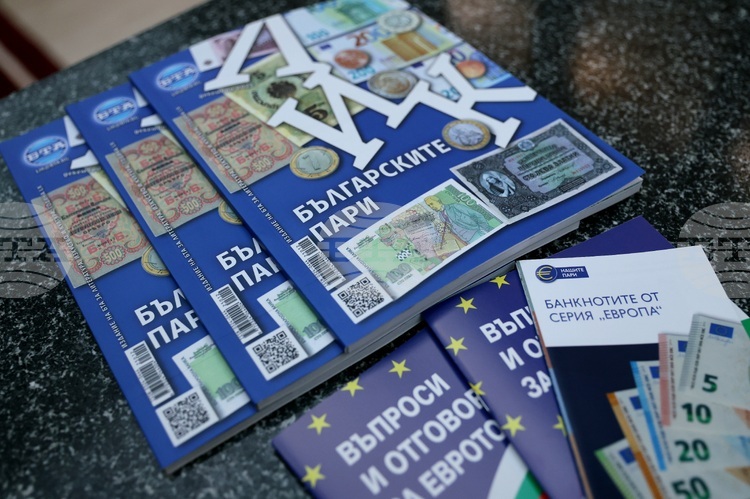
On Tuesday, BTA press clubs both in Bulgaria and abroad held events to present the LIK magazine issue entitled “Bulgarian Money”. On January 1, 2026, Bulgaria became the latest country to join the euro area.
In Sofia, BTA Director General Kiril Valchev said that this issue of the magazine offers an honest account of the currency that has been in circulation in Bulgaria since the late 1800s. BTA reported on the Bulgarian lev for the first time on July 7, 1899. The article at the time read that “the Paris Ottoman Bank telegraphed the Public Debt Administration that the Bulgarian National Bank had paid, on behalf of the Bulgarian government, 2.5 million leva in overdue contributions for the Eastern Rumelia tax.”
At the same presentation, Bulgarian National Bank (BNB) Governor Dimitar Radev said that the adoption of the euro is not the result of a sudden turn but continues a path Bulgaria has been following for many years. Radev stated that the BNB’s tellers’ hall serves as a reminder that money is not just banknotes and coins but “a matter of trust”. He added: “Our monetary history leaves important lessons. Perhaps one of the most important of them is that the resilience and strength of money do not depend on its name or its symbols, but on the rules, institutions, and discipline behind it.”
Following Radev, LIK Editor-in-Chief Georgi Lozanov said that despite centuries of attempts to steer Bulgaria toward a Eurasian model of social development, since the Third Bulgarian Kingdom the country has been moving toward Western European development and toward a sense of belonging to that cultural sphere. “There was a forced pause during communism, which has now been overcome,” he added.
LIK magazine’s Managing Editor, Yanitsa Hristova, reported that the issue includes a chronological timeline of key dates from the bank’s history. She added: “In this issue, readers can explore some of the key milestones in the evolution of the currency over the years: from the late 1940s, when certain Bulgarian banknotes were withdrawn and new ones were put into circulation, through the reforms of the 1950s and 1960s, to the introduction of the currency board and Bulgaria’s entry into the eurozone.”
Prof. Pencho Penchev of Sofia’s University of National and World Economy said the emergence of money pre-dated the emergence of the State after the country’s liberation from Ottoman rule in 1878. He specified that local currency was minted in the towns of Tryavna, Lom, Shumen and Panagyurishte, where it took the form of square-shaped coins called vot.
Dr Julia Zaharieva, founder and dean of the European Union Law programme at the Sofia University Faculty of Law, said that when it comes to a national currency, people are very sensitive, which is why the national symbols on euro coins help give them a distinct national identity. She shared that the designer of the eagle depicted on the national side of the German euro coins was Bulgarian artist Snezhana Ruseva.
Participants in Bulgaria’s 34th Antarctic expedition commented on the introduction of the euro as the country’s official currency. Kamen Nedkov, Commander of the St Kliment Ohridski Bulgarian Antarctic Base, said the adoption of the euro had gone largely unnoticed on the Ice Continent as there are no financial transactions among the team members, with the neighbouring Spanish base or with visiting ships.
Radko Muevski, Commanding Officer of Bulgaria’s naval research vessel Sv. Sv. Kiril i Metodii shared: “There are no currencies or coins in Antarctica; mutual support is our greatest currency.” Onboard, the crew uses internal exchange tokens, such as internet access, he added.
In an interview taken in BTA’s Bucharest press club, product manager Antoni Peychev compared the eurozone to a magnifying glass that reveals both the positives and negatives of recent decades. He reported that many Romanians want to switch to the euro in order to attract foreign investment.
Prof. George Pleios of the University of Athens said in the Greek capital that Bulgaria is much better prepared to adopt the euro than Greece was more than 20 years ago. He warned that insufficient preparation for the lower interest rates on bank loans could lead to an increase in imports and a decrease in exports of local production as one possible drawback.
In Odesa, pupils Daria Miroshnikova and Lika Velchuk shared that they were impressed by the fact that Cyrillic script appears alongside the Roman and the Greek alphabet on the euro banknotes.
Alexander Borimecicov, Administrative Director of the Ruse University branch in Taraclia, said in Taraclia that he is hopeful that the currency transition will be beneficial and improve the quality of life for all Bulgarians.