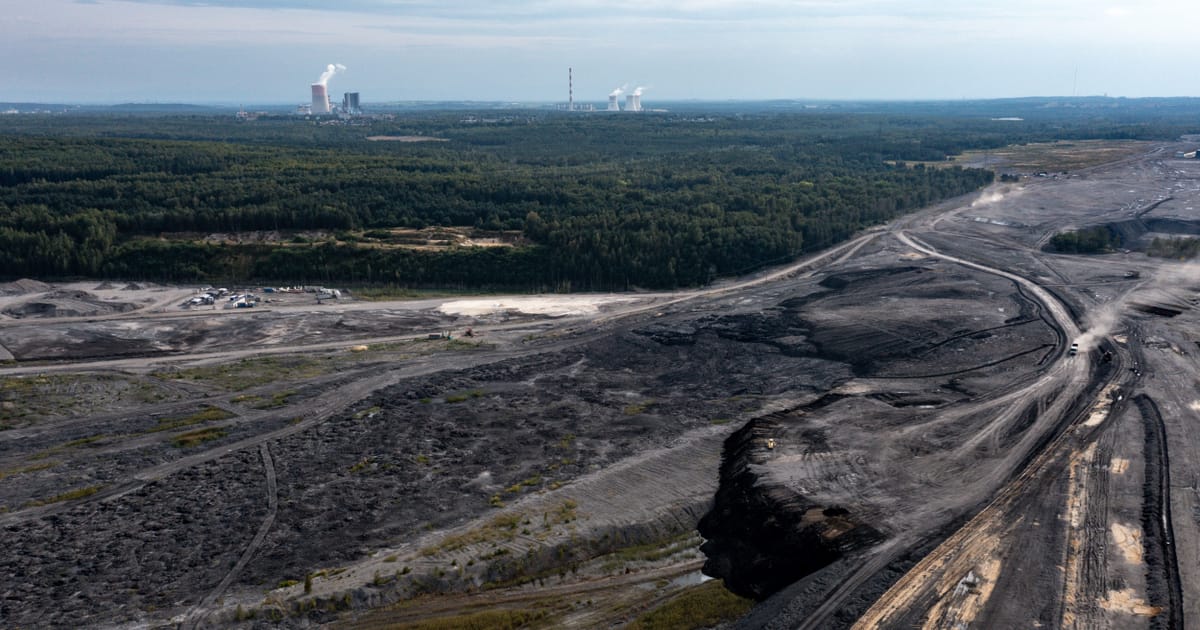
In the country’s coal region — one of the EU’s biggest — advocates and union leaders are working to ensure the energy transition doesn’t leave miners behind.
BYTOM, Poland — Adam Drobniak pulled into the parking lot of a convenience store and stepped out of his sedan into the overcast afternoon. A coal mine just across the street cast dust into the air as conveyor belts sorted the shards of black, burnable rock. Down the road, a goliath coking plant belched fire and thick clouds of steam as its roaring ovens cooked off impurities in the coal to refine it for blast furnaces. The air smelled burnt, and it was difficult to tell whether the sky was gray from clouds or smoke. Drobniak took out a silver case from his pocket and flashed a mischievous smile as he withdrew a hand-rolled cigarette, then dangled it from his lips and touched the flame of an old-fashioned Zippo to the tip.
“I spent decades around this,” he said, motioning to the surrounding area. “How much more damage can it do?”
The coking plant in Bytom, Poland. Still entrenched in the coal industry, the city suffers from high poverty and unemployment rates. (Alexander C. Kaufman/Canary Media)

Bytom is located in Silesia, an ethnically distinct province in southern Poland and the European Union’s biggest coal-mining region. Silesia still produces millions of tons of coal annually and has been extracting it from the ground for hundreds of years. The first state-owned coal mine opened about 20 minutes southwest of Bytom in 1791, when the region was controlled by Prussia. Over the next two centuries, the area was transformed into a key node in Central Europe’s industrial supply chain, with the third-largest gross domestic product of any province in the region, behind only the Polish capital of Warsaw and the Romanian capital of Bucharest. Coal became a way of life.
Now Silesia is figuring out the least painful way to kill the coal industry.
An economist by training, Drobniak has become something of a doctor administering palliative care.
Over the past five years, Drobniak, who works at Poland’s University of Economics in Katowice, Silesia’s provincial capital, has partnered with labor unions, local officials, and industry leaders on a “just transition” plan to shift Silesia away from coal without abruptly destroying the livelihoods of thousands of people whose families have worked in the industry for generations, spanning kingdoms, republics, communism, and capitalism.
Adam Drobniak stands on a bridge overlooking the coking plant in Bytom. An economist by training, he has helped craft a “just transition” plan that prioritizes a slow phaseout of coal. (Alexander C. Kaufman/Canary Media)

That plan, which seeks to capitalize on an economic transition already underway in Poland and give workers the time and resources to adjust, has become something of a model for neighboring countries such as Romania and Bulgaria, which are struggling with their own transition away from coal. And, though the plan faces pushback from EU policymakers in Brussels and shifting priorities in Warsaw as different parties vie for national power, Poland seems to be moving in the right direction. Across the province, new industries — from manufacturing to technology — are booming.
However, development has not been evenly distributed. The economic gap between cities such as Bytom and Katowice has more than doubled in the past three decades. While Katowice teems with new buildings and businesses, Bytom represents what Drobniak called the “worst case” for the transition, a corner of Silesia unusually entrenched in coal and suffering from high poverty and unemployment rates as the industry shrinks. The city has lost nearly a quarter of its population since the early 2000s, with residents leaving in pursuit of better opportunities elsewhere. Indeed, the coal mine that was cranking away when Drobniak and I visited Bytom this fall was set to close in December. Most of the miners there will likely transfer to other coal mines in Silesia.
As in many parts of Europe, wind turbines line the horizon on the drive into Silesia. Solar panels glimmer on old stone roofs. Poland is racing to build its first nuclear power plant and is inking deals with virtually every major small-modular-reactor vendor in the U.S. and the United Kingdom. The country is even carrying out drilling experiments to see whether geothermal heat could replace coal in its district heating system. It’s no wonder why: Poland’s coal phaseout is set to kick up a notch this year, even as electricity demand is rising. But the size, history, and Europe-wide importance of Silesia’s coal industry put the phaseout on a different scale — making the steps the region is taking to avoid upheaval for workers especially consequential.
The Silesian coal industry’s first brush with death came three decades ago.
In 1996, Poland enacted sector-wide reforms meant to consolidate mines and privatize state-owned enterprises as the country transformed after the fall of the Soviet Union. Over the course of just a few years, the number of jobs in the mining sector plunged by 356,000. After Poland joined the EU in 2004, its economy grew rapidly and employment in the coal sector partially recovered. But it dipped again, by tens of thousands of jobs, during the 2008 financial crisis and the 2020 pandemic.
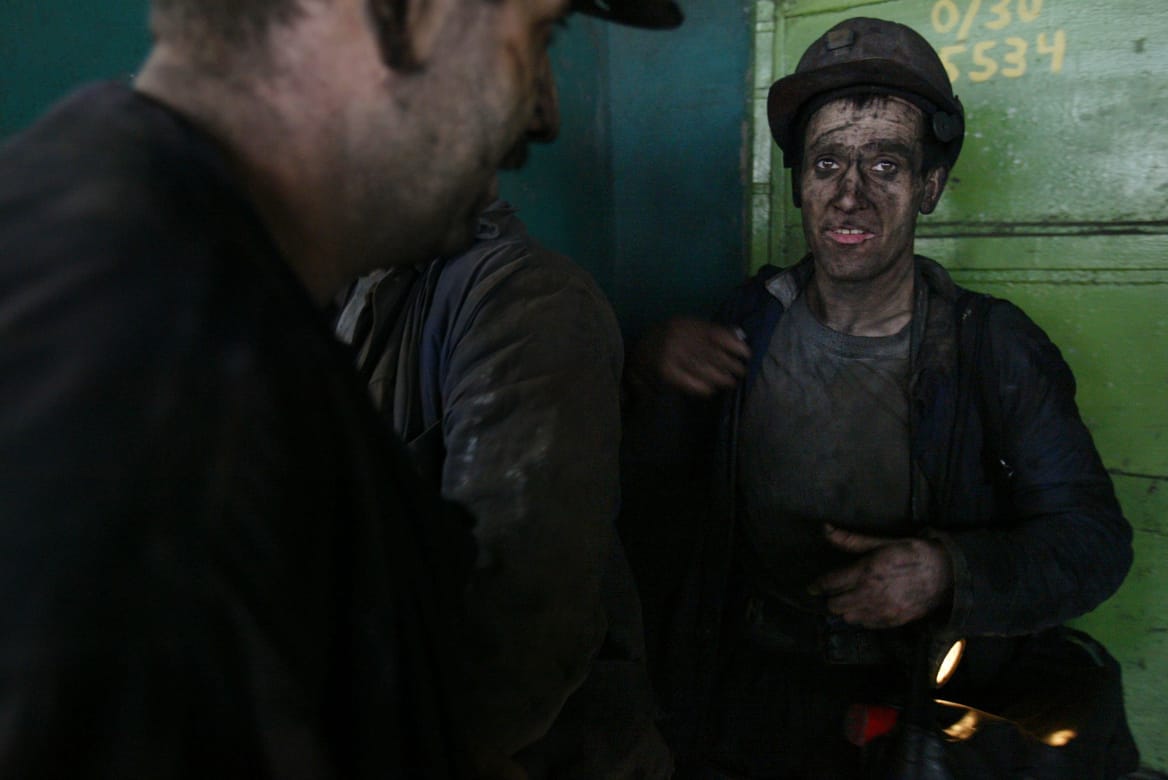
Miners at the Wieczorek coal mine in Katowice, Silesia’s capital, shortly before Poland joined the EU in 2004. The mine closed in 2018 and the site is now being developed as a hub for video game designers. (Sean Gallup/Getty Images)
Poland’s overall wealth expanded as the country integrated into the EU. But the relationship also brought tensions. As Brussels imposed increasingly strict targets to cut emissions from power plants and phase out coal, many countries built up renewables backed by natural-gas-fired plants. Pipelines stretching westward across Europe from the bloc’s eastern border soon flowed with gas molecules from Russia, one of the world’s biggest producers.
Poland was reluctant to follow suit. Centuries of fighting off invasions from the east — including four decades under Moscow’s control as a Soviet satellite — left Poles wary of depending on Russia for fuel. When Russia invaded Ukraine in 2022 and started throttling Europe’s gas supply, Warsaw’s continued reliance on coal seemed, to some extent, vindicated. However, even as the conflict underscored the risks of Russian gas, surging electricity demand across the EU and looming emissions-cutting deadlines only emphasized the need for Poland to find new sources of power.
To Silesia’s coal miners, the end is looking inevitable.
“We are fighting for our lives here,” Krzysztof Stanisławski, a lifelong miner, told me when I visited the headquarters of the Kadra trade union, which represents many of the region’s coal workers. “It’s a big problem. We are fighting, and we are losing.”
But there are degrees of losing. In July, Drobniak and members of the Kadra union had visited the British city of Newcastle as part of a tour of the U.K.’s former coal-producing regions. The location was fitting. The city in northeastern England was once a coal-mining capital whose product fueled the first phase of the Industrial Revolution. But in the early 1980s, then–British Prime Minister Margaret Thatcher incapacitated the coal unions as part of the Conservative Party’s crackdown on organized labor, and the steady push toward cleaner sources of power shrank the industry. The final coal mine near Newcastle closed in 2005.
“We visited Newcastle to learn about what we should avoid in the future,” Drobniak said. “There were very poor provisions to support the people there. We saw it physically. The Newcastle area just seemed very degraded.”
Hoping that Poland could avoid a similar fate, Drobniak had already helped broker a deal with the national and provincial governments to phase out coal in waves. The talks started in early 2020, when government regulators invited a group of economists to prepare a report on what a just transition away from coal could look like. The economists came out with recommendations in May of that year and promptly began work on a national strategy in June, all while drafting regional plans for provinces such as Silesia.
To start, the agreement promised benefits to keep coal workers solvent. Under the plan, which took effect in 2021, workers can access free training to transition to other lines of work while continuing to receive some compensation from their mining jobs.
Workers who opt to quit the mining industry for good are entitled to a one-time severance payout of 170,000 Polish zloty ($47,000). Miners who are within four years of retirement and leave early can count on a salary equivalent to 80% of their typical annual earnings.
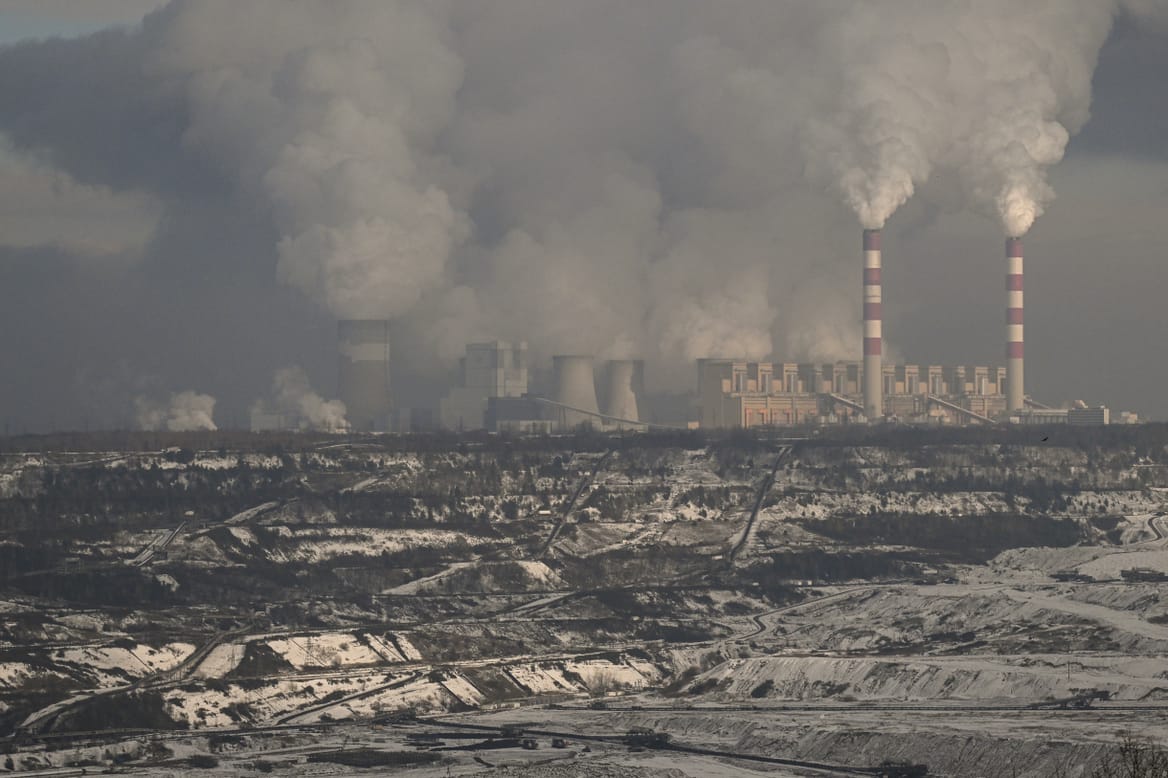
The 5,298-megawatt Belchatow power plant in central Poland is the biggest coal-fired power plant in Europe. Poland has some of the dirtiest air in Europe, and its per capita greenhouse gas emissions are the fifth highest in the EU. (Omar Marques/Anadolu via Getty Images)
The deal that Drobniak helped broker set a deadline of 2049 for Poland’s final coal operations to shut down, years later than in many other EU nations. Not everyone supported the idea. Poland’s reliance on coal has rendered its air some of the dirtiest in Europe, shaving an average of nine months off its citizens’ lives. Its per capita greenhouse gas emissions are the fifth-highest in the EU, and Brussels has continued to pressure Poland to speed up its transition. Meanwhile, Warsaw is bristling at spending more money to keep the coal sector’s operations going for another 23 years.
Over coffee and cookies at Kadra’s modest offices on the outskirts of Katowice, in the shadow of idle smokestacks from now-defunct coal-fired plants, Grzegorz Trefon, the union’s head of international affairs, recalled a famous speech Nikita Khrushchev gave at the Polish Embassy in 1956, in which the Soviet leader vowed to defeat the capitalist forces of the world through patient confidence that “history is on our side.”
“That’s what we want,” Trefon said. “We want to win by time.”
The reference to a reviled Russian ruler drew chuckles among his compatriots in the room. Dariusz Stankiewicz, the regional government’s lead specialist on the transition from coal, stepped in to clarify what Trefon meant.
“This shows that when we are facing this in a very slow manner, our economy can transform itself and produce new workplaces,” he said.
Between 2005 and 2022, Silesia lost 55,000 jobs in the mining sector, according to government data. But the region added 160,000 jobs in other sectors during that same 17-year time period.
“If we slow down the process, the economy can cope with this problem and produce new jobs,” Stankiewicz said. “This is why I support this very slow phasing-out process.”
In Bytom, poverty is entwined with pollution. Men looking older than their years, with sinewy muscles and tattoo-covered torsos, arrive shirtless at the grocer to buy cases of beer or vodka after finishing midday shifts at the mine. Across the street from the coking plant, women visibly solicit customers for sex from the stoops of Soviet-era apartment blocks. Drobniak warned me to be ready to run if anyone seemed to be eyeing my camera.
A roughly half-hour drive east, on the northeast side of Katowice, is a neighborhood with similar-looking buildings but a dramatically different vibe. The cobblestone streets and old brick buildings of the Nikiszowiec Historic Mining District hark back to an earlier era when this part of the region was powdered with coal dust and ash from active mines and industrial sites.
Flowers bloom in window boxes of prized apartments in the Nikiszowiec Historic Mining District in Katowice. The city has developed rapidly over the last two decades. (Alexander C. Kaufman/Canary Media)

Today, however, the district is spotless and filled with local tourists who come to see hockey games at its indoor rink, eat at upscale restaurants, and shop at its art galleries. A facility that once contained a major coal mine now serves as a hub for video game developers.
“This was not a place that people wanted to come to,” Drobniak said. “Now it’s hard to get a table at the restaurants here on a Friday night.”
Both Warsaw and Brussels have contributed to Katowice’s advancement over the past 20 years, as has celebrity academic Philip Zimbardo, the American social psychologist best known for the Stanford Prison Experiment, whose international work eventually led him to set up a nonprofit called the Heroic Imagination Project in the historic district in 2014. That organization worked to create employment opportunities for young people, and as conditions improved, the EU gave the city a grant of 200 million euros ($235 million) to help revamp industrial buildings for modern uses.
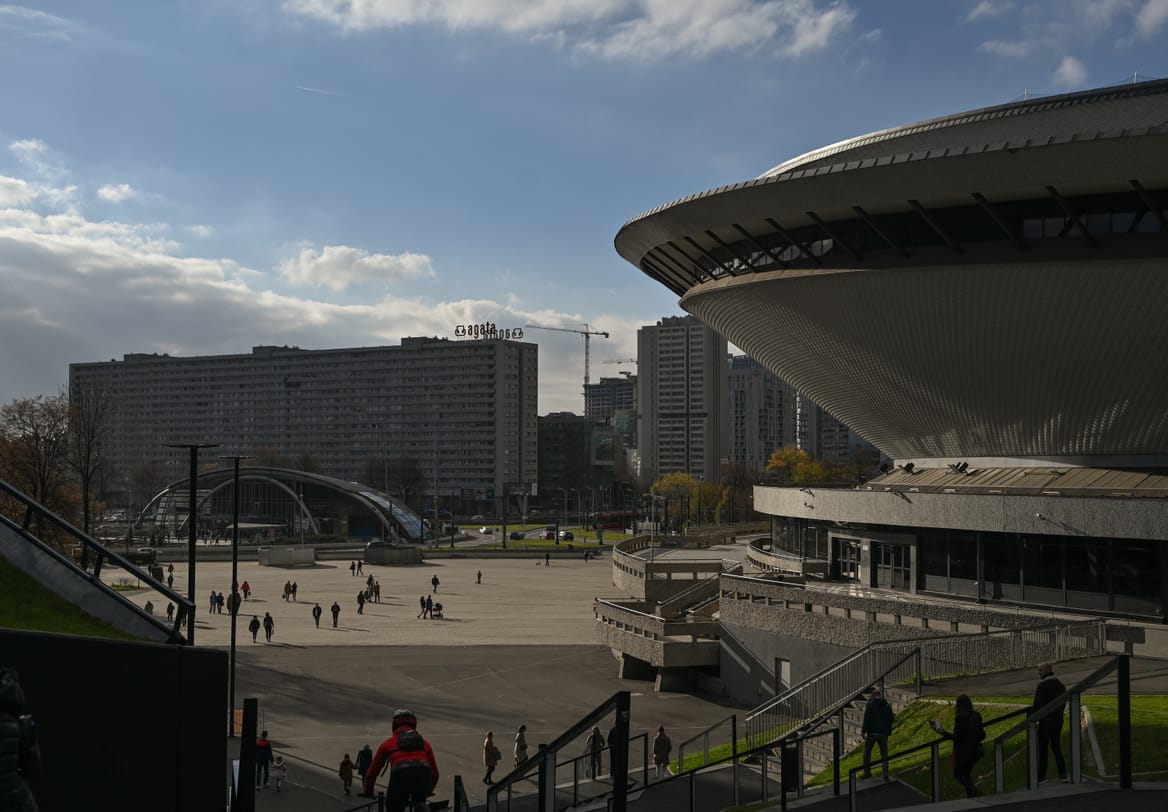
The starkest transformation, however, may be in the city center, where the newer industries that Silesia has attracted have flocked. While mining once accounted for more than half of the province’s gross domestic product, it now makes up a third, as factories producing automobiles, machinery, and electronics have popped up. Gleaming new office towers brandishing the logos of multinational consultancies rise between older brick buildings. Modern luxury condos with architecture one might expect in Miami or Tel Aviv but not Central Europe take up entire blocks of an otherwise quaint city. A grass-covered park swoops down to a vast, futuristic stadium built in the Soviet times. Once an area where coal was gouged from the ground, it is now a gathering space for entertainment and corporate events — part of why Katowice was recognized last year as Poland’s best city to live in.
The Spodek Arena in Katowice’s city center. Researchers recently proposed the idea of combining Katowice and the former coal-mining cities of central Silesia into one metropolis to help bridge the economic divide between them. (Artur Widak/Anadolu Agency via Getty Images)
But Katowice remains small compared with larger cities such as Warsaw and Krakow. To Drobniak, the future of Silesia should look something like Seoul or Tokyo.
A few years ago, researchers proposed the concept of the Metropolis GZM, short for Górnośląsko-Zagłębiowska Metropolia. Rather than a piecemeal approach to developing new industries in the patchwork of former coal-mining hubs that dot central Silesia, Metropolis GZM would unite the urban areas into one, interconnected with railways, bike paths, and corridors of tall buildings.
“In the entire surrounding area, we have about 2.5 million people,” Drobniak said. “We would be the biggest city in Poland.”
Merging would help solve one of the trickier elements of the transition. Bringing the entire region under one municipal planning organization would, in theory, help find ways to bridge the divide between thriving cities like Katowice and declining hinterlands like Bytom.
“People are afraid that they’ll lose their identities because they are connected by generations not with Katowice but with other cities like Bytom,” Drobniak said. “We’d like to put the discussion on a different level and say, ‘There is no Katowice. It will be something new.’ We don’t know what will be the name of this urban structure. But this is a must. We must do this. If not, we will be fragmented and separated, and the metro areas of Krakow and Wroclaw will attract young people from us.”
The Silesian Museum sits at the site of a former coal mine in the center of Katowice, whose rusting equipment remains as a symbol of the past. (Alexander C. Kaufman/Canary Media)

The critical thing, Drobniak said, is to revive the economy rather than push residents to leave, keeping the youths and workers who draw new industries and stemming the decline of Bytom and other cities.
In former American coal-mining hubs in Appalachia, such as West Virginia, generations of families remain entrenched despite the downward trajectory of the industry and the dangers of a polluted environment. But those roots are shallow compared with Poland’s, said Trefon. Miners in Silesia can trace their families in local history nearly twice as far back as 1777, when the U.S. was founded.
“My family lives here. There are churches with my relatives’ names going back 400 years,” he said. “That’s why we have so much connection to this land. It’s not possible to find another place to remake the mining industry. But we need to find a sustainable way for the development of new economic activity that will stay here.”