The average price of electricity for the whole year in 2025 stood at €80.39 per megawatt-hour, compared with €40.49 per megawatt-hour in Finland.
In Estonia, the average price was a slight fall, €6.86 per megawatt-hour, on that seen in 2024.
According to Electricitymaps data, Estonia imported 46 percent of the electricity it consumed, or 4.69 terawatt-hours, from Finland in 2025, up from 36 percent in 2024.
This was despite a fault taking the Estlink 2 cable, which links the two countries, offline at the end of January 2025, until midsummer.
Other challenges included February 2025’s desynchronization from the Russia and Belarusian grid (BRELL) and synchronization with the Continental European frequency area.
While Estonia is still a net importer of electricity, due to the interconnections with neighboring states it also exports, primarily to Latvia. Estonia’s southern neighbor received 14 percent of the total generated in 2025, or 1.45 terawatt-hours.
Tiit Hõbejõgi, acting head of energy trading at Enefit, a subsidiary of the state-owned Eesti Energia, said the restriction on the electricity connection between Estonia and Latvia is stopping prices in Estonia being any higher.
“As a result, cheaper Nordic electricity remains in Estonia to a greater extent and keeps prices here somewhat lower than in the rest of the Baltics,” Hõbejõgi said.
Kalev Kallemets, chairman of the management board at Fermi Energia, also cited on social media the restriction of Estonia–Latvia transmission capacity by 525 megawatts for frequency control, as well as the mild winter up to the end of 2025, as factors in pricing.
Eesti Energia CEO: Estonia buys electricity at a high price and sells it cheaply
In a recent interview with Delfi, Eesti Energia CEO Andrus Durejko said that the problem with Estonia’s energy business model concerns expensive electricity imports and cheap exports.
 Andrus Durejko. Source: Arp Müller/ERR
Durejko said in 2025, Estonia exported 98,000 megawatt-hours at €29.6 per megawatt-hour, while importing 43 percent of its energy at €90 per megawatt-hour. This results in buying at a high price and selling at a low price, creating an unprofitable situation for the energy sector.
In contrast, Latvia exports hydropower when prices are high and imports when they’re low, resulting in a much more positive balance sheet. Currently, Estonia has no way to lower the average electricity price, as both oil shale and gas are expensive, according to Durejko.
Consumption in 2025 affected by mild winter
Estonia’s electricity consumption last year amounted to 7.9 terawatt-hours, roughly on par with 2024, according to data from grid operator Elering.
Hõbejõgi said that while warmer winter temperatures reduced consumption, the overall growth in electrification, such as the shift to electric transport, offset this decrease.
“In Enefit’s electric vehicle charging network alone, charging volumes increased more than twofold,” he noted.
Finland has nuclear power, in Estonia oil shale and wind power almost neck-and-neck
In Finland, 37 percent of consumption comes from nuclear energy and the country has two operating nuclear power stations, something Estonia currently lacks.
While the share of electricity generated by oil shale in Estonia is far lower than in the past, it is still the largest single source, having 14 percent of the share to 1.4 terawatt-hours over the year. This was a 3 percentage point fall on 2024’s figure for oil shale, however.
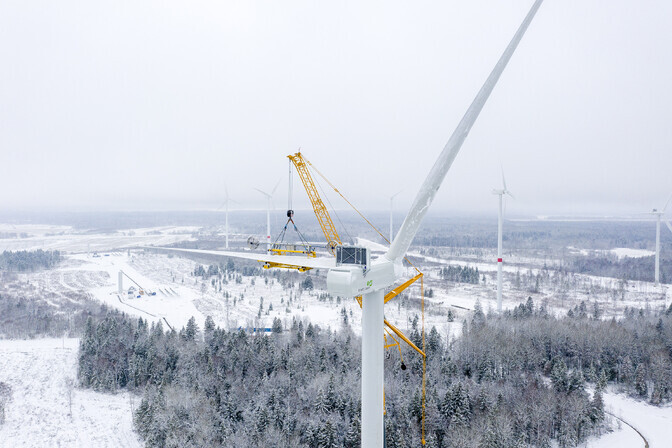 An under-construction wind turbine in Estonia. When the wind is low is when more electricity gets imported from Finland. Source: Eesti Energia
The oil shale sector was only just ahead of wind power in Estonia, which accounted for 13 percent of consumption, while generation from solar energy at 11 percent (1.1 terawatt-hours) was also significant.
Both gas and biomass made up 5 percent of consumption, or 0.5 terawatt-hours each. Much of the remainder is imported.
Month-by-month data on the economics of electricity in Estonia
In January, electricity in Estonia averaged 9.2 cents per kilowatt-hour, influenced by low wind energy, the Estlink 2 outage, and cold weather.
In February, prices jumped 65 percent to 15.2 cents per kilowatt-hour, nearly double February 2024, due to high fossil fuel use, low wind production, transmission limits, and cold weather, marking the desynchronization from Russia and synchronization with the Continental European grid.
Then in March, prices dropped 41 percent to 9.02 cents per kilowatt-hour, due to higher wind, lower heating demand, and solar energy, but were still 32 percent higher than March 2024, due to transmission limits and reduced Latvian hydropower.
In April, prices fell 19 percent to 7.33 cents per kilowatt-hour, thanks to lower heating demand and high solar and wind production. However, prices were nearly 20 percent higher than April 2024, due to Latvia’s low hydropower production and rising fossil fuel use linked to higher gas prices.
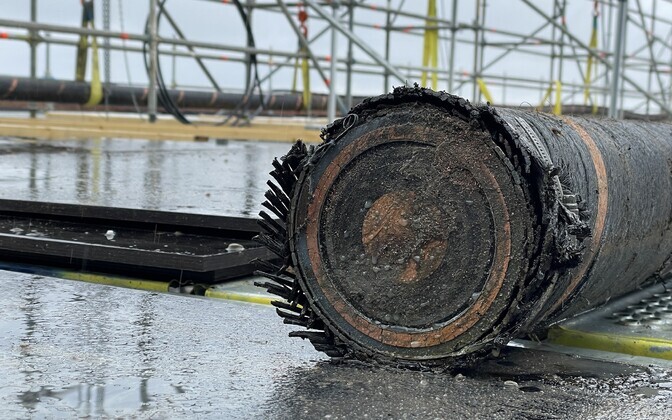 Estlink 2 was offline for the first half of 2025. When it came back into service, prices fell, and imports rose. Source: Dmitri Fedotkin/ERR
For May, prices averaged 6.8 cents per kilowatt-hour, down 8 percent from April, as natural gas prices dropped and renewable energy increased in Lithuania and Estonia, while Latvia generated more hydropower.
The next month, June, saw prices drop 39 percent to 4.1 cents per kilowatt-hour, the fourth straight month of decline, driven by increased wind and hydropower production. However, there were large price fluctuations, ranging from -0.5 to 8.7 cents per kilowatt-hour, eased by the return of Estlink 2 on June 19.
In July, prices fell 11 percent to 3.7 cents per kilowatt-hour, nearly 63 percent lower than July 2024, thanks to strong solar, above-average Latvian hydropower, and Estlink 2’s return. In August, reduced solar, nuclear plant maintenance, and lower hydropower output raised prices to 7.7 cents per kilowatt-hour.
The following month, prices rose to 8.1 cents per kilowatt-hour, nearly 5 percent higher than August, due to lower solar production, the extended outage of Estlink 1, and reduced Latvian hydropower.
October brought an 11 percent price rise to 8.98 cents per kilowatt-hour, due to reduced solar, higher heating demand, lower wind energy, and limited imports from Latvia.
In November, colder weather pushed prices to 9.6 cents per kilowatt-hour, 7 percent higher than October and nearly 16 percent higher than November 2024, due to lower wind production and increased reliance on fossil fuel generation.
For the last month of the year, December, electricity cost an average of 7.4 cents per kilowatt-hour.
Overall, Estonia is clearly a net importer of electricity, although the target for 2035 is to balance electricity exports and imports.
A new link is being planned between Estonia and Latvia, while completion of the submarine Estlink 3 connection with Finland will not come until the next decade.
—