Governments really dislike competition. And they dislike moral limits even more.
Just War Theory exists because states, left to their own devices, will always find reasons to justify force. The theory does not ask whether a target is good or evil. It asks whether the use of violence itself is morally licit. That distinction is fatal to the United States action against Nicolás Maduro.
Maduro is no saint. He governs an authoritarian regime accused by international observers of corruption, repression, and criminal activity. None of that is disputed here. Just War Theory does not require moral sympathy for the accused. It entails restraint by the accuser.
Orthodox. Faithful. Free.
Sign up to get Crisis articles delivered to your inbox daily
By the classical standards articulated by St. Augustine of Hippo and systematized by St. Thomas Aquinas, the United States action fails.
Not marginally. Categorically.
This is not a close call. It is a total collapse of moral reasoning so complete that the only way to defend it is to deny that Just War Theory applies at all.
The Category Error
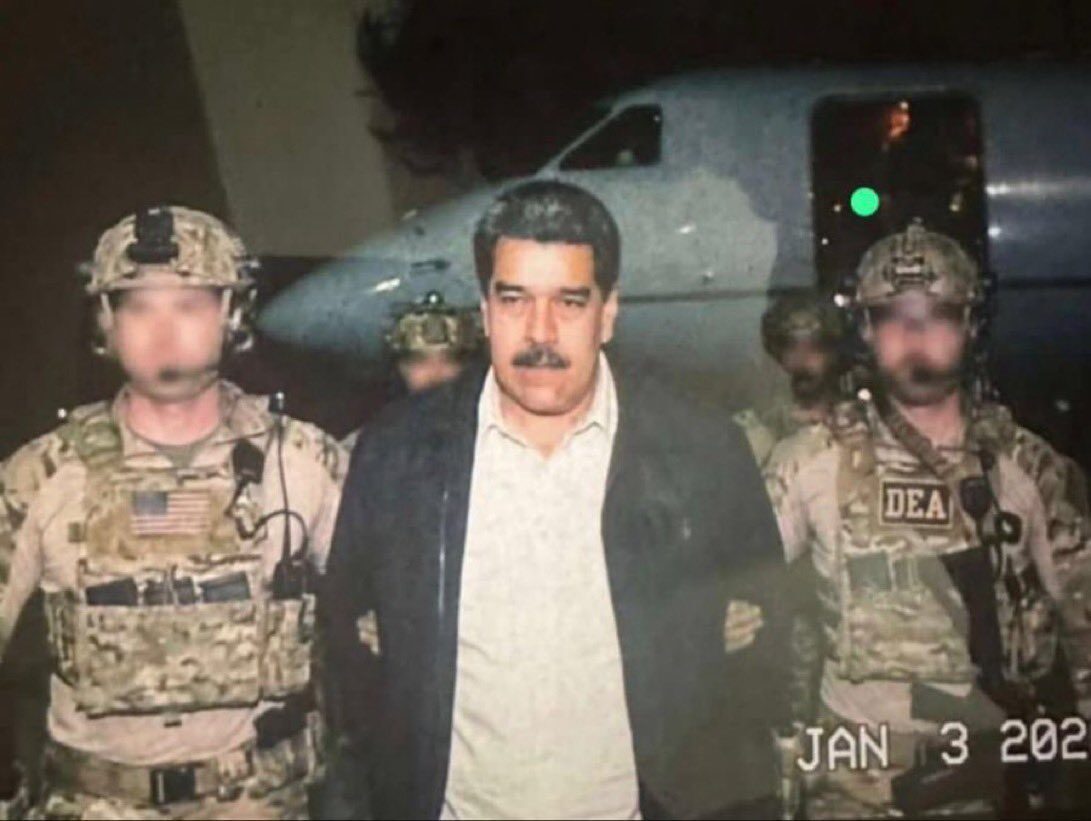
The United States treated criminal accusation as a warrant for war.
This is the foundational error from which every other contradiction flows. Just War Theory exists precisely to prevent this move. War is permitted only to repel aggression or to defend innocent life. It is never permitted as a tool of international policing. Indictments are not just causes. Arrests are not military objectives. Law enforcement does not become moral simply because it is carried out by a superpower.
The state insists that this was not war but law enforcement. Yet if the act has the scale, means, and consequences of war, calling it something else does not change its moral object. Classical Just War thought does not allow semantic laundering. If force is used in a manner functionally indistinguishable from war, it is morally judged as war.
Once this distinction collapses, no foreign leader is safe, and no limit on violence remains principled. The moral fire wall between order and chaos is gone. Dmitry Medvedev, a key Kremlin figure, has already threatened to capture Ukrainian President Volodymyr Zelenskyy, repeating Moscow’s assertion that his legitimacy is disputed under wartime conditions and citing Maduro as precedent.
Classical Just War doctrine requires public declaration not as a procedural technicality but as a moral discipline. War is a grave act that must be acknowledged as such. Sneaking it through the back door under euphemisms is itself evidence of moral disorder.
If the action was just, it should have been declared as such. If it could not be declared, that alone signals awareness of its injustice.
Calling war “law enforcement” is not prudence. It is clever evasion. Calling a preborn human being a “fetus” does not change the nature of the object.
The Fentanyl Narrative Collapse
The public justification for U.S. action shifted rapidly.
Initial messaging framed the operation as necessary to combat deadly fentanyl flows. This claim does not survive contact with publicly available data. U.S. law enforcement agencies consistently identify Mexico, China, and precursor chemical supply chains as the dominant sources of fentanyl entering the United States. Venezuela does not rank among the primary exporters. Not remotely. Several European countries, including Belgium, Germany, and the Netherlands, rank higher.
This discrepancy became unmistakable when J.D. Vance publicly pivoted the justification, stating that fentanyl “is not the only drug in the world” and suggesting a broader narcotics rationale.
This was not clarification. It was an admission that the original casus belli was inadequate.
Just War Theory requires a clear, grave, and imminent threat. Narrative drift (more accurately, narrative collapse) is evidence that such a threat was never established. Borrowing the language of emergency after the fact does not create moral legitimacy.
The administration has gestured toward self-defense language, borrowing concepts from international law that mirror Just War reasoning. This only deepens the problem.
Self-defense presupposes an armed attack or an imminent threat of one. No such attack occurred. No such threat was demonstrated. Conflating long-standing criminal allegations with immediate danger is not a mistake. It is a deliberate expansion of moral license. If this qualifies as self-defense, then every nation is permanently at war with every other nation.
Legitimate Authority and Jurisdictional Overreach
The United States asserts domestic criminal jurisdiction over a sitting foreign head of state. This is not international adjudication. It is not extradition. It is not multilateral authorization through treaty or tribunal. It is unilateral extraterritorial enforcement backed by force.
Even if an indictment exists, and indictments are allegations rather than convictions, Just War Theory does not recognize domestic courts as competent authorities for initiating violence against sovereign states. Aquinas is explicit that legitimate authority must be public, ordered toward peace, and constrained by justice. Jurisdictional overreach corrodes all three.
The arraignment itself reveals the moral sleight of hand. A man seized through overwhelming force is then placed before a judge as if the preceding violence were irrelevant. Due process is invoked only after the act that obliterated it.
This is not rule of law. It is the aesthetic of law applied after power has already spoken. If kidnapping followed by courtroom ritual counts as justice, then justice is nothing more than the victor’s paperwork.
Statements by U.S. officials complicate any claim of right intention. President Donald Trump publicly suggested that the United States would effectively run Venezuela until a safe and proper transition could be arranged. In response, Venezuela’s Vice President Delcy Rodríguez was sworn in as interim president by the Venezuelan Supreme Court and immediately demanded Maduro’s release.
This sequence matters. Just War Theory forbids ulterior motives. When force becomes entangled with regime transition language, nation management ambitions, or political restructuring, moral legitimacy collapses even if the initial grievance were just.
This sequence matters. Just War Theory forbids ulterior motives.Tweet This
Simultaneous discussions of reopening the U.S. embassy and restarting oil operations only sharpen the contradiction. The incentives are not hidden.
Celebratory rhetoric reinforced the perception of corrupted intention. Public reactions by Lindsey Graham, who praised the operation in media appearances, conveyed triumph rather than restraint.
Moral seriousness is incompatible with gloating over coercive force.
Graham’s on-air enthusiasm, capped by the “Make Iran Great Again” spectacle, revealed something deeper than poor taste. It revealed appetite. Once condemned as a warmongering hawk, the unmarried senator now appears fully embedded within a political culture that treats escalation as entertainment. When killing becomes content, justice has already died.
There is no evidence that peaceful alternatives were exhausted.
There was no multilateral extradition process. No international tribunal referral. No sustained regional mediation effort. Force appears to have been selected not as a final option but as an efficient one. Efficiency is a virtue in business. It is not a moral category in Just War Theory. When force is chosen because it is easier, justice is already abandoned.
The United States has acknowledged the use of more than 150 aircraft, whose bombing of targets in Caracas and elsewhere functioned as a distraction for the extraction operation. Venezuelan security personnel were killed, among others.
This alone establishes that the operation had battlefield characteristics. Any military operation undertaken to seize a foreign head of state necessarily risks civilian harm, destabilization, and escalation. Just War Theory prohibits exposing innocent life to lethal risk for the sake of law enforcement objectives. Even limited force becomes disproportionate when the end sought is arrest rather than defense.
The language of “surgical” action collapses under the weight of scale. Precision does not absolve injustice.
Oil, Incentive, and the Disguised Motive
Any claim that this action was disconnected from energy interests strains credulity.
Venezuela possesses an estimated $17 trillion in proven oil reserves, the largest on earth. These reserves are not abstract. They are concentrated primarily in the Orinoco Belt and consist of dense, sulfur-rich, extra-heavy crude. This is not the light, sweet crude favored by every refinery. It is precisely the kind of viscous, complex crude for which U.S. Gulf Coast refineries were built or retrofitted over decades, particularly those clustered around Houston and the broader Texas coast.
These refineries invested billions to process heavy, sour crudes that other regions cannot easily handle. When supplied with the right feedstock, they yield high-value products such as diesel and jet fuel, despite the complexity and environmental cost of processing. Venezuelan crude is not a mismatch for U.S. infrastructure. It is a near-perfect fit.
And this is no secret. U.S. energy firms have lobbied openly for renewed access to Venezuelan oil. Political figures have spoken candidly about reopening production, restarting partnerships, and reintegrating Venezuelan supply into U.S.-aligned markets. President Trump himself has promised that American companies would return.
Just War Theory treats motive with brutal seriousness. Even a just cause is corrupted by mixed intention. When the use of force coincides with explicit commercial incentives, strategic resource alignment, and long-standing industrial appetite, claims of moral purity collapse.
War is never permitted to secure resources. Not overtly. Not covertly. Not under the euphemism of law enforcement.
The presence of enormous oil reserves does not prove intent. But it makes disinterested intent implausible. If force conveniently advances strategic energy interests, then it is not accidental. It is instrumental. And instrumental violence is precisely what the tradition forbids.
The decisive issue was not drugs. It was not human rights. It wasn’t even seizing oil resources directly. It was monetary defiance.
Under Nicolás Maduro, Venezuela increasingly sold its oil outside the petrodollar system. Caracas accepted payment in Chinese yuan and other non-USD currencies and, in some cases, experimented with digital settlement mechanisms. This was not incidental behavior under sanctions. It was strategic noncompliance with the monetary architecture that underwrites American power.
A superpower carrying roughly $38 trillion in national debt and running persistent trade deficits cannot tolerate major oil exporters refusing to recycle oil revenues into U.S. dollar demand. The petrodollar system is not merely a legacy arrangement. It is the quiet engine that sustains dollar primacy, suppresses borrowing costs, and absorbs global demand for U.S. liabilities. When an oil-rich state defects, it threatens more than pricing conventions. It threatens monetary order.
The timing matters. Maduro’s defiance occurred amid visible stress in the dollar system itself. Gold at roughly $4,500 per ounce and silver near $80 per ounce signal fiat’s erosion. In such an environment, symbolic challenges become dangerous precedents. If Venezuela can sell oil outside the dollar, others can follow.
Seen in this light, the raid was not aberrational. It was corrective and a clear signal to the world. It was a violent reminder of who sets the rules and what happens when a resource-rich state opts out.
Needless to say, Just War Theory forbids war for commercial or monetary ends.
The Reciprocity Test
This is the simplest moral test, and the most devastating.
If Venezuela, Russia, Iran, or China seized a U.S. official abroad under their domestic criminal indictments, Americans would call it an act of war. They would be correct.
Suppose you’re one of the tens of millions of Americans who believe Joe Biden stole the 2020 election. Can you imagine a Chinese or Russian raid on Washington, the transport of the poor confused octogenarian to a foreign courtroom, and the subsequent leveling of charges of illegitimacy? Even if he’s a usurper, he’s our usurper, thank you very much. This is an American matter and Beijing has no jurisdiction here.
If an act would be war when done to us, it is war when we do it to others. Just War Theory exists precisely to enforce this symmetry. Any doctrine that depends on who holds power is not moral doctrine. It is imperial preference.
One of the most striking features of this episode is the reaction among segments of the MAGA movement.
A political coalition that rose to prominence opposing nation-building, foreign entanglements, and imperial policing now circulates maps depicting the Western Hemisphere draped in American flags. Greenland is sometimes included. President Trump has promised further action throughout the region. This has largely been met with enthusiasm within his core base, especially baby boomers and Gen Xers. It is as if his followers forgot how “stupid” Trump described nation-building, standing center stage, scolding “low energy” Jeb and, by proxy, his feckless brother, for the misadventures of toppling dictators.
Yet America First rhetoric appears increasingly compatible with hemispheric dominance so long as the dominance is American. This is not restraint. It is managerial empire.
And it may even be worse. Several Catholic men in a large local group chat lamented that Maduro wasn’t forced to wear a “Make America Great Again” hat during the exposed caravan through New York City which served as his humiliation ritual. How degrading. How sad that so many are so quick to dispense with any semblance of decency when their side “wins.”
This moment did not arise in a vacuum.
The Monroe Doctrine, often portrayed as defensive, was historically deployed to suppress the political will of Latin American populations seeking reconnection with Catholic European powers. As Charles Coulombe documents in Puritan’s Empire, monarchist movements in Mexico, Peru, and elsewhere were substantial and popular. Europe even installed a Habsburg, Emperor Maximilian, in Mexico. The United States ensured his capture and public execution.
President Thomas Jefferson advised James Monroe on the doctrine and explicitly encouraged provoking war with Spain to seize Florida, while suggesting the opportunistic acquisition of Cuba if circumstances allowed. “Remember the Maine!” indeed.
The doctrine was never morally neutral. It treated the Western Hemisphere as subordinate rather than sovereign. It was also decidedly anti-Catholic in its conception and for much of its implementation.
Empire did not begin over the weekend. It merely found a new vocabulary.
Final Judgment
By classical Just War standards, the United States action fails every single Just War test.
There was no just cause. No legitimate authority. No right intention. No exhaustion of peaceful alternatives. No proportionality between means and ends. Civilian casualties were accepted for non-defensive objectives. Exploiting oil resources and protecting a failing money system were ulterior motives.
From top to bottom, this was unjust war masquerading as police work.
If Just War Theory means anything at all, then this was morally insane.
