I look around the comedor at the Kino Border Initiative where migrants receive humanitarian aid and holistic accompaniment in Nogales, Mexico, and I see people whose hopes were dashed on Jan. 20, 2025. That was the day that President Trump was inaugurated and signed an executive order effectively eliminating their access to asylum in the United States.
After the shock of the initial news, families had to figure out what other options were available that would provide them with safety and a livelihood. Within weeks, the number of people coming to eat with us decreased, and fewer people needed shelter as families moved on in search of finding another option. Some are settling in Nogales, Sonora, where they are applying for asylum in Mexico or waiting for the political winds to change.
One is a single mother who traveled from Ecuador with her young son, fleeing political persecution. The mother, who asked to remain anonymous, tells me, “We’ve come this far, and with all that has already happened to us … terrible things … we wait and pray and do what we can to survive.” As I listen to her or talk with other asylum seekers about their daily routines, or play Jenga with the children, I am surprised by what I feel: hope. It doesn’t make sense to me, but it’s real.
As the impact of drastic anti-immigrant policies on families continues to worsen, I sometimes wonder about celebrating a Jubilee Year of Hope now. Since the year started, our people have been victims of indiscriminate ICE raids. They need to make family plans for fear of being disappeared when they go for their court hearings and ICE check-ins, and the dehumanizing rhetoric in the media prompts them to ask, “Why do they hate us so much?”
The border is not a “happy place” to be these days, nor is any migrant community in the U.S. Our reality is complex, and happiness is not the same as hope. While dealing with the impact of systemic cruelty, I am tempted to be consumed by anger or give in to despair.
Perhaps, then, this is the exact time and place to drill down to what hope really means for those of us called to encounter unjust policies and accompany those most impacted by them. This seems especially true for those of us who believe that our Catholic faith demands it. It helps to read Pope Francis’ papal bull Spes Non Confundit:
Everyone knows what it is to hope. In the heart of each person, hope dwells as the desire and expectation of good things to come, despite our not knowing what the future may bring. Even so, uncertainty about the future may at times give rise to conflicting feelings, ranging from confident trust to apprehensiveness, from serenity to anxiety, from firm conviction to hesitation and doubt. Often we come across people who are discouraged, pessimistic and cynical about the future, as if nothing could possibly bring them happiness.
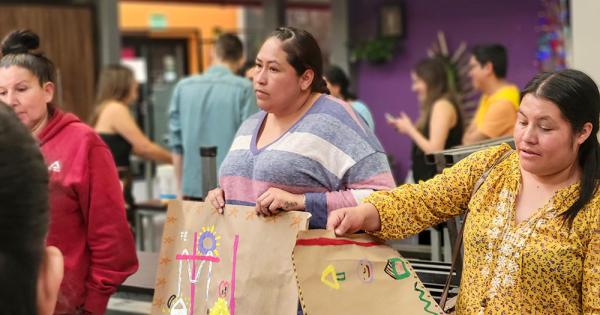
Surprisingly, here at Kino, I don’t come across many people who are pessimistic or cynical, especially people who have been displaced. They are discouraged, yes, but hopeless, no. I see women supporting each other in our Proyecto de Vida workshop, where while embroidering handbags and blouses, they share news they’ve heard from loved ones far away, as well as their anxieties for tomorrow. All the while their children are playing nearby, unaware of the precarious situations their mothers worry about. They hope for the day when they can continue their journey.
I reflect on the celebrations we’ve had over the past few months: Mother’s Day, Father’s Day, Dia de los Niños, graduations … family celebrations, really. My experience is that when we are separated from our families, our sense of family expands. We begin to see each other as our brothers and sisters, our mothers and fathers, our children. Celebrating each other here, in these circumstances, gives me hope. Spes Non Confundit continues:
Signs of hope should also be present for migrants who leave their homelands behind in search of a better life for themselves and for their families. Their expectations must not be frustrated by prejudice and rejection. A spirit of welcome, which embraces everyone with respect for his or her dignity, should be accompanied by a sense of responsibility, lest anyone be denied the right to a dignified existence. Exiles, displaced persons and refugees, whom international tensions force to emigrate in order to avoid war, violence and discrimination, ought to be guaranteed security and access to employment and education, the means they need to find their place in a new social context.
At Kino, we’re trying to do some of this. Over the past few years religious sisters from various congregations have come to Kino as part of the Catholic Sisters Walking With Migrants program. They give me hope, too, as they return from their experience at the border to accompany and advocate in their own communities.
I think of Adorers of the Blood of Christ Srs. Dani Brought and Anita Fearday, who after their month at Kino, participated in a five-day “Hometown Immersion” experience with immigrants in St. Joseph, Missouri. This innovative program exposed participants to best practices of integrating newcomers into Midwestern towns and communities. And Dominican Sr. Cecilia Canales, who, after serving as prioress for the Dominican Sisters of Mission San Jose and vicar for religious for the Los Angeles Archdiocese, is now accompanying and advocating for migrants in Southern California.
I think of Providence Sr. Tracey Horan, who started the Catholic Sisters Walking With Migrants program here at Kino. She continues daily in advocacy efforts that decry the lack of accountability for migrants who have been neglected and abused in a system that increasingly criminalizes them and disregards their human rights.
One thing that these sisters have pointed out to me is the powerful witness of faith and hope shown to them by the people in migration they know. As such, it makes sense to me that we recognized them as missionaries of hope in the Jubilee Year that just closed. Pope Leo XIV notes in his message for the World Day of Migrants and Refugees that they are “privileged witnesses of hope. Indeed, they demonstrate this daily through their resilience and trust in God as they face adversity while seeking a future in which they glimpse that integral human development and happiness are possible.”
My prayer is that these missionaries are welcomed into our communities with open arms and that we learn from them, that we grow in our capacity to receive the God-given richness they have to offer, like we did when we celebrated Friends Across Borders in Southern Arizona and Sonora, and when our church celebrated a binational encounter in October. We showed up in a powerful display of solidarity: bishops, pilgrims and community members from Mexico and the United States reaffirming their commitment to standing with migrant communities. Bishops representing 12 dioceses signed a joint declaration affirming that “in the Church, no one is a stranger” and emphasizing that the hope we receive through Christ transcends “every border, every barrier, and every source of division.”
Sometimes it’s hard-to-find hope, but like God, it’s there. Maybe this has been the perfect year for a Jubilee celebration, especially one that calls me to look around with the eyes of faith.
(To learn more about the Catholic Sisters Walking with Migrants program, contact Sr. Eileen McKenzie at 520-867-5438 or [email protected].)