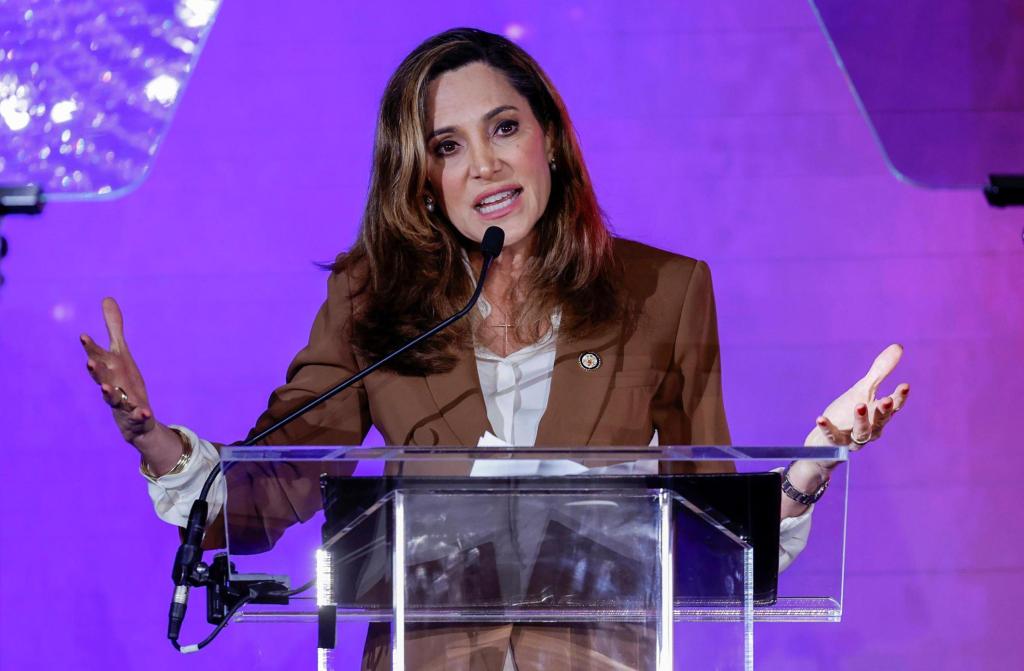
Congresswoman Maria Elvira Salazar is attempting to sell her Dignity Act through the oxymoronic tagline, “dignity, not citizenship,” a proposal that serves for her to speak out of both sides of her mouth.
In a video uploaded to social media, Salazar goes over the legislation after superimposing Trump’s voice over one of his erratic tweets using artificial intelligence, detailing how the farm lobby is frustrated that their workers are being deported. Salazar wants to grant more than 10 million immigrant workers living in the U.S. work permits if they pay $7,000 in fines plus 1% of their wages each year to the U.S. Treasury. Her bill would offer no path to citizenship, and no right to vote, ever.
Speaking to a TV audience, right-wing economist Milton Friedman said that “illegal immigration is beneficial to the United States so long as it remains illegal.” Friedman argued that the labor power of these workers could be exploited for economic benefit while they pay into benefits like Social Security, without ever receiving a dime in return.
Friedman saw as ideal a perpetual underclass of non-citizens who can be exploited without offering them a path to actual dignity; who would never have a chance to earn citizenship and the representation, benefits, and sense of belonging that come with living in an equal society. It’s not hard to see Salazar drawing inspiration from Friedman for her dystopian vision for “fixing” immigration, which is why the status quo, since the 1986 Reagan-era Amnesty bill that legalized six million people, has been to punt the political football of comprehensive immigration reform. It’s too difficult an issue for Congress, and business interests make money exploiting these workers.
The modern Republican Party is not Friedman’s or Reagan’s. Paradoxically, the same workers who are exploited for their labor while paying into benefits for other Americans and getting nothing in return themselves are demonized and subject to an increasingly hostile enforcement regime. Salazar’s Dignity Act is ignored by not just the Trump Administration but also by Congressional leaders. It has no counterpart in the Senate, and House Leadership refuses to give the bill a hearing, since it’s unpopular with the MAGA base.
If there is one constituency that loves Salazar’s bill, it’s big business interests. The congresswoman touts on social media posts and interviews that lobby groups like the National Association of Home Builders back her so-called Dignity Act. But Salazar seems out of touch with the base of the GOP, who, along with populist elements of the Democratic Party like Sen. Bernie Sanders, have come out strongly against H1B visas, noting that the program incentivizes low wages and exploitation, as termination from employment means deportation, a dynamic discouraging workers from speaking out when mistreated.
 Thomas Kennedy is a writer, advocate and elected Democratic National Committee member living in Miami.
The Dignity Act would create similar dynamics under different contexts. As we have seen with other programs granting precarious protections, like Temporary Protected Status, another mercurial president could attempt to attack the program via executive action, or more dangerously, Congress could revoke it, leaving millions exposed to deportation. If you don’t think that can happen, I invite you to read about the millions of people currently being undocumented by the Trump administration, and we could soon see more than half a million DACA recipients lose status.
The Dignity Act is a further effort to sanitize Salazar’s reputation while not delivering anything substantial on immigration, as this bill will never be approved in Congress, and in fact, it won’t even get a hearing. It serves as a public relations tool.
It’s not a bad thing if this bill never becomes law. It would enshrine into law a caste system on behalf of big business, in which the hardest-working yet vulnerable in our society are forced to pay fees and a portion of their wages to a government that won’t accept them as citizens. The slogan of the American Revolution was “no taxation without representation.” To sell this to the public as “dignity, not citizenship” is not just absurd; it’s immoral.
Thomas Kennedy is a writer and immigration advocate from Argentina who now resides in Miami.