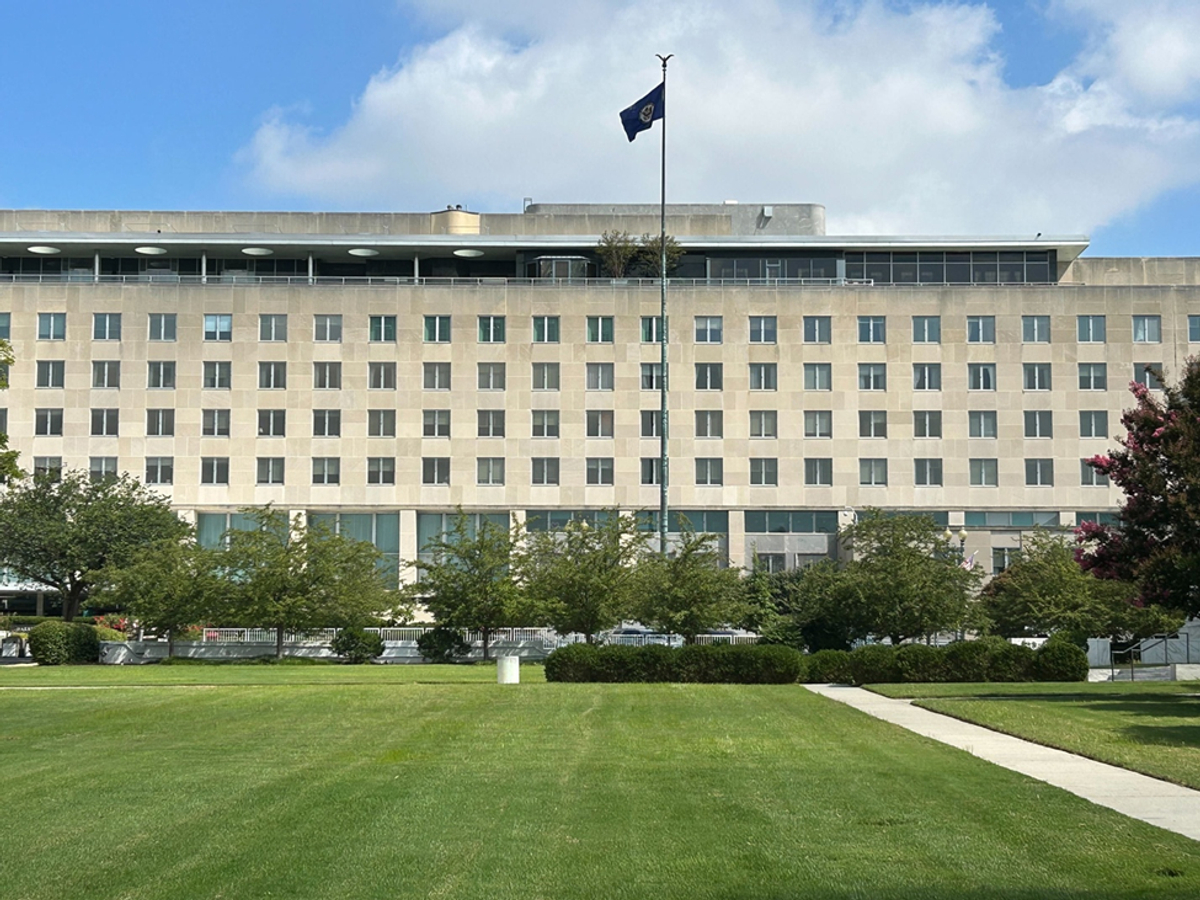
If the European Union was hoping for a softer touch from Washington as the Trump administration enters its second year, a senior State Department official just threw a bucket of cold water on the Berlaymont.
The administration doubled down on its scorched-earth critique of Europe’s economic policies Monday, with the official framing Brussels’ regulatory approach as a literal threat to the continent’s survival.
Follow our coverage of the war on the @Kyivpost_official.
Jacob Helberg, under secretary of state for economic affairs, told reporters at the Brussels Hub that Washington now regards Europe’s sluggish growth and stringent regulations as a “crisis” that risks leaving the continent an also-ran in the AI century.
His comments follow the December release of the US National Security Strategy, which sent shockwaves through European capitals for its warnings of “civilizational erasure” and references to “elite-driven” restrictions on liberties.
“I know that the national security strategy… drew a lot of attention in Europe,” Helberg said, addressing the elephant in the room. “What I’d like to highlight is that that language is a warning. It’s not an insult. There is a growing sense of concern and alarm in the United States about Europe’s relative economic decline.”
A “growing economic divergence”
Helberg pointed to a widening chasm between the two sides of the Atlantic.
Other Topics of Interest
After the US Attack in Venezuela: Will Greenland be Next?
Denmark’s Prime Minister Mette Frederiksen has warned that if the US were to launch a military attack on Greenland, it would mean the end of NATO.
While the US economy capped off 2025 with a robust 4.3% growth rate in December, major European players like Germany have stagnated.
“There is a degree of alarm in Washington about the need for serious reforms in order to jolt the European economy back to life,” Helberg said. “We think it’s possible with the right reforms.”
The under secretary specifically targeted the EU’s regulatory burden, suggesting that Brussels’ current “simplification effort” is a “historic opportunity” to stop the bleeding before the gap becomes permanent.
The “one law to rule them all’
The sharpest barbs were reserved for the EU’s landmark AI Act. Helberg argued that the US favors a sector-based approach, rather than the EU’s “law to rule them all” model.
“We believe that regulating the technology as a whole… will ultimately lead to massive overregulation,” Helberg warned.
He argued such rules effectively act as a protectionist shield for incumbents while suffocating the startups Europe desperately needs to compete.
“Europe has the talent… the universities… the financial institutions,” Helberg said, adding: “The difference is energy is very expensive in Europe, and the regulations are far too onerous. For Europe’s own good, we believe the EU should work on an AI opportunity agenda.”
Pax Silica: new architecture
The briefing served as a victory lap for Pax Silica, the US-led economic security pact signed last month.
The pact – which notably includes the UK and the Netherlands but bypasses the EU as a bloc – aims to lock down the “full-stack” of AI, from minerals to chips.
“This is the first time countries are organizing around compute, silicon, and energy,” Helberg said.
He noted that the explosion in AI is creating record demand for infrastructure that Europe risks missing due to “regulatory bottlenecks.”
Helberg singled out the Netherlands – home to semiconductor giant ASML – as a strategic pivot point.
He expressed hope that Pax Silica would serve as a “springboard” for discussions with other “smart” partners, like Greece, rather than waiting for a consensus from Brussels that may never come.
Strategic alignment vs. “adversarial” reliance
Addressing European calls for “strategic autonomy,” Helberg struck a transactional note.
He warned that if the continent wants to keep its 70-year security umbrella, its economic policies had better start reflecting the same reality.”
“We want to make sure that security architecture is not untethered from our shared economic security posture,” he said.
While he noted the US is “comfortable” with Europe pursuing diverse partnerships, he issued a pointed warning against relying on “powers that are outwardly adversarial” – a clear nod to Beijing and Moscow.
The message for 2026 is unmistakable: Washington is building the future of the “AI Century” with or without the EU.
For Brussels, the choice is to deregulate and join the “Pax Silica” or remain a high-regulated museum of the 20th century.