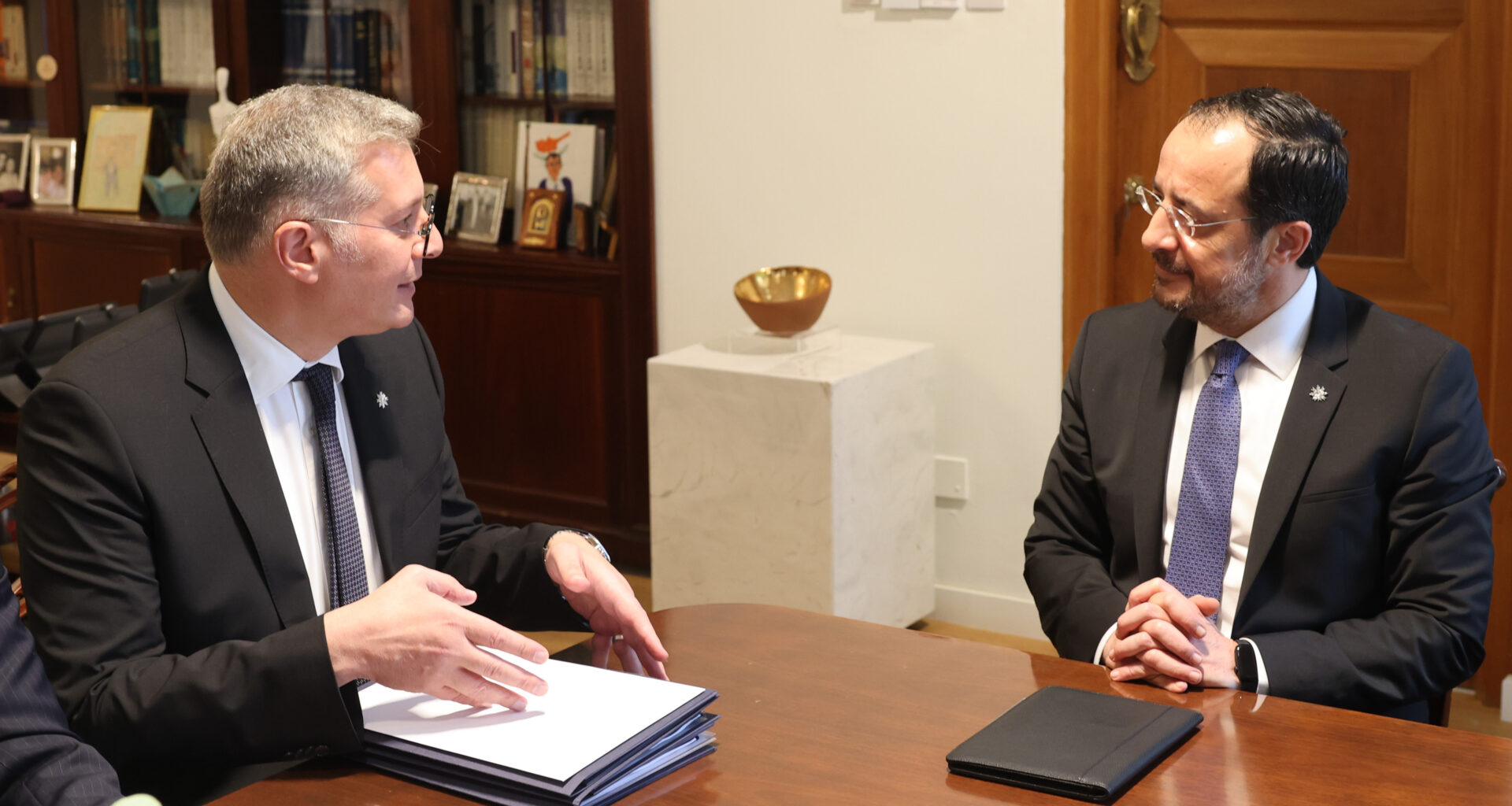
President Nikos Christodoulides on Wednesday promised to bring the European Union “closer to Egypt” during Cyprus’ six-month term as the holder of the Council of the EU’s rotating presidency.
“One of the key priorities of our presidency is to bring the EU closer to the region, closer to Egypt,” he told Egyptian Petroleum Minister Karim Badawi during a meeting at the presidential palace.
He added that Egypt is “a strategic partner of the EU and a pillar of stability in a region which has to face many challenges”.
In addition, he made reference to the issue of energy, saying that it is “a key issue” on his agenda, before adding that he will meet an executive from Italian energy company Eni on Thursday.
Regarding cooperation in the field of energy between the two countries, he said that “time is of the essence”.
“There must be coordination so that developments can take place as soon as possible.”
Cyprus and Egypt entered into a series of agreements regarding their energy sectors last year, with one such agreement seeing the Egyptian government designated as the “host government” for Block 6 of Cyprus’ EEZ, which contains the Kronos gas field.
Given the proximity of the Kronos field and Block 6 to Egypt’s Zohr gas field, which Eni also operates, Eni will be able to use its own infrastructure to take the Cypriot natural gas to the Segas liquefied natural gas (LNG) terminal in the Egyptian port city of Damietta.
On this matter, Badawi had said during his previous visit to Cyprus in September last year that his country plans to “accelerate the process to make it possible to transport Cypriot natural gas” to Egypt to be liquefied, and that he expects the gas to “be ready in 2027 for delivery to Europe”.
“We are all collectively committed to delivering the first Cypriot gas through Egypt’s terminals to Europe by 2027. We are all working together, with unity and cooperation, to achieve this,” he said.
He added that the Egyptian government considers the matter to be of “strategic importance”, and said the process of extraction of natural gas off the coast of Cyprus, liquefaction in Egypt, and subsequent export to Europe will “make Cyprus a major exporter of natural gas to Europe”.
He added that the matter is being “closely monitored” by Egyptian President Abdel Fattah al-Sisi.
Seabed surveys to find a sinking point for the pipeline which will take natural gas from Cyprus’ EEZ to Egypt for liquefaction began in June last year, with the initial aim being for natural gas from the Aphrodite gas field to be taken to Damietta.
That came after the governments of Cyprus and Egypt, as well as American multinational corporation Chevron, Israeli energy company NewMed Energy, and the BG Group, which is owned by Royal Dutch Shell, signed an agreement which, according to the Cypriot government, established “the framework for the effective commercialisation” of the gas in the field.