

RADM Golding with Japanese Ambassador to New Zealand Makoto Osawa. Image courtesy Japanese Government.
Line of Defence Magazine Editor-at-large Dr Peter Greener explains New Zealand’s deliberations over the ANZAC frigates replacement – and why two ships should not be an option.
When the Defence Capability Plan 2025 was released on 7 April this year, I subsequently noted that whilst any new DCP is a significant event, the Defence Capability Plan 2025 was more significant than most.
From a naval perspective a commitment was made in the DCP that the two ANZAC frigates would be replaced with contemporary frigates. It was recognised that the RNZN’s two Offshore Patrol Vessels would also need replaced and that consideration should be given to see whether “commonality of design or systems with the frigates may be possible.”
Since then matters have moved apace and this article will consider what vessels may be under consideration for the ANZACs replacement, and just how many hulls might be desirable.
With the release on 4 August 2023 of the Defence Policy and Strategy Statement 2023, New Zealand’s decades old dream that we were surrounded by the world’s largest moat was shattered. Speaking at the launch of the Statement, Defence Minister Andrew Little emphasised that we no longer lived in a benign strategic environment and that we would undoubtedly be required to spend more on defence.
Read it in the magazine…
Two days later, speaking to Jack Tame of TVNZ, when asked directly about the replacement of the frigates, the Minister said “We have two frigates at the moment…The question is, is what we’ve got enough to equip us for what the future might hold?”
Following the release of the DPSS, the RFI for the maritime fleet replacement, released on 7 September 2023, made clear that a significant level of overall capability was being sought. Among the requirements identified, naval combat capabilities were the first to be mentioned.
In response to this RFI, on 25 October 2023 Babcock was first out of the blocks when it confirmed that it would present its proven Arrowhead 140 platform (the basis for the Royal Navy’s Type 31 frigate) as the future solution for the RNZN, though little further information about the RFI response was made available publicly.
The Australian dimension
The next salient development was when the Australian Government released its Independent Analysis into Navy’s Surface Combatant Fleet on 20 February 2024. This review had been recommended by the Defence Strategic Review (DSR) which had been publicly released on 24 April 2023.
The DSR had recommended independent analysis into the composition of the Navy’s future surface fleet. Subsequently the Independent Analysis Team, led by US Navy Vice Admiral (Ret’d) William Hilarides, assisted by former Commander Australian Fleet Vice Admiral (Ret’d) Stuart Mayer, found that the RAN needed to grow and embrace a two-tiered structure. They recommended that the RAN acquire nine Tier 1 vessels and a fleet of 11 Tier 2 general purpose frigates – the replacement for the ANZACS.
“The imperative for interoperability with Australia took on some substance on 21 August 2025, when the purchase of five MH-60R Seahawk helicopters was announced by Defence Minister Judith Collins and Foreign Affairs Minister Winston Peters…”
On 08 July 2024, Australian Defence Magazine noted that Australia had selected five ship designs from an original list of twenty. Those designs were: Mitsubishi Heavy Industries’ Mogami-class, ThyssenKrupp Marine Systems’ MEKO A-200 (a child of the current ANZACS), Navantia’s Alfa 3000, Hanwha Ocean’s Daegu-class or the FFX Batch II, and Hyundai Heavy Industries’ Chungnam-class or FFX Batch III.
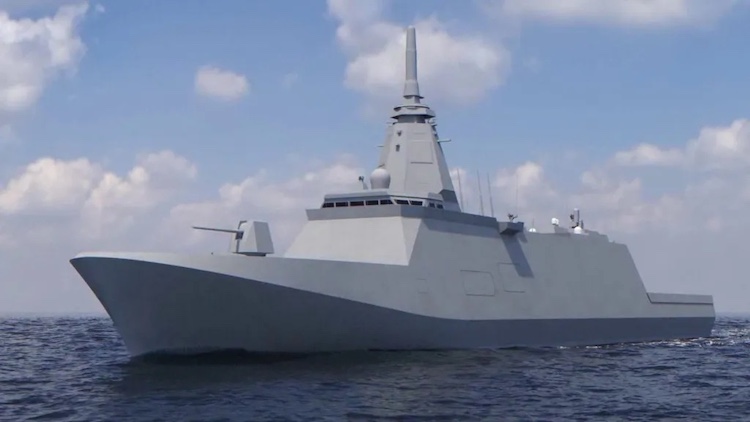
Mogami class frigate. Image courtesy Australian Government.
Conspicuously absent from this list was the Arrowhead 140. It was not to be long before the original shortlist had been culled.
On 8 November 2024, ABC News announced that multiple sources had confirmed that cabinet’s National Security Committee (NSC) had chosen Japan’s upgraded Mogami 30FFM and Germany’s MEKO A-200 as the final two designs ahead of a final selection the following year. An official government press release was made on 25 November 2024, highlighting that the first three frigates would be built offshore and the remaining eight would be built at Henderson in Western Australia.
The long awaited Defence Capability Plan 2025, released some four months later on 7 April 2025, made it very clear that New Zealand was to align itself much more closely with Australia. Former Royal New Zealand Navy Captain Andy Watts noted in the Winter 2025 issue of Line of Defence Magazine that the alliance with Australia, and the need for interoperability, was mentioned fully 33 times throughout the document.
Of particular significance were the following observations in the DCP:
What is the Australian approach, and is there any reason for New Zealand to take a different approach?
New Zealand and Australia have committed to prioritising combined defence procurement as an enabler of interoperability.
New Zealand will seek to procure the same assets and equipment as Australia where it makes sense to do so. This will help with interoperability.
The imperative for interoperability with Australia took on some substance on 21 August 2025, when the purchase of five MH-60R Seahawk helicopters was announced by Defence Minister Judith Collins and Foreign Affairs Minister Winston Peters, as the preferred option to replace the existing ageing maritime helicopters.
The total cost for the helicopter package is to be some $2 billion. Australia currently has some 23 Seahawks, with another 13 to be delivered in 2026.
The New Zealand frigate contenders
Whilst there was a great deal of publicity about the purchase of the new maritime helicopters – and two new Airbus A321XLRs for strategic airlift – there was no further news on deliberations with regards to New Zealand’s frigate replacements.
Some two weeks earlier, on 05 August 2025, the Australian Government had issued a press release which indicated that an upgraded Japanese Mogami-class frigate would be its ANZAC frigate replacement. With a range of up to 10,000 nautical miles, a 32 Cell Vertical Launch System, and fitted with surface-to-air missiles and anti-ship missiles, the upgraded Mogami-class frigate is a very well specified general-purpose frigate.
It wasn’t then to be long before there was news about New Zealand’s considerations. On 23 September, Babcock partnered with the New Zealand Defence Industry Association to showcase new opportunities for local businesses wishing to explore opportunities in the Defence and Maritime industries. Here again Babcock outlined potential opportunities to support the delivery of the Arrowhead 140, which it was continuing to propose as a future solution for the Royal New Zealand Navy (RNZN). This news though was soon to be eclipsed by news media reports from Japan.
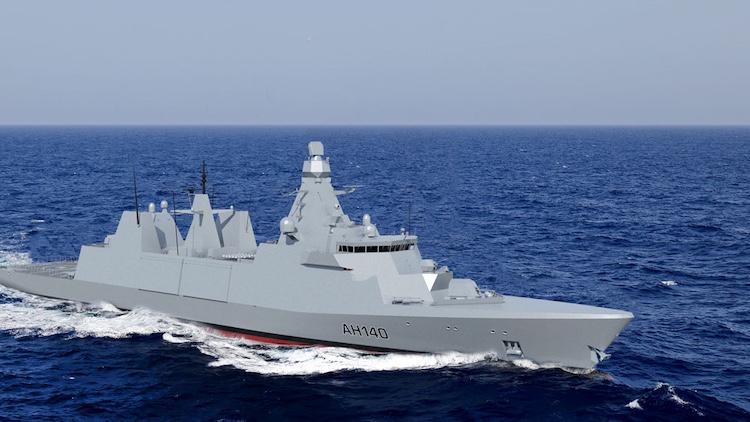
Arrowhead 140. Image courtesy Babcock.
Lost in translation?
On 20October 2025, two major Japanese news agencies each posted similar exciting stories. The release from Nikkei News said, “New Zealand Navy Commander Admiral Golding met with Defense Minister Gen Nakatani at the Ministry of Defense in Ichigaya, Tokyo. He conveyed his willingness to introduce Japanese destroyers. ‘We are proposing within the New Zealand government that they become a new naval asset,’ he said.”
Kyodo News reported that “On the 20th, Defense Minister Gen Nakatani met with Commander Golding of the New Zealand Navy at the Ministry of Defense. Golding conveyed the Navy’s intention to introduce an upgraded version of the Maritime Self-Defense Force’s state-of-the-art destroyer, the FFM (Mogami-class), into its navy.”
Some three days later on 23 October, Washington based The Defense Post carried a more restrained headline, New Zealand Mulls Japan’s Next-Gen Mogami Frigates as Pacific Pressures Grow. Whilst The Defence Post emphasised that there was no contract decision, nevertheless it suggested that “the meeting positioned the new FFM as the leading option for New Zealand’s next-generation frigate program.”
Just over a week later on 02 November Nikkei again posted a short article, Defense Minister Koizumi meets with New Zealand Defense Minister to discuss export of Mogami-class destroyer. The article indicated that the two Ministers had met in Kuala Lumpur, where Minister Collins had expressed an interest in the Mogami frigate and that there would be “future discussions toward the introduction of the vessels.”
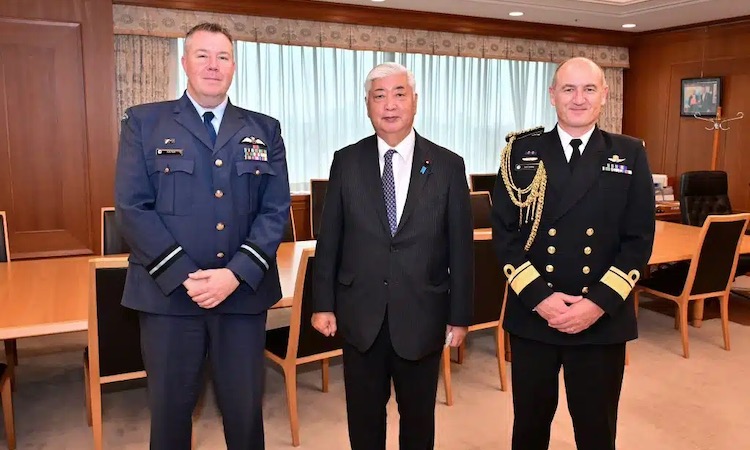
Japanese Defence Minister Nakatani with Chief of Navy RADM Garin Golding and NZDF Air Component Commander CDRE Andy Scott. Image courtesy Japanese Government.
What about Babcock’s Arrowhead 140?
On 13 November 2025, in a post on LinkedIn, the British High Commission stated, “This morning our Defence Advisor, Cdr Michael Proudman, was privileged to have the opportunity to talk to the NZ Prime Minister to discuss the strong and enduring UK–NZ defence partnership. An insightful conversation reaffirming the deep bond and shared commitment between our nations.”
In response, former Rear Admiral Jim Gilmour posted that it was “Encouraging to consider that an alternative to Mogami Frigate option might have come up in this discussion.”
“Whichever platform is chosen, and whether the ships are built in Rosyth, Henderson, or Nagasaki, New Zealand will, as with the ANZACs, seek to maximise local industry participation in the project.”
More recently, on 15 December in fact, the assumption that the leading contenders were indeed the Arrowhead 140 and upgraded Mogami class was given more substance by the publication of an article in Navy Lookout titled, New Zealand’s frigate choice: Mogami or Type 31?
The arguments in favour of each of the designs are carefully spelt out in the article, though it is made clear that the Arrowhead has an edge in terms of adaptability and the potential for the same hull to perform many of the wide range of tasks spelt out in the original RFI for maritime fleet replacement.
Whichever platform is chosen, and whether the ships are built in Rosyth, Henderson, or Nagasaki, New Zealand will, as with the ANZACs, seek to maximise local industry participation in the project. Whether such participation could ever be as generous as with the ANZAC build, where fully $800 million of the $1.219 billion cost was spent with New Zealand firms, remains to be seen.
How many ships?
Again in the 2025 Winter issue of Line of Defence Magazine, former RNZN Officer Andrew Watts highlighted that operational research had repeatedly demonstrated that a minimum of three ships were needed to ensure the reasonable availability of one fully effective ship at any given time.
“Given the imperative in the DCP to reduce the number of ship classes in the Navy, whilst some may consider that three fully fitted frigates may be adequate, four hulls might be preferable.”
This had been brought home forcefully in the NZDF Annual Report for 2020-21 where, under the heading Performance Measures and Standards, the response for Naval Combat is “no capability” for both 2020 and 2021.
In fact, as long ago as 1997, when a third ANZAC was being considered for purchase, an academic research report was commissioned by Treasury. Written by Professor G.A. Vignaux from the School of Mathematics and Statistics at Victoria University of Wellington, it concluded that “A frigate force of 2 frigates cannot carry out the Government requirement. A force of 3 frigates is marginal…”
Given the imperative in the DCP to reduce the number of ship classes in the Navy, whilst some may consider that three fully fitted frigates may be adequate, four hulls might be preferable. Cost will ultimately be a consideration, but either Mogami or Arrowhead could provide two fully fitted frigates, with two ‘fitted for but not with.’ This would provide the Navy with four ships with common systems, reducing the training burden, yet providing the opportunity to up-arm if circumstances dictated it.
Some twenty years ago I interviewed Sir Geoffrey Palmer about the initial decision to purchase the two ANZACS, and he said:
I felt then that we needed a four frigate Navy, and I still feel that now. I couldn’t have lived with myself if we hadn’t bought them. It never occurred to me that we’d not end up buying the four.
Perhaps now is the time to remedy the situation?