
Artificial intelligence jobs are the fastest growing in the country, with the technology moving from a niche skill to required knowledge in recent years, new data has revealed.
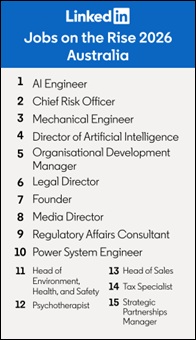
LinkedIn’s Jobs on the Rise 2026 list, based on jobs posted by members on the platform from 1 January 2023 to 31 July 2025, reveals the rise of AI in recent years has led to skyrocketing demand for AI-specific roles in Australia.
The list measures the jobs that have become more popular in the last three years.
The 2026 iteration of the rankings, with a focus on tech roles, stands in stark contrast to the previous version.
Last year’s list was dominated by roles such as teachers, servers, travel specialists and electrical design engineers, thanks to a post-pandemic rebound in the education and services industries.
Tech leading the way
Following this rebound, there is now a focus on technology-led growth, with AI now in high demand across the economy, LinkedIn Career Expert Brendan Wong said.
“This year’s list shows how quickly the job market is evolving,” he said.
“AI is no longer a specialist skill – it’s becoming part of everyday work and leadership.
“Jobseekers can use this list as a roadmap to explore emerging roles, understand the skills employers value most, and position themselves for the opportunities shaping Australia’s future of work.”
According to the new data, AI engineering is now the number one job on the rise in Australia.
AI engineers design and build systems that utilise artificial intelligence to perform tasks, and have shown a “major surge” in demand for these roles in Australia in the last three years, according to the report.
The second highest job on the rise is Chief Risk Officer – workers who identify, assess and manage potential risks that could impact the operations of businesses.
Director of Artificial Intelligence is listed as the fourth highest job on the rise.
This role involves overseeing the development and implementation of AI strategies within a company, and its rise is down to more C-suite executives moving to upskill their businesses in the technology.
The fifth job on the list is organisational development manager, a role which can help with the implementation of AI across a workplace.
Many of these AI-focused roles also command higher salaries than many other tech jobs.
According to the 2025-26 Australian Tech Salary Guide, a Director of Artificial Intelligence earns an average of $236,000 annually, while machine learning engineers, data scientists and photonics algorithm engineers are paid far more than traditional software development roles.
AI skills in-demand
The data also reveals that AI literacy is the most in-demand skill that Australian employers are looking for when hiring.
According to the research, eight in 10 global company leaders are more likely to hire an individual who is more comfortable using AI tools than someone who has more experience but less proficiency with AI.
“Whether you’re in tech, business or creative industries, building AI literacy and staying open to new skills will be key to futureproofing your career,” Wong said.
“The most successful professionals will be those who combine technical know-how with adaptability and a willingness to learn.”
This backs up previous reports of an increasing number of tech companies requiring job applicants to use or display a proficiency with AI tools during the hiring process.
Rise of the founder
The LinkedIn data also shows that entrepreneurship has significantly grown in popularity in recent years, thanks in part to the ability of individuals to use AI tools to launch a business and compete with bigger players.
Founder is now the seventh-fastest growing job in Australia, according to the data.
There has been a just under 60 per cent increase in LinkedIn members adding “founder” to their profiles from July 2024 to July 2025, and this number has more than tripled in the last three years.
More than three in 10 workers said AI has increased the likelihood of them starting their own business.
The research also reveals that smaller Australian businesses are hiring at a faster rate than their bigger rivals.
The average headcount among local small and medium businesses outpaced large firms by nine-fold, and hiring among SMEs was up 5 per cent year-on-year, while there was a 3 per cent decline among companies with 1,000 or more employees.
There will also soon be more AI-focused roles in the Australian Public Service, with all federal agencies expected to this year appoint Chief AI Officers, with the rise of generative AI causing a “fundamental shift” in the operations of governments.
And while the rise of AI has created many new jobs, there are also widespread concerns that jobs will be replaced by the technology, with this even leading some to “gatekeep” their own knowledge in an effort to increase their worth.