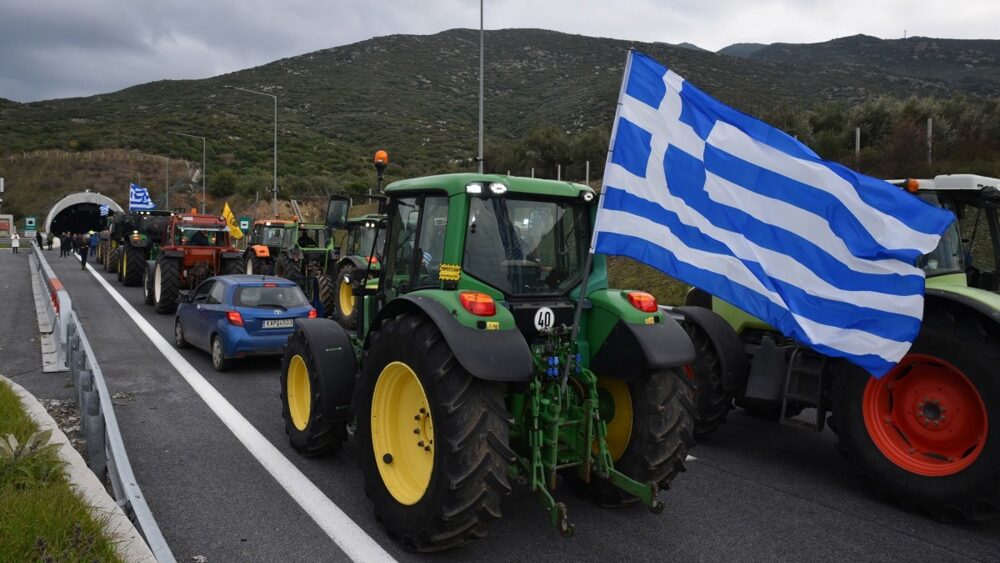
 Protesting farmers with their tractors on the Athens-Thessaloniki highway, near Larissa, Thessaly, December 22, 2025. Photo: EPA/APOSTOLOS DOMALIS.
The Greek government on Monday announced new support measures to address the crisis over farmers who have been on the streets for almost 40 days protesting about high production costs, delays in subsidies and compensation, and the distribution of state support.
At a press conference, the government said that 16 of 27 demands of the farmers have been resolved or are being addressed, while another four are being processed. Seven of them are deemed outside the EU budget limit and framework.
The measures include the redistribution of about 160 million euros of basic support to farmers and livestock breeders and a reduction in the price of electricity for agriculture. The state Agricultural Insurance Organisation will now be allowed to offer 100 per cent compensation, and the compensation limit is increasing to 200,000 euros from the current 70,000 euros.
At the same time, investments of 4.3 billion euros are being launched in the primary sector, with new financial tools and support programmes. An agreement was signed between the Ministry of Rural Development and Food and the Hellenic Development Bank for the activation of the three new financial instruments under the EU’s Common Agricultural Policy Strategic Plan, which will allocate 350 million euros for Greek agri-food businesses.
Refunds of a pecial consumption tax on agricultural oil are being introduced at the time farmers put the fuel in, and not months later, through an application. A national tracking system with a unique barcode is also being established for all Greek products.
However, many farmers remain unsatisfied. “I expected the government to stand up … announcing measures for the future of agriculture, instead they told us through half-truths that we don’t want you,” Giorgos Botas told state-run ERT from the blockade in Malgara, northern Greece.
“The future is considered very bleak. I don’t know how the farmers will respond, they certainly won’t leave the streets so easily,” he added.
Farmers were set to decide later on Wednesday whether to continue protests. Meanwhile, Konstantinos Tzavellas, prosecutor of the Supreme Court, sent a new order telling prosecutors to intervene immediately in road blockades by farmers.
“We ask for your immediate intervention, with the assistance of the relevant police authorities,” the order states.