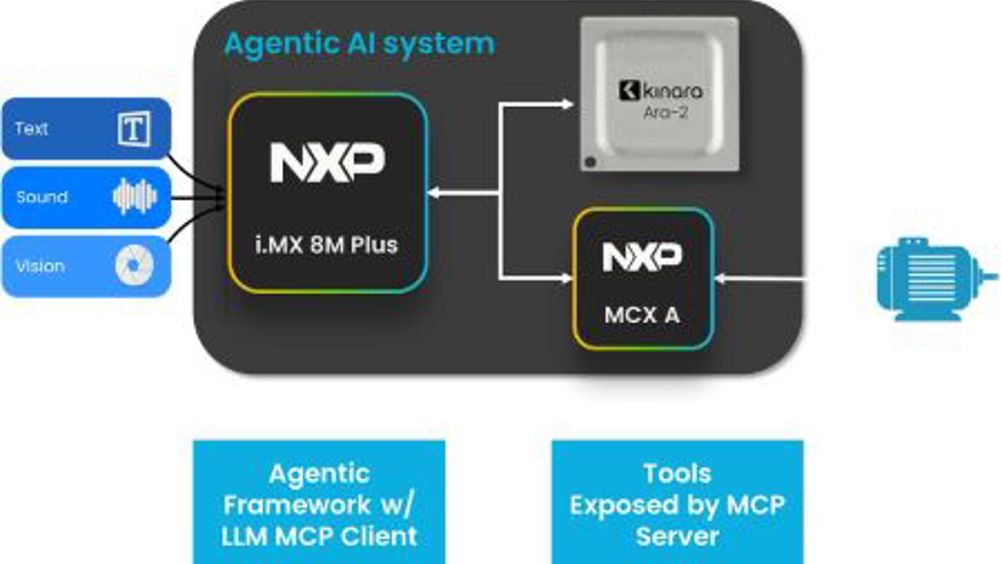
The framework is intended to simplify and speed up the development, orchestration and deployment of agentic AI systems for both experienced engineers and less specialised developers. When paired with NXP’s edge AI hardware, it allows teams to rapidly prototype and deploy secure, real‑time AI applications optimised for on‑device operation.
According to NXP, the eIQ Agentic AI Framework is among the first solutions focused on bringing agentic AI to the edge. The company says it offers low‑latency performance, built‑in security and resilience, enabling systems to make immediate, deterministic decisions in environments where connectivity, power and time constraints are critical.
The framework is designed to remove common development bottlenecks by coordinating multiple models and agents in real time. In practical terms, edge‑based AI agents running on the platform could instantly shut down industrial machinery when safety risks are detected, alert clinicians to urgent patient conditions, update medical records in real time, or autonomously adjust building management systems to respond to hazards such as fire — all without needing to send data to the cloud.
“With the new agentic AI capabilities delivered by the eIQ Agentic AI Framework, NXP is bringing autonomy to edge AI devices and delivering a crucial building block for our long‑term edge AI vision,” said Charles Dachs, Executive Vice President and General Manager of Secure Connected Edge at NXP Semiconductors. “We’re empowering both novice and experienced developers with a secure, real‑time, hardware‑optimised software platform to quickly deploy similar AI‑enabled functions to new use cases, improving time to market and reducing development overhead.”
NXP said the framework caters to a wide range of skill levels. Advanced developers can integrate complex, multi‑agent workflows into existing toolchains, while less experienced teams can build functional, edge‑native agentic systems without requiring deep expertise in AI optimisation. The platform also supports transitioning large, cloud‑scale models to deterministic, low‑latency execution suitable for edge environments.
The eIQ Agentic AI Framework supports NXP’s i.MX 8 and i.MX 9 application processor families, as well as Ara discrete neural processing units. This enables scalable agentic workflows that can be converted from multi‑step AI processes into fully on‑device deployments. The framework aligns with open agentic standards, including Agent‑to‑Agent (A2A) communication and the Model Context Protocol (MCP), which NXP said helps developers assemble and deploy on‑device agent pipelines more quickly.
To meet the performance requirements of real‑time edge systems, the framework includes hardware‑aware model preparation and automated tuning tools. Multiple models – such as vision, audio, time‑series and control – can run in parallel while maintaining predictable performance.
An intelligent scheduling engine distributes workloads across CPUs, NPUs and integrated accelerators so that perception, classification and decision‑making tasks can operate concurrently. NXP said this capability is particularly relevant for robotics, industrial automation, smart buildings and transportation systems.
Security has been placed at the heart of the framework’s design. NXP said the platform will include protections against threats such as prompt injection attacks, adversarial inputs and model spoofing. These software‑level safeguards are integrated with the company’s edge hardware security features, including secure boot, runtime isolation zones and a hardware root of trust, to support deployments where data integrity, safety and system resilience are essential.
Alongside the framework, NXP also introduced the eIQ AI Hub, a cloud‑based developer platform that provides access to edge AI development tools – it allows developers to prototype and test models quickly, including deployment on cloud‑connected hardware boards for performance reporting, while retaining the option for on‑premise use. According to NXP, the platform offers automated workflows for newcomers and streamlined conversion and tuning pipelines for advanced users.
The eIQ Agentic AI Framework forms part of a broader eIQ tool suite, which includes eIQ Time Series Studio and eIQ GenAI Flow. The full set of tools, as well as the updated modular eIQ AI Toolkit, is available via the eIQ AI Hub or for on‑premise deployment.