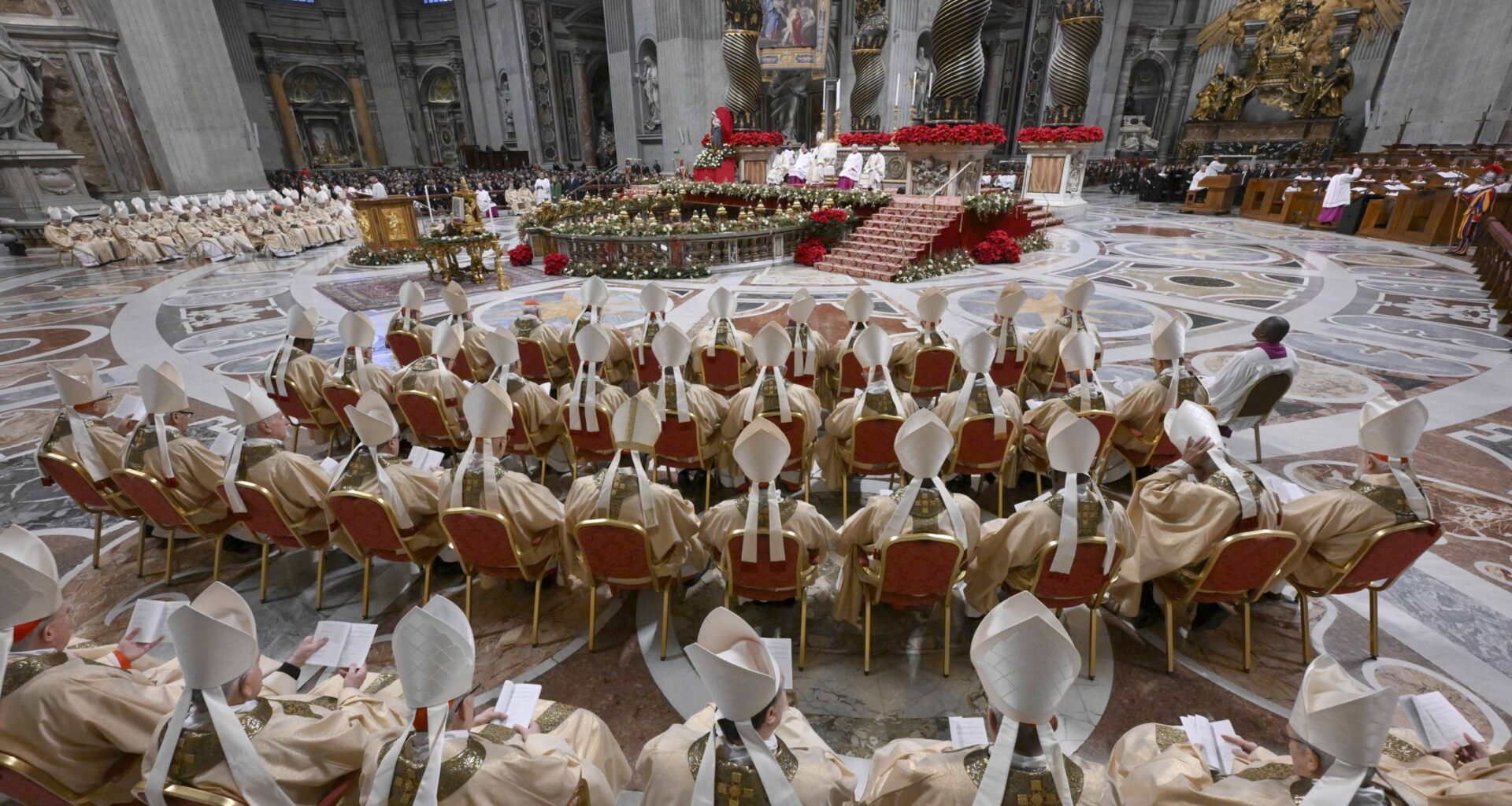
As this issue of America is going to press, Pope Leo XIV and the College of Cardinals are beginning a two-day set of meetings in Rome, called an Extraordinary Consistory. The meetings happen behind closed doors as a way for the cardinals to cooperate with the pope in shared discernment and to support him in his governance of the universal church.
The Vatican has said relatively little about the agenda for the meeting, describing it in the broadest possible terms as taking place “within the context of the life and mission of the church” and expecting it to be “characterized by moments of communion and fraternity.”
Some media reports described Pope Leo’s Christmas letter to the cardinals as setting out four points for discussion. Leo asked the cardinals to reread two documents from Pope Francis in preparation for the meeting: “Evangelii Gaudium,” his initial apostolic exhortation, which Pope Leo summarized in his first address to the cardinals after his election; and “Praedicate Evangelium,” the apostolic constitution restructuring the Roman Curia. He also asked them to reflect on synodality and liturgy.
It is likely, of course, that we will learn more about what was discussed both from official Vatican communications and from cardinals speaking to the press following the consistory. But even if the Vatican were to release a full transcript—which it certainly will not do—a detailed breakdown of the conversations among the cardinals would not be the most important takeaway from the meeting.
To understand why, it helps to understand what extraordinary means in the parlance of ecclesial governance and how that technical meaning may slowly be getting turned inside out.
Ordinary consistories happen either for the creation of new cardinals, when the pope names new members to the college, or for the cardinals to vote on canonizations. While any cardinal can attend an ordinary consistory, they do not require the attendance of cardinals from outside Rome.
Extraordinary consistories, on the other hand, involve every cardinal and are primarily consultative in nature. Canon law describes them as being celebrated “when particular needs of the church or the treatment of more grave affairs suggests it.” While there are other mechanisms available for discussion among the cardinals (Pope Benedict XVI regularly held consultative meetings alongside ordinary consistories, and Pope Francis had his smaller “C-9” advisory council), a global meeting of all cardinals for discussion about the church has historically been a rare occurrence, literally “out of the ordinary” course of events. During his long pontificate, St. John Paul II held only six extraordinary consistories, Benedict XVI held none, and Pope Francis held only three.
But this pattern could be changing. During the cardinals’ meetings before the conclave that elected Leo, a number of them commented that except for those who had participated as members of the Synod on Synodality, the cardinals did not know each other well and expressed a desire for the college to be convened more regularly. Pope Leo acknowledged this hope in his meeting with the cardinals just two days after his election.
Cardinal Timothy Radcliffe, in an interview published just before the start of the consistory, commented that “many cardinals think that there should be at least one a year.” Of course, if that pattern were to be established, there would be nothing “extraordinary” about such consistories in the sense that word currently holds.
In fact, that may turn out to be the point. One tension that the church faces is between its day-to-day modes of governance—bishops acting in their own dioceses and together as conferences, and the Roman Curia working at the level of the universal church—and the broader forms of consultation introduced through the synodal process over the last several years.
Pope Leo has clearly indicated that he is convinced of the importance of synodality. The pattern of this consistory reflects that commitment, with a greater role for working groups and relatively less time devoted to individual cardinals making speeches to the whole body of the college.
One practical effect of this arrangement is the greater significance given to dialogue and conversation, meaning that the relationships cardinals build with one another and their ability to forge a consensus will likely have more impact than a speech given by any one individual.
Whether Pope Leo regularizes so-called extraordinary consistories to happen annually or develops some other method for ongoing consultation, I expect that he will continue to encourage the College of Cardinals in the practice of dialogue as part of the ordinary way the church carries out its mission. The success of this meeting should not be measured solely by what decisions it influences or topics it discusses, but by its integration of dialogue into the day-to-day life of the church. That example is itself an important ministry for the cardinals to offer in support of and in union with the pope.
Related