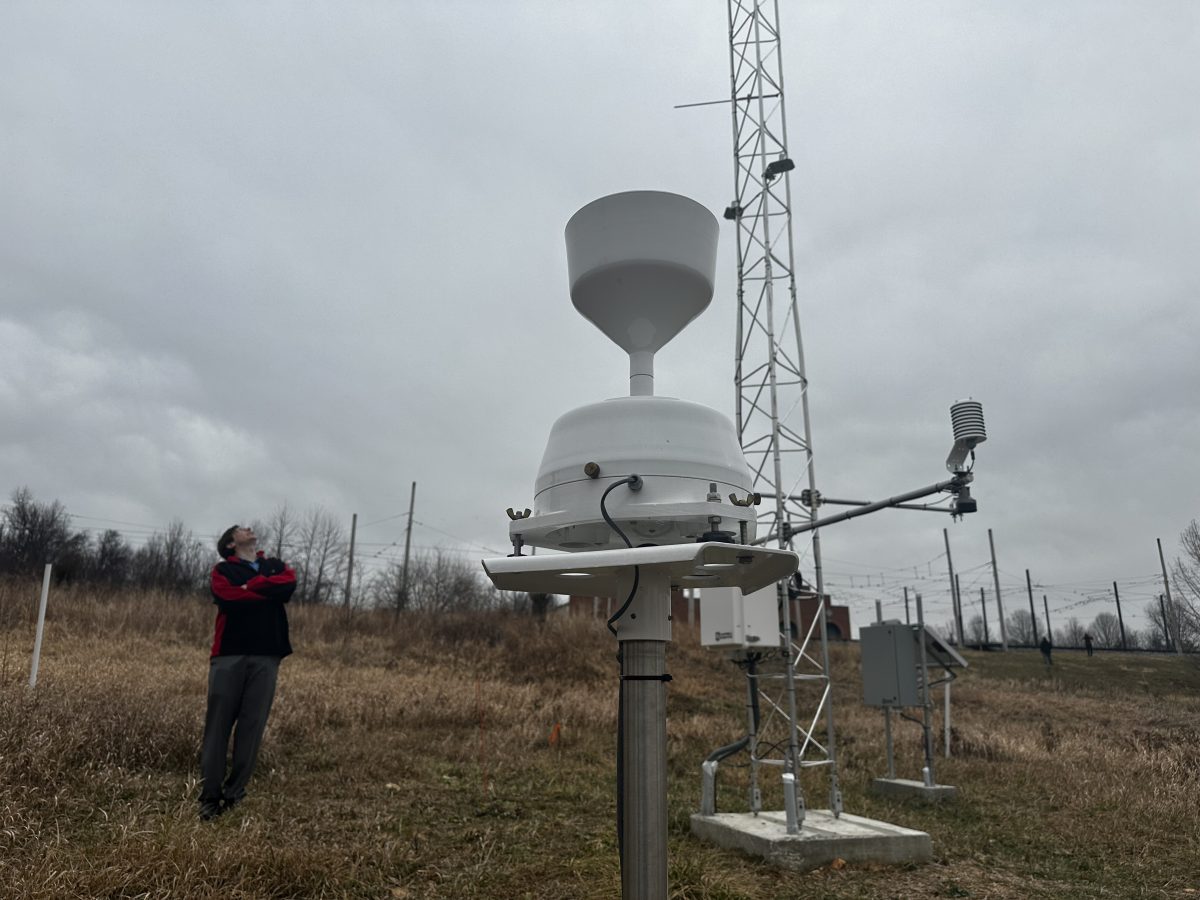
Bolted into a concrete slab in a grassy field in Colesville, a 30-foot-tall metal tower with devices to measure weather conditions ranging from wind speed and direction to temperature and sunlight stands as one of the latest innovations employed by Montgomery County to improve its resiliency to climate change and track local impacts.
“Weather systems represent the most veritable and pervasive and persistent threats that we have here in Montgomery County,” Luke Hodgson, director of the county’s Office of Emergency Management, said at a Tuesday press conference at the National Capital Trolley Museum in Colesville. The property is the site of the weather station tower, one of three now in operation in the county. Three more are expected to be brought online this year.
The tower is an all-encompassing weather station and the product of the Maryland Mesonet, a project by the University of Maryland and Maryland Department of Emergency Management that aims to create a network of advanced, rapid-sampling weather monitoring and data collection systems across the state. The goal of the program is to improve emergency preparedness, risk assessment and the accuracy of regional weather forecasts, according to program manager James Hyde.
In addition to Hodgson and Hyde, local officials, including County Executive Marc Elrich, Climate Change Officer Sarah Kogel-Smucker and County Council President Natali Fani-Gonzalez (D-Dist. 6), along with the team behind the weather stations, attended the press briefing to discuss the county’s progress on its climate action goals.
Those goals include reducing greenhouse gas emissions by 80% by 2027 and then 100% by 2035 and improving resilience to climate change, according to the county’s climate action plan outlining 84 goals.
“As climate change accelerates, weather forecasting has become more and more challenging. Weather systems have become hyper-localized, where we see one part of our county inundated with intense conditions, [while] another part of our county community is fair,” Hodgson said.
Having precise weather monitoring and forecasting is “critical to public safety,” Hodgson said, guiding the county’s response to extreme weather events, such as taking precautionary measures and strategically deploying resources. Coupled with the 40 new flood sensors that have been installed around the county, the weather stations are a powerful tool to help protect residents during extreme weather events, Hodgson added.
The Colesville weather tower, along with two others installed in the county last year in Potomac and Poolesville, are three of dozens installed around the state to create a network of localized weather stations.
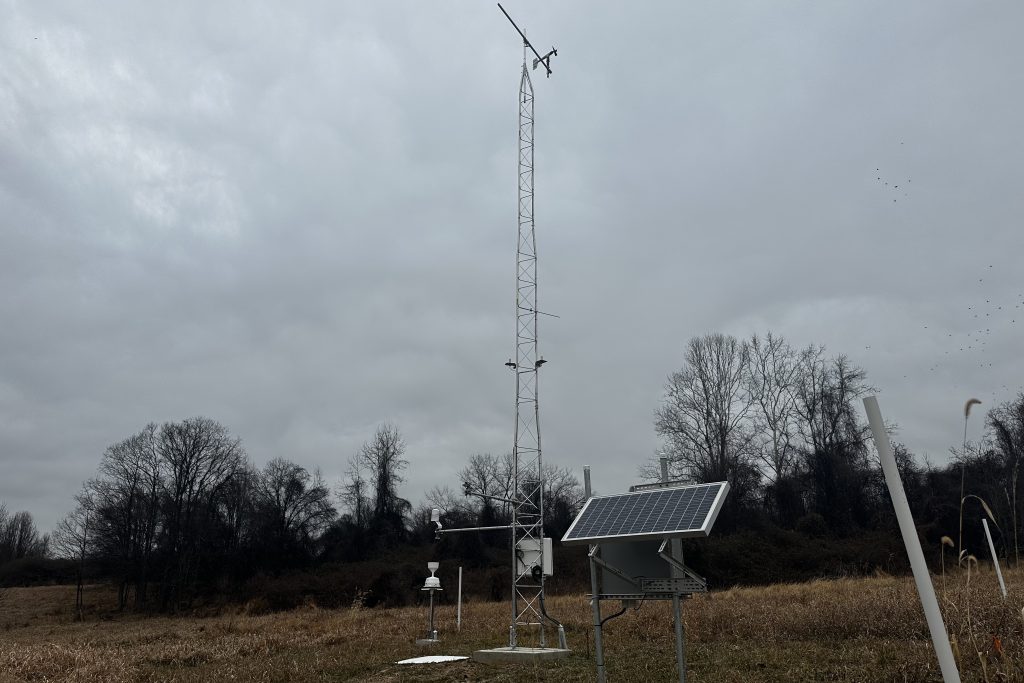 The Maryland Mesonet weather station in Colesville measures soil temperature and moisture, wind speed, sunlight, snow depth, rainfall and pressure. It is powered by a solar panel. Photo credit: Elia Griffin
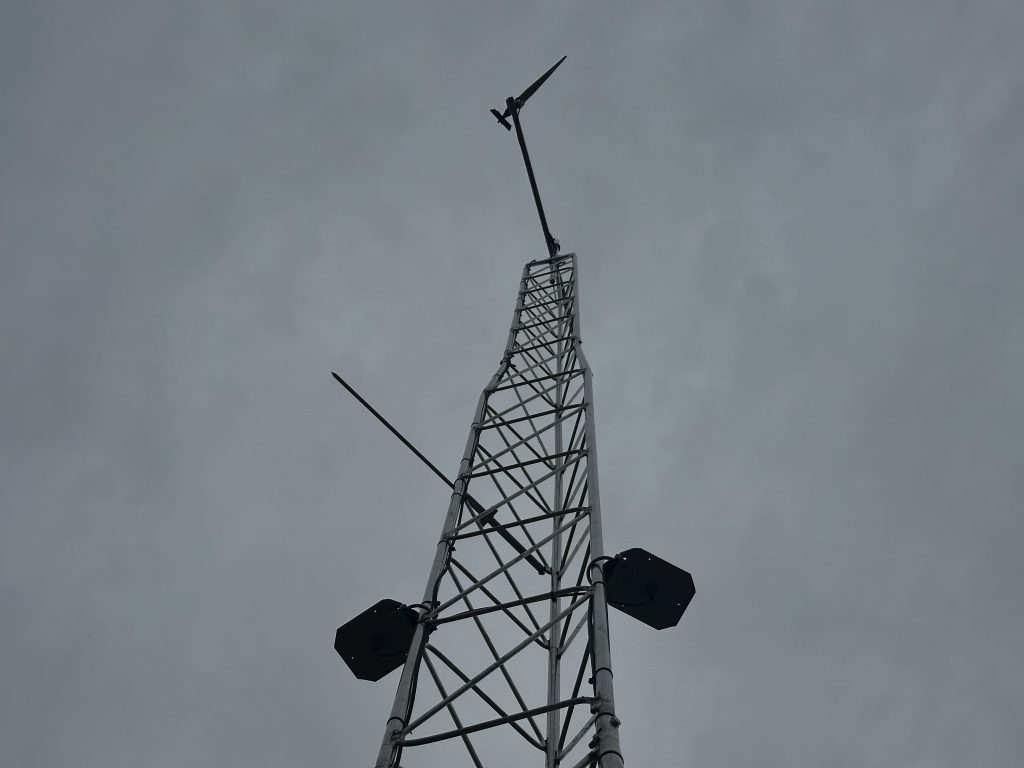 The 30-foot-tall metal tower has a anemometer at the top that measures wind direction and speed. Photo credit: Elia Griffin
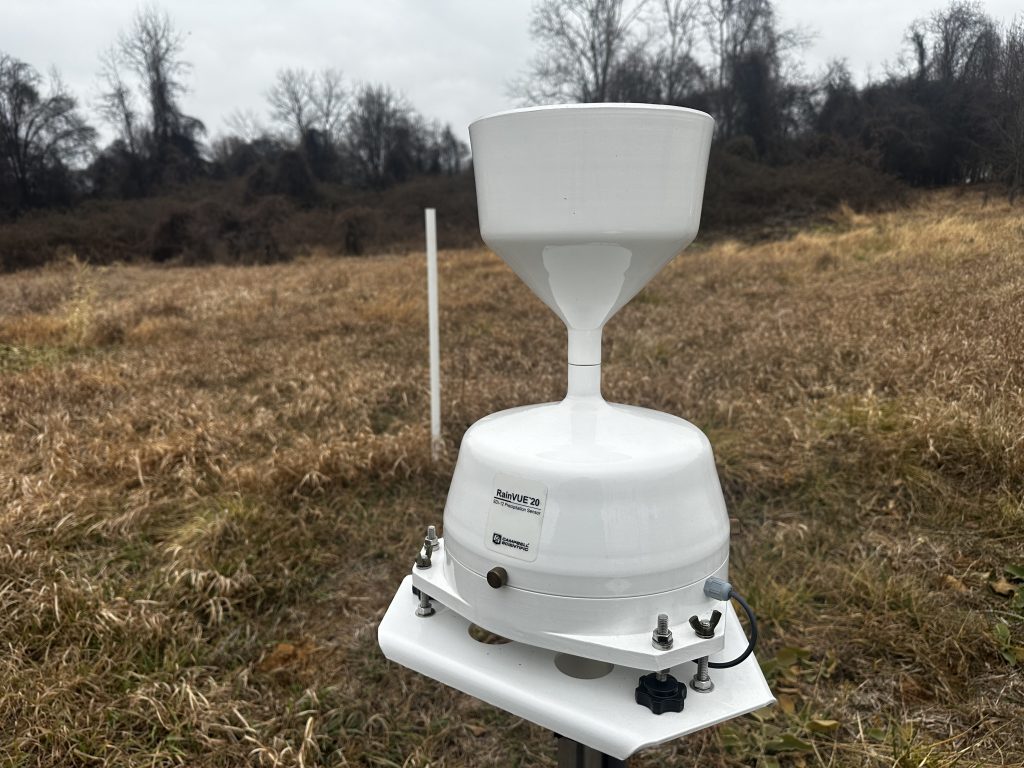 Mesonet rain gauge. Photo credit: Elia Griffin
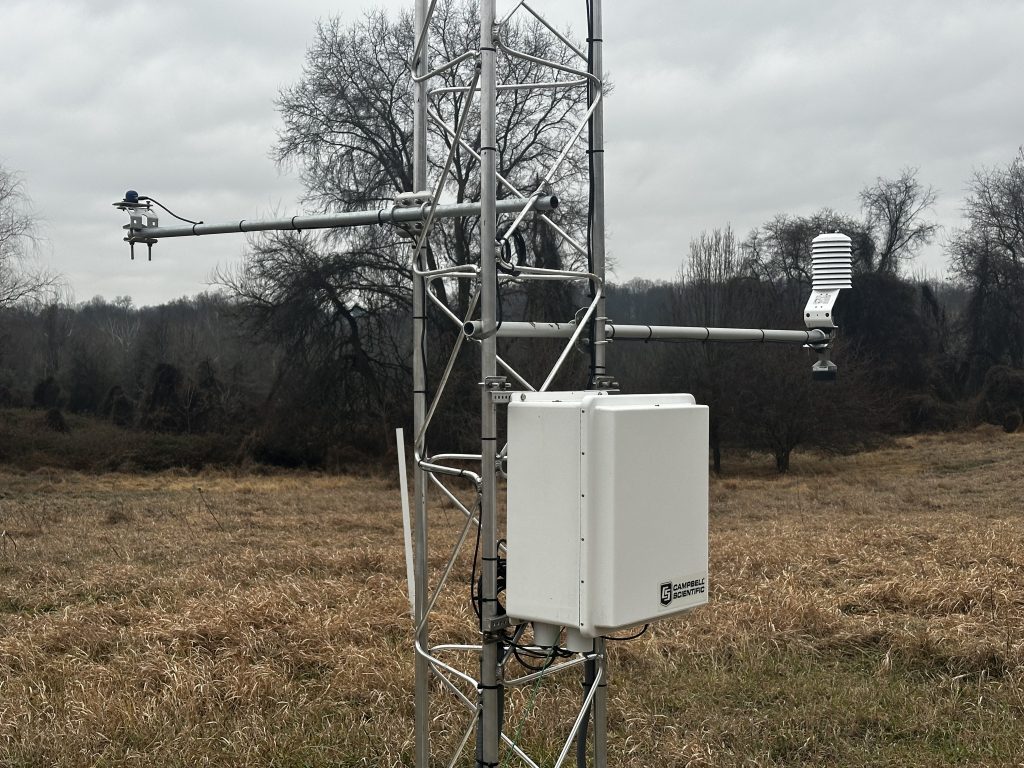 Measurement devices on the Mesonet tower in Colesville. The Devices on the left measure sunlight and snow depth while the cylindrical device on the right measure temperature and relative humidity. The white box is a datalogger and barometer. Photo credit: Elia Griffin
The stations measure a variety of weather conditions such as wind speed and direction, temperature, humidity, barometric pressure, snow depth, soil moisture and temperature, rainfall and sunlight. They are built to withstand up to 115 mph winds, according to Hyde, and are powered by solar energy. The stations only require maintenance every about every five years to replace metal bearings.
Data captured by the stations are publicly available and will also be utilized by first responders, the National Weather Service and the county’s Department of Emergency Management and Homeland Security, according to county officials.
According to Hyde, the stations take measurements every three seconds, then average that data and transmit the averages to the University of Maryland Mesonet system every minute.
With those data points, the stations can detect weather events that occur on the mesoscale, according to Maryland Mesonet, hence the “meso” in the project’s name. Those events include thunderstorms, wind gusts, heat bursts and squalls.
Mesoscale events range in size from 1 to 150 miles in horizontal scale and can last from minutes to several hours, according to the Maryland Mesonet website. The events can often go undetected by conventional observation systems because they are too small-scale and high in frequency, the website states. The project’s densely spaced weather station network aims to address that issue.
Progress on climate action
“Climate change is probably the most important issue of our time,” Elrich said during the press briefing.
In addition to highlighting the weather station, county officials announced the release of the fiscal year 2025 annual report on the county’s climate action plan, touting progress toward achieving stated climate goals as of June 30 end of fiscal year 2025. According to Elrich, the county had begun work on 80 of its 84 goals.
In 2017, the county officially declared a climate emergency and created its Climate Action Plan in 2021. Out of the 80 actions underway, the county has completed or made significant progress on 63 of those actions, Elrich said Tuesday.
In addition to the weather stations, Elrich noted several of the county’s other climate successes, including the zero-fare policy for all Ride On buses to help reduce reliance on cars, adding more electric buses to the fleet for a total of 52, and advancing the county’s building energy performance standards.
Pointing to the Trump administration’s strong opposition to taking action on climate change, Elrich said that having data from the Mesonet Maryland stations is critical, particularly when responding to storms and flooding.
“Knowledge is important. I know the current administration is not interested in knowledge. Knowledge is actually incredibly useful. You can’t make decisions if you don’t understand what it is you’re dealing with,” Elrich said. “This kind of information will give us a better idea of what’s happening at ground level, literally.”
Dense network of weather stations
During 2025, the county partnered with Maryland Mesonet’s team of climate scientists, researchers and engineers to set up the three 30-foot-tall weather towers in Potomac, Poolesville and Colesville. This year, the county plans to install three more weather stations, including a tower in Laytonsville, and two smaller versions in Takoma Park and Silver Spring, Hodgson told Bethesda Today on Tuesday.
The larger, 30-foot stations cost about $30,000 and the smaller stations, which are portable, cost about $12,000, according to Hodgson. The first three stations were funded through state grants stemming from federal homeland security grants, and the three future stations will be funded by the county.
In addition to improved emergency preparedness, the stations also help fill in the geographical gaps where federal weather monitoring systems don’t reach, Hodgson said. Before the Mesonet was in the county, officials mostly relied on federal weather monitoring stations – typically located at airports – leaving “humongous gaps in weather observation,” he added.
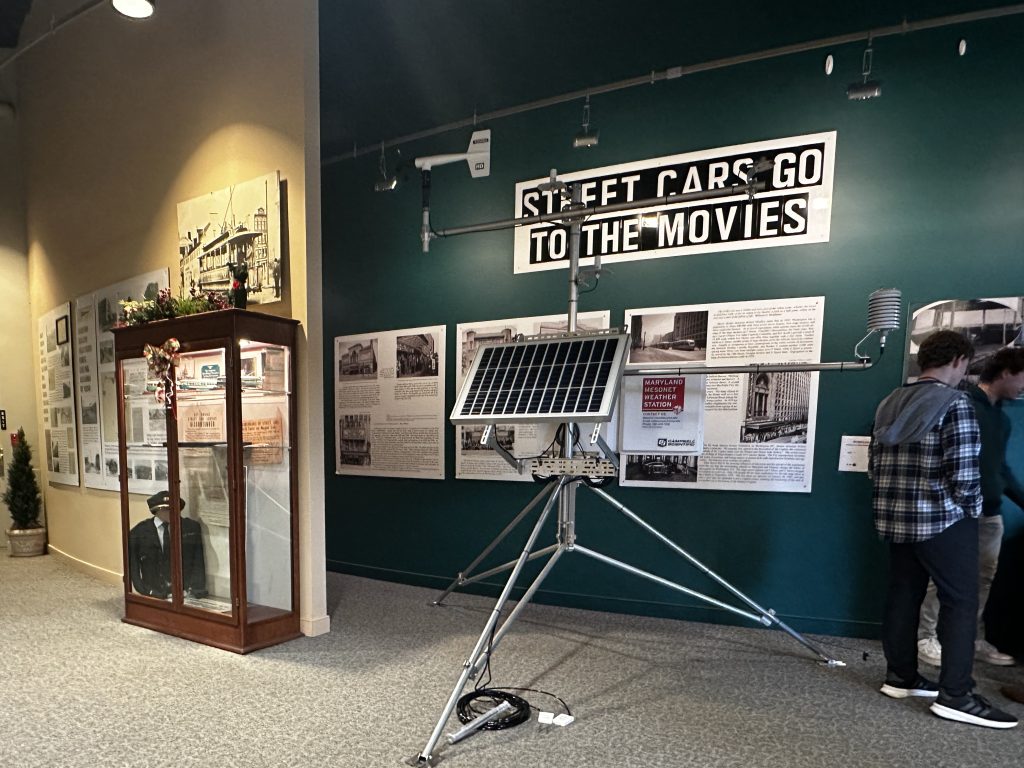 A smaller-sized Mesonet weather station. Two of these will be placed in Silver Spring and Takoma Park this year. Photo credit: Elia Griffin
Each of the stations are about 10 miles from each other, creating a densely spaced weather monitoring network in the county, Hodgson said. This network will help local officials make decisions during weather emergencies and help meteorologists provide more accurate predictions — and help the county keep track of local climate events and changes over time.
Maryland Mesonet Director Sumant Nigam said Tuesday that the statewide network is about halfway complete, with 40 of the 76 planned stations already built.
“As collected data sets grow, we’ll be able to provide a highly granular description of [meteorological] conditions, of climate change, footprints, and of seasonal exceedances in climate variables countywide,” Nigam said.
As a weather and climate scientist and longtime county resident, Nigam said he was “truly excited” about how the weather station project was helping advance the county’s climate action plan.
While focused on building the network, Hyde said the Maryland Mesonet team hopes to offer an app that residents can use for information about the weather in their area.
“What we want to do, in the end, is make decision-making for weather easier,” Hyde said. “Whether that be for local government, whether that be for the state or the National Weather Service or, you know, a mother trying to decide what kind of clothes to put on their kid in the morning.”