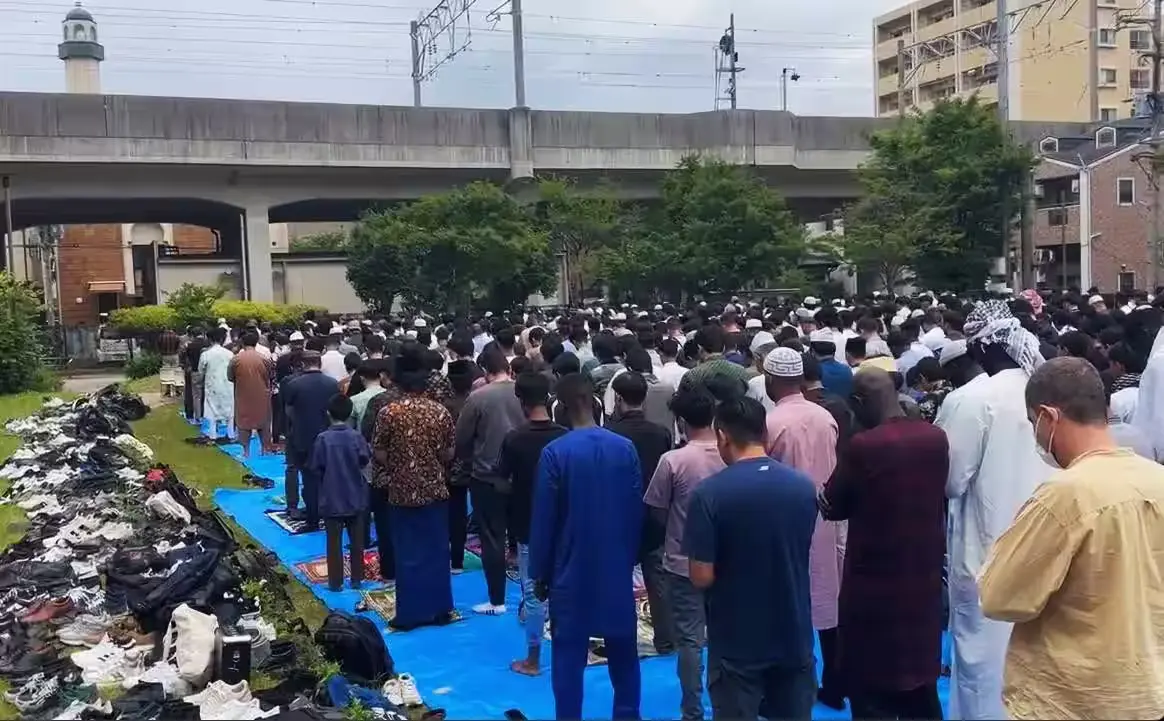
According to the Higashi Ward Office in Fukuoka City, the religious corporation that operates the Fukuoka Mosque applied in June 2025 for permission to occupy 100 square meters of a nearby public park for Muslim prayers. Similar applications had been approved in 2019 and 2024, and the ward granted approval again.
On the day of the event, however, the area used extended far beyond what had been authorized. About 600 Muslims knelt on blue tarps spread across the park, praying in unison to recitations broadcast over loudspeakers. Those unable to fit inside the Fukuoka Mosque in Higashi Ward spilled into the adjacent park, ultimately occupying an estimated 600 square meters, roughly six times the permitted area.
Mixed Reactions
Ammar Nabil, 65, an Egyptian national who serves as the religious corporation’s representative director, explained that the gathering coincided with a major Islamic festival and fell on a Saturday, drawing far more worshippers than expected. He acknowledged that attendance exceeded projections and said the situation resulted from the organization’s miscalculation.
Reactions among nearby residents were mixed. One man living in the area said, “There are more foreigners now, but I don’t feel the prayers in the park are particularly problematic.” Another resident took a different view, saying, “It’s a completely different culture, and when the numbers increase, it feels intimidating.”
In September 2025, street demonstrations protesting the use of the park were held in front of the mosque. Ryuichi Shirozu, 72, head of the local neighborhood association, subsequently called on the mosque to take steps to prevent a recurrence.
“We interact with them, and even when problems arise, we’ve always resolved them through dialogue,” he said.
The ward stated that it has “instructed the mosque to strictly adhere to the permitted area going forward.” Major Islamic festivals occur twice a year, with the next scheduled for March 2026.
Number of Muslim Residents Doubles in Four Years
As the number of foreign residents continues to rise, local communities are increasingly encountering different cultures and customs.
In a nationwide Sankei Shimbun survey, a majority of local government leaders cited cultural and customary friction as the primary negative impact of Japan’s growing foreign population.
The survey, which covered all 1,741 municipalities nationwide, found that 515 local leaders identified such friction as their chief concern.
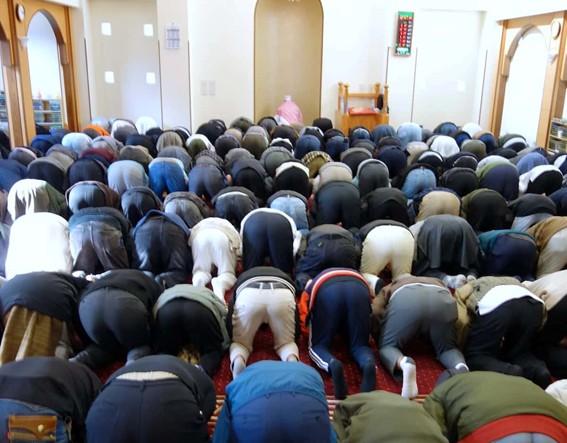 Muslims praying at Fukuoka Mosque, December 2025, Higashi Ward, Fukuoka City.
Professor Emeritus Hirofumi Tanada of Waseda University, a specialist in Japan’s Muslim communities, estimates that approximately 360,000 foreign Muslim residents were living in Japan as of the end of 2024. That is roughly double the number recorded four years earlier.
More than half of this population consists of Indonesian caregivers and technical trainees. Japan and Indonesia implemented an Economic Partnership Agreement (EPA) in 2008 that opened the way for the acceptance of nursing and caregiving personnel. Since then, inflows from Indonesia, which has the world’s largest Muslim population, have expanded rapidly.

Burial Grounds an Election Issue
Islam prescribes five daily prayers, with men in particular expected to attend communal noon prayers at mosques on Fridays. Research by Professor Tanada indicates that the number of mosques in Japan began to rise in the 2000s and, as of July 2025, had reached 164 locations across 140 municipalities nationwide.
In contrast, Islamic practice requires the burial of the dead, yet in Japan, where cremation accounts for nearly all funerals, there are only around ten cemeteries that permit Islamic burials.
As the Muslim population continues to grow, demand for burial sites has increased accordingly. Securing the consent of local residents, however, has proven difficult, and the issue has increasingly emerged as a point of contention in local elections.
In Hiji Town, Oita Prefecture, a Muslim organization proposed the development of a large-scale burial cemetery. The plan became a central issue in the 2024 mayoral election, where a newcomer campaigning on firm opposition to the project won, effectively halting the proposal.
A similar dynamic emerged in the October 2025 Miyagi gubernatorial election. An incumbent candidate who advocated developing burial grounds to accommodate Indonesian workers faced a strong challenge from a newcomer running on an opposing platform.
Mosque Construction in Fujisawa
In northern Fujisawa City, Kanagawa Prefecture, around 60 Muslims gathered in a rented community hall on a Friday afternoon for prayers. High school students in uniform and children were among those in attendance. Most participants were Sri Lankan nationals, many of whom are engaged in the used car trade.
According to city statistics, approximately 800 Sri Lankans reside in Fujisawa. While Sri Lanka is widely known as a Buddhist-majority country, it also has a substantial Muslim population. Most Sri Lankans living in Fujisawa are believed to be Muslim.
During the sermon, the prayer leader emphasized the importance of proper conduct, drawing parallels between Islamic ethical principles and what he described as Japanese moral values.
As attendance has increased, the Sri Lankan organization has proposed constructing a dome-roofed mosque in northern Fujisawa. Although the group had secured the land and obtained the necessary development approval from the city, posts expressing concern about the project spread rapidly on social media in October 2025.
In response, two local neighborhood associations invited representatives of the organization to a residents’ briefing on December 20, 2025. During the meeting, residents raised concerns, including the potential for traffic congestion and the impact a dome-shaped structure could have on the character of the surrounding area.
Seeking a Forum for Dialogue
Mohammad Anas, 52, the organization’s representative director, said the group plans to implement traffic countermeasures and ensure that sound from the facility does not extend beyond its premises.
The organization also proposed establishing a consultation forum on mosque operations, with participation from local neighborhood association leaders. Yukio Anzai, 69, one such association head, said, “To avoid dividing the community, we want to continue discussions.”
As the number of foreign residents increases rapidly, local communities are finding themselves compelled to respond, often in ways that test current systems for coexistence.
Professor Tanada noted that, with the government actively accepting foreign residents, “the time has come” for it to take a more direct role in shaping policy responses. The focus, he said, should be on accepting them as residents, including measures related to “Japanese-language education and welfare,” rather than leaving such issues entirely to individuals, local communities, and municipal governments.
RELATED:
(Read the article in Japanese.)
Author: The Sankei Shimbun
Continue Reading