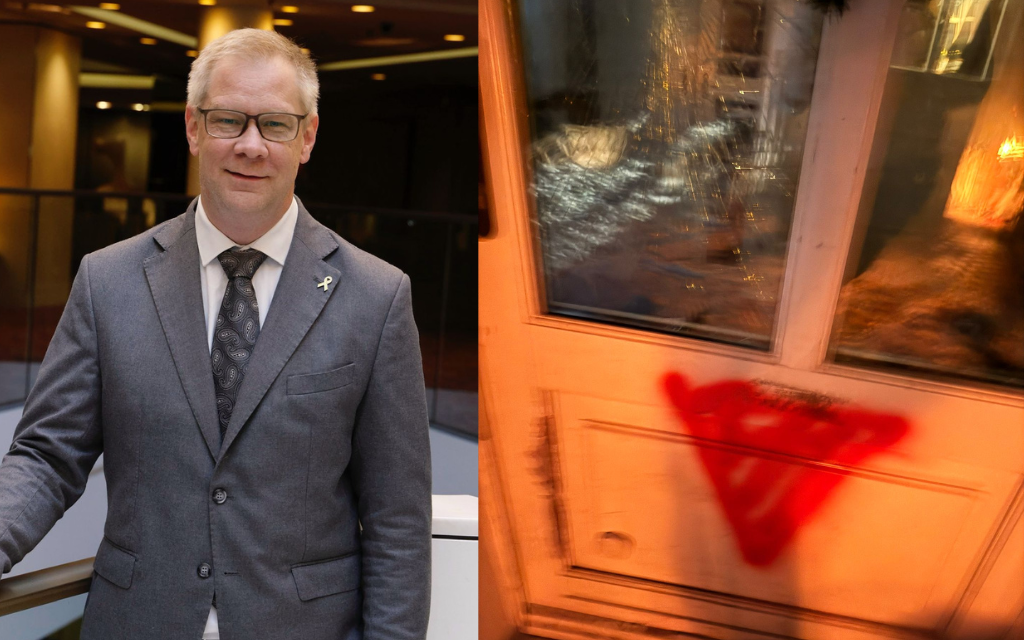
When I spoke with Andreas Büttner, the antisemitism commissioner for Brandenburg, a German state, the official tasked with combating antisemitism and safeguarding Jewish life, he was still processing the fact that someone had set fire to an outbuilding on his residential property while his family slept inside. The attackers left a red Hamas triangle behind.
For Jewish readers, that detail stands on its own. Büttner had already been targeted months earlier. His car was vandalized with swastikas and other far-right symbols. The escalation was not a shift in ideology but a convergence of threats. Different extremist languages, the same conclusion.
Andreas Büttner is a former police officer, a long-serving state politician, and a member of Die Linke, Germany’s left-wing party. In June 2024, he was appointed Brandenburg’s first antisemitism commissioner, an office created by state law to strengthen the fight against antisemitism and protect Jewish life.
From the beginning, Büttner rejected the careful language that often governs German discourse on antisemitism. In public statements and interviews, he has consistently argued for a clear naming of antisemitism, including its Israel-related forms. He spoke openly about Israel-related antisemitism. He has also been a vocal critic of institutions and narratives he views as contributing to antisemitic distortions of Jewish history. He intervened when cultural institutions instrumentalized Jewish history for political messaging, including a Potsdam exhibition criticized for depicting Anne Frank in a keffiyeh.
The response was predictable. Members of his own party initiated expulsion proceedings. In public discourse and online forums, Büttner became the target of escalating abuse. German media have reported that he was subjected to antisemitic insults, including being labeled a “Zionist pig” and a “child murderer.” Then someone came to his home.
Can Jews Still Rely on the State?
When asked whether Jews in Germany can still rely on the state, Büttner does not offer reassurance as a matter of symbolism or performance.
“Jews must be able to rely on the state,” he told me. “And the state has the duty to justify that trust every single day.” He describes committed police officers, prosecutors, teachers, and administrators who take antisemitism seriously. He does not question their intent. He questions capacity.
“We have a situation in which antisemitism appears too often, too loudly, and too publicly,” he said. “For many Jews, this creates the feeling: we are on our own.”
Then he adds what is rarely said plainly.
“In parts, the state appears overwhelmed,” Büttner said. “Not because of indifference, but because radicalization and mobilization, especially since October 7, are moving faster than routines, responsibilities, and sometimes political resolve.”
For Jews, this distinction matters less than the outcome.
Germany has built a powerful culture of Holocaust remembrance. Büttner does not dismiss it. He warns that it has become insufficient. “Antisemitism is not only history,” he said. “It is the present.”
The most underestimated form, in his view, is Israel-related antisemitism, not because criticism of Israel is illegitimate, but because antisemitism increasingly adopts political language. “When Israel becomes the collective Jew,” he said, “when double standards apply, when demonization begins, and when Jews in Germany are held responsible for the Middle East, we are no longer dealing with debate.”
Failing to name that clearly does not produce balance. It produces exposure. “That blind spot,” Büttner said, “is dangerous for Jews.”
Büttner’s sharpest observations concern his own political environment. Within parts of Germany’s left, antisemitism collides with self-image. The assumption that standing with the oppressed precludes antisemitism functions as a barrier against self-examination. “Antisemitism does not fit the moral narrative,” Büttner said. “So it gets redefined.” The vocabulary shifts toward terms such as anti-Zionism, decolonial critique, and solidarity, while the impact on Jewish life remains unchanged. He avoids generalization. There are allies on the left who speak clearly and act accordingly. But there are also milieus where acknowledging antisemitism would require ideological correction, fractured coalitions, and political cost.
That reluctance shapes public space. Jews register it immediately.

Fire burns in an outbuilding on the property of the Brandenburg antisemitism commissioner during an arson attack in January 2026. Credit: Courtesy of Andreas Büttner
When Visibility Turns Risky
For many Jews in Germany, a long-standing assumption has eroded. “One illusion,” Büttner said, “is that antisemitism happens only at the margins.” Another is that public visibility provides protection.
“For many Jews,” he said, “visibility now also means risk.” The idea that safety can be achieved through restraint, through quieter presence, or reduced visibility, he rejects outright.
“That is not protection,” Büttner said. “It is surrender.”
Across Germany, antisemitic chants are heard openly at demonstrations. Videos circulate. Police intervene. The aftermath is often opaque. Büttner understands why this is read as indifference. “If consequences are not visible,” he said, “people conclude that there are none.” Legal complexity does not erase lived reality. Speed matters. Prioritization matters. Specialized structures matter. A rule of law that cannot be felt will not be trusted. “Zero tolerance toward antisemitic violence and incitement,” Büttner said, “must be enforced within the framework of civil liberties. These are not opposing principles.”
Before becoming commissioner, Büttner knew antisemitism as a policy issue. After taking office, he encountered the daily reality. “Antisemitism is not a topic for those affected,” he said. “It structures everyday life.” It shapes the routes taken, the symbols concealed, and the decisions made quietly. It imposes calculations that others never have to perform. He also learned how adaptable antisemitism remains.
“It follows moral fashions,” he said. “The substance stays the same.” That is why remembrance alone does not suffice. “We need present-day policy,” Büttner said.
The Question Jews Ask Each Other
At the end of our conversation, I asked the question many Jews ask privately. Would he recommend Germany as a place to live? His answer resists both reassurance and alarm. “Jewish life is possible in Germany,” he said. “And it requires protection.” Location matters. Community matters. Institutional response matters.
Then he states the standard by which Germany must be judged. “The benchmark cannot be whether someone manages somehow,” Büttner said. “It must be whether one can live freely, without fear.” Germany has not reached that point. Until it does, the attempted arson at Andreas Büttner’s home should not be treated as an isolated attack on a public official. It should be understood as a signal, not only to him, but to the Jews whose safety he is charged with defending.
Michael Kuenne works as a journalist on antisemitism, extremism, and rising threats to Jewish life. His reporting continually sheds light on the dangers that come from within radical ideologies and institutional complicity, and where Western democracies have failed in confronting the new rise of Jew-hatred with the due urgency it does call for. With hard-hitting commentary and muckraking reporting, Kuenne exposed how the antisemitic narratives shape policymaking, dictate public discourse, and fuel hate toward Israel. His writings have appeared in a number of international media outlets, including The Times of Israel Blogs. Kuenne has become a voice heard for blunt advocacy in regard to Israel’s right to self-defense, critiquing ill-conceived humanitarian policies serving only to empower terror, while demanding a moral clarity which seems beyond most Western leaders. With a deep commitment to historical truth, he has covered the resurgence of Holocaust distortion in political rhetoric, the dangerous normalization of antisemitic conspiracies in mainstream culture, and false equivalencies drawn between Israel’s actions and the crimes of its enemies. His reporting dismantles sanitized language that whitens the record of extremism and insists on calling out antisemitism-whether from the far right, the far left, or Islamist movements, without fear or hesitation.