Half of the broccoli grown in Sweden is currently left in the field at harvest. Axfoundation and Grönsakshallen Sorunda have now developed a method to make use of the broccoli leaves, together with partners across the entire value chain. One result is a broccoli leaf soup being launched by IKEA Sweden in January.
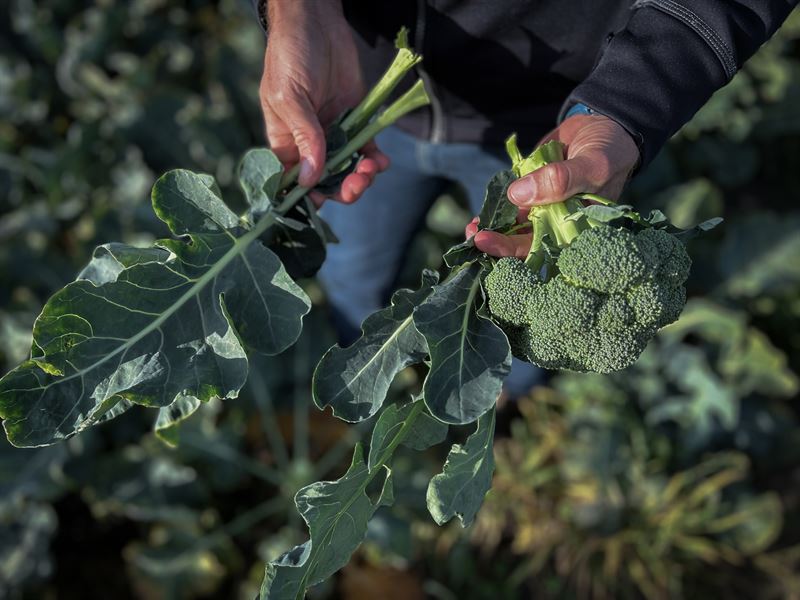
By harvesting the upper broccoli leaves, Sweden’s broccoli yield could be doubled, without requiring additional resources or affecting soil organic matter. Photo: Axfoundation
“Today there is a lot of focus on producing more food, but an equally important challenge is making better use of what we already produce,” says Veronica Öhrvik, agronomist and Project Manager within Future Food at Axfoundation. “Broccoli leaves are a clear example of a nutritious resource that is left unused today, representing a significant loss for both human health and the environment.”
In Sweden, only about 20 percent of the broccoli plant is typically used – the florets. The stem and leaves are usually left in the field, even though roughly half of the leaves are fully edible. As a result, large amounts of potential food never reach consumers. By harvesting the upper broccoli leaves, Sweden’s broccoli yield could, in practice, be doubled, according to calculations by The Whole Plant Initiative.
Building on research from the Swedish University of Agricultural Sciences (SLU), Axfoundation has brought together growers, processors, wholesalers, and food companies to test how broccoli leaves can be utilized in real-world conditions. Pilot trials were carried out at Axfoundation’s development center, Torsåker Farm, and in collaboration with Grönsakshallen Sorunda, the method was further optimized for food production: the leaves are chopped, packaged, and gently heat-treated to achieve the right taste, color, and texture.
“By taking the research all the way into practice, we’ve shown that broccoli leaves can be used efficiently and at scale,” says Veronica Öhrvik. “The leaves work in a wide range of dishes and can, for example, be used in place of spinach.”
One concrete result of the project is the broccoli leaf soup now being launched by IKEA in Sweden.The soup illustrates how a raw material that was previously left in the field can become a commercial food product, without requiring additional land, water, or agricultural inputs.
“Creating more from less is part of our DNA and runs through all of our product development,” says Erika Norrman, Country Food Manager at IKEA Sweden. “At IKEA, we want to increase access to plant-based food as part of a varied diet, and this initiative allows us to offer an affordable soup made from broccoli leaves that tastes good and does good.”
The soup will be served in all IKEA stores in Sweden starting end of January and will be available in limited quantities. The ambition is to make use of an even larger volume of broccoli leaves during the 2026 harvest.
Facts: Broccoli Leaves and Food Waste in Sweden
The broccoli plant is made up of roughly 20% florets, 30% stem, and 50% leaves. (SLU)
About half of the leaves are edible, yet they are typically left in the field.
2,800 tons of broccoli are harvested each year in Sweden. (Swedish Board of Agriculture)
Harvesting the upper leaves could double yields. (The Whole Plant project)
Nearly 70% of the edible broccoli grown in Sweden is lost, including unharvested leaves and losses later in the supply chain. (The Whole Plant project; Swedish Food Agency)
Using more of the plant can reduce climate impact per kilogram of food, according to SLU calculations.
Broccoli leaves contain fiber and vitamins C and K and can, in some cases, be more nutrient-dense than the florets. (SLU)
Vegetable intake in Sweden is low: only 1 in 10 children and adolescents and 2 in 10 adults meet national dietary recommendations. (Swedish Food Agency)
Background: The Broccoli Leaf Initiative
The broccoli leaf innovation builds on the research project “Increasing Food Production in Sweden – Utilizing Side Streams for Innovative Products,” driven by SLU and funded by the European Agricultural Fund for Rural Development (EIP-agri). Within The Whole Plant initiative, Axfoundation has worked with partners to test and develop the solution in practice at Torsåker Farm.
Through pilot trials, broccoli leaves that were previously left in the field have been turned into a usable ingredient for food production.The work has resulted in several new products, including the broccoli leaf soup now launched by IKEA Sweden and a vegetarian patty from Sevan.
The solution has been made possible through collaboration between Axfoundation, Broddarpsgården, Grönsakshallen Sorunda, Grönsaksmästarna, HIR Skåne, IKEA Sweden, Martin & Servera, RISE, and SLU.
Media Contacts:
Linda Andersson Media Relations, Axfoundation
inda.andersson@axfoundation.se, +46 (0)73-087 15 70
Veronica Öhrvik, agronomist and Project Manager within Future Food, Axfoundation
veronica.ohrvik@axfoundation.se, +46 (0)73-055 38 51
Axfoundation is an independent, non-profit organization working practically and concretely towards building a sustainable society. Axfoundation develops practical solutions to complex sustainability challenges within Future Food and Future Materials. Believing strongly in business as a driving force for change and in broad collaboration between relevant actors in society, Axfoundation collaborates with over 300 partners across sectors and industries. Together, the organization tackles local and global sustainability challenges based on practical issues related to the things we buy, the food we eat and the resources we use.
Torsåker Farm is Axfoundation’s development center for future food and materials. Here, we aim to accelerate the transition to sustainable materials and food systems – for the benefit of the climate, the environment, and public health. Together with researchers and practitioners, we take on complex challenges and develop concrete solutions – whether in the soil, in the water, or in Ladugården’s (the Barn’s) test kitchens and test facilities.