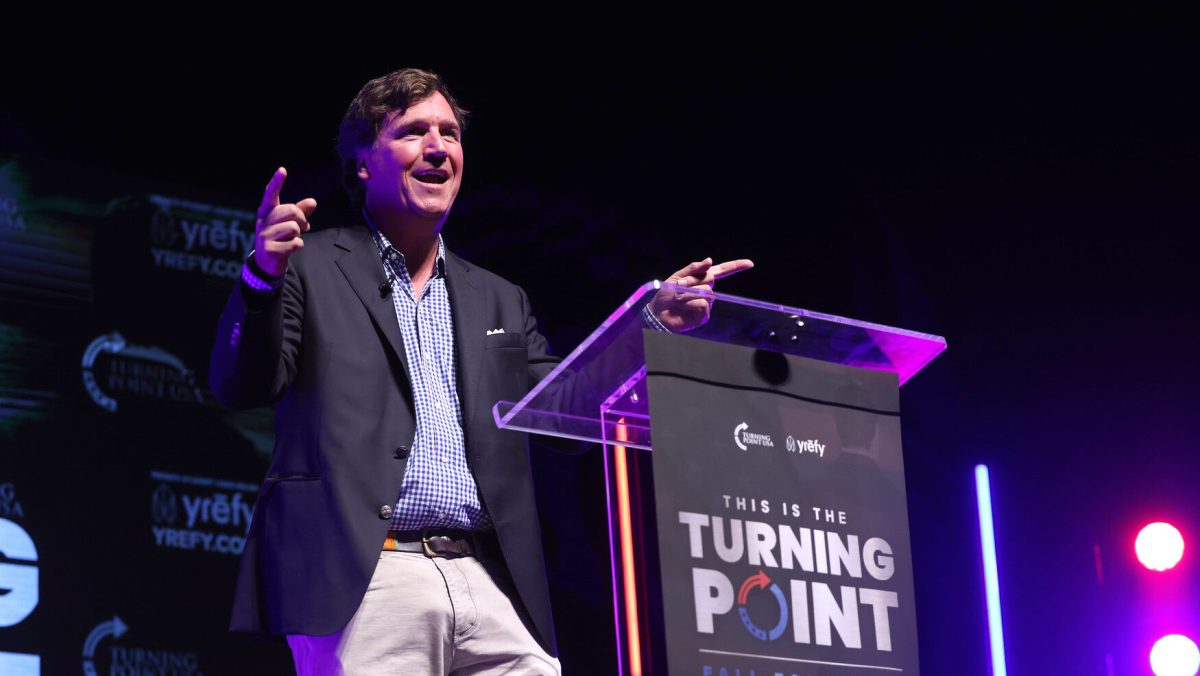
From George Ball to Tucker Carlson: The Persistent Question of American Intervention
On January 3, 2026, U.S. forces captured Venezuelan dictator Nicolás Maduro and his wife in an operation ordered by President Donald Trump. The couple now faces drug trafficking charges in a U.S. federal court. Trump justified the action under the Monroe Doctrine, citing Venezuela’s hosting of Iranian, Russian, and Chinese military infrastructure—including reports of drone production facilities, oil trade benefiting hostile powers, and potential ballistic missile bases targeting the U.S., its ships, and installations.
The operation reignited debate over American intervention. Political commentator Tucker Carlson, who had praised Venezuela as “the most socially conservative country in the Western Hemisphere” for its bans on pornography, abortion, same-sex marriage, gender reassignment, and usury on October 29, 2025, doubled down on January 4, 2026. He said he cares about Venezuela “because I have children,” warning the intervention would lead to greater wars. Weeks earlier, at Qatar’s December 2025 Doha Forum, Carlson had dismissed Israel as “a completely insignificant country” providing “nothing” to the United States.
Middle East analyst Michael Doran identifies this as part of a broader development within American conservatism. As Doran writes in Tablet Magazine, “‘MAGA’ and ‘America First’ once functioned as synonyms—two labels for the same revolt against the Progressive orthodoxy of an entrenched elite that was unresponsive to the voters. But inside Trump’s base, a rising faction now insists the two are diverging.” The question centers on which interventions serve American strategic interests.
The multifront war on Israel that began with Hamas’s October 7, 2023, massacre has become a test case for this debate. Throughout 2024 and into 2025, voices across the political spectrum questioned American support for Israel even as the Jewish state fought Iranian proxies—the same Iran building infrastructure in Venezuela.
These developments reflect a debate that has persisted for nearly 50 years, cycling through American politics with the rhythm of election years and party alignments. The arguments—that Israel drains American resources, that pro-Israel sentiment is irrational, that U.S. leverage should force Israeli concessions—were articulated in 1977 by George Ball, former undersecretary of state under Presidents Kennedy and Johnson.
Israeli Prime Minister Benjamin Netanyahu announced on December 24, 2025, a $110 billion, ten-year plan to expand domestic arms production and reduce Israel’s dependence “on any party, including allies.” The beginning of the post-October 7 war saw resistance in the Democratic Party’s progressive wing to assist Israel militarily. On April 20, 2024, the House passed the Israel Security Supplemental Appropriations Act (H.R. 8034), with 37 Democrats voting “no” along with 21 Republicans. In September 2021, only nine representatives opposed a similar bill: Eight progressive Democrats and Republican Thomas Massie of Kentucky. This trend of withholding support for Israel had spread more widely by the end of 2025.
If the debate over American intervention follows cycles rather than consistent principles—if it cannot distinguish between Venezuelan threats and Israeli assets—then Israel cannot rely on stable American support regardless of which party controls Washington. Netanyahu’s independence initiative reflects this assessment.
The Cyclical Pattern: How Parties Switch Positions
In 2011, the Economist’s “Democracy in America” blogger Erica Grieder observed a shift in Republican attitudes toward foreign intervention. During the George W. Bush administration, Republicans supported military interventions in Iraq and Afghanistan. Democrats like Senator Joe Lieberman, who agreed with Bush, found themselves marginalized. Yet by 2011, under President Barack Obama, these positions had reversed. Republicans opposed Obama’s Libya intervention, reverting to non-interventionist rhetoric to oppose a political rival.
Polling data confirmed this reversal. A 2004 Pew poll showed 58 percent of “conservative Republicans” supporting international interventionism, with about a third more concerned with domestic issues. By 2011, these numbers had flipped: 55 percent of conservatives favored focusing on domestic problems, while one-third advocated international intervention. Grieder concluded this shift “might be cyclical—a Democratic president, an economic downturn, a result of tea-party Republicans having stormed the dais.”
Conservative editor Alex Massie provided context. Most Republicans, he argued, are “non-interventionists” who oppose specific interventions based on national interest calculations, not true “isolationists” like Ron Paul or Gary Johnson. Massie identified the core pattern: “It has become traditional for the opposition to complain that the incumbent President (and his party) is too preoccupied with foreign affairs. There are, all things being equal, relatively few foreign policy voters. That’s why Clinton, Bush, Kerry and Obama each accused their opponent of neglecting the ‘homeland’.”
The opposition party—whichever party that is—gravitates toward criticizing overseas commitments as distractions from domestic needs. The perception of vital national interest matters more than ideological consistency. Republicans criticized Obama not for intervening too much but for being weak, for siding with Iran and Syria. Similarly, Republicans blamed the 1979 rise of Iran’s Islamic Republic on President Carter’s withdrawal of support for the Shah, resulting in the hostage crisis.
The pattern extends to Republican administrations. In 1957, President Eisenhower threatened to withdraw American support for Israel unless it withdrew from the Sinai Peninsula, captured during the 1956 Suez Crisis. Eisenhower’s approach would be echoed by future administrations: use the threat of aid withdrawal to extract territorial concessions from Israel.
George Ball’s 1977 Template: The Original Modern Critique
In 1977, Democratic diplomat George Ball published an article in Foreign Affairs titled “How to Save Israel in Spite of Herself.” Ball, who had served as Ambassador to the United Nations under President Kennedy, articulated what would become the template for Israel criticism across both parties for the next half-century.
Ball made three core arguments. First, Israel drains American resources for no clear benefit. Second, American pro-Israel sentiment is irrational and driven by sectarian interests that contradict U.S. national interests. Third, the United States should use its aid as leverage to force Israel into territorial concessions, threatening withdrawal of support to compel compliance.
Ball’s formulation: “It is not whether we should try to force an unpalatable peace on the Israeli people, but rather how much longer we should continue to pour assistance into Israel to support policies that impede progress toward peace and thus accentuate the possibility of war, with all the dangers that holds not only for Israel but for the United States and the other industrialized democracies…. Put another way, how much longer should we go on subsidizing a stalemate that is manifestly untenable for all concerned?”
Ball believed the American public’s pro-Israel sentiment was irrational and that claims of antisemitism stifled Israel-critical discourse. He pushed for an American-led peace settlement based on his interpretation of UN Security Council Resolutions 242 and 338, calling for Israel to withdraw from Judea and Samaria. Like many American diplomats, Ball believed the Arab-Israeli conflict to be the root cause of Middle Eastern instability and that Israel’s holding onto the gains of 1967 would make it “a ward of the United States.”
Ball’s intellectual heirs pushed for the 1993 Oslo Accords. In 1992, Ball and his son Douglas published The Passionate Attachment, claiming that American sectarian interests in Israel ran counter to American national interests. Doran notes this approach was shared by former Secretary of State James Baker and former Secretary of Defense Robert Gates.
Thirty years after Ball’s article, John Mearsheimer and Stephen Walt published “The Israel Lobby and U.S. Foreign Policy,” which is still referenced by anti-Israel proponents. They argue that AIPAC disproportionately influences American foreign policy, often against U.S. and Israeli national interests, entangling the United States in Middle Eastern conflicts.
Mearsheimer and Walt, like Ball, downplay U.S. strategic interests in the Middle East and Israel’s assistance in maintaining them—the intelligence, military technology, and stability Israel provides. Mearsheimer has supported Russia against Ukraine and described Israel as an apartheid state.
The Religious and Cultural Roots
Doran traces the liability-versus-asset debate to whether solving the Arab-Israeli conflict is central to Middle Eastern regional stability. If Israel is associated with the United States and constitutes a regional “problem,” it will taint America in the eyes of Muslims and Arabs. These principles have been applied to U.S.-Iran relations and are considered the source for Obama’s Tehran outreach.
Doran traces the debate to two interwar schools of Protestantism: Protestant modernism, informed by reason and science, was associated with anti-Zionism; Protestant fundamentalism, emphasizing Biblical literalism, supported Zionism. These perspectives shaped American public opinion for decades. Both left and right have viewed Israel through their own ideological lens.
The Gap Between Influencers and the Base
In December 2025, at Turning Point USA’s AmericaFest conference in Phoenix—a gathering of 30,000 young conservative activists—an informal straw poll revealed pro-Israel attitudes despite anti-Israel rhetoric dominating certain corners of conservative media.
When asked to identify the greatest threat facing America, 31,008 respondents selected “radical Islam” as their top concern, ahead of socialism and Marxism. On Israel specifically, 86.7 percent viewed it as either an ally (53.4 percent) or America’s top ally (33.3 percent). Only 13.3 percent said Israel was “not an ally.”
These findings are notable given that the conference became a flashpoint over Israel. Republican commentator Steve Bannon attacked fellow commentator Ben Shapiro as “Israel First” and “a cancer.” Yet the attendees overwhelmingly rejected the anti-Israel framing.
The gap between online influencers and the grassroots conservative base suggests the anti-Israel campaign may be louder than representative. Daniel Greenfield of the David Horowitz Freedom Center observed that infiltration of events like TPUSA with anti-Israel “Groypers” is “an op” designed “to create the illusion of a major tilt.” The polling data indicates this operation has not succeeded in moving the base.
The Persistence of the Pattern
Ball’s 1977 argument persists across nearly 50 years. The same claims—that Israel is strategically insignificant, drains American resources, enjoys support driven by irrational sentiment, and should face U.S. leverage to force concessions—reappear across both political parties.
The pattern holds whether the critic is Democratic diplomat Ball, Republican officials Baker and Gates, academics Mearsheimer and Walt, or media personality Carlson. The packaging changes—Ball used Cold War realpolitik, Mearsheimer and Walt used academic analysis of lobbying power, Carlson uses populist economic nationalism—but the core claim remains: Israel is more trouble than it’s worth.
If the debate over American intervention is cyclical and partisan rather than principled, relying on consistent American support becomes dangerous. The opposition party will find reasons to question overseas commitments. The party in power will face pressure to demonstrate it is not neglecting domestic needs. Israel, as the largest recipient of American military aid and focus of intense scrutiny from both left and right, will be caught in this cycle.
Netanyahu’s December 2025 announcement reflects this assessment. The $110 billion independence initiative is not primarily about doubting current American support—though President Biden’s threats of an arms embargo during the Gaza war reinforced Israeli concerns. Rather, it reflects an assessment of American political patterns. The debate over intervention will continue cycling through American politics regardless of which party controls Washington.
The Venezuela operation demonstrates that when strategic threats are clear—hostile powers in the Western Hemisphere—intervention follows. Yet America’s strategic ally Israel, which provides combat-tested military technology, intelligence, and regional deterrence against the same Iranian regime building infrastructure in Venezuela, has not always enjoyed support. As Doran warns, “America First, as defined by Tucker Carlson… is a suicide pact, in which the U.S. unilaterally dismantles its own vast and uniquely powerful global military and economic empire in exchange for far lower living standards and a world whose strategic choke-points are controlled by the Chinese Communist Party and its allies.”
Sources
Ball, George W. “How to Save Israel in Spite of Herself.” Foreign Affairs 55, no. 3 (April 1977): 453-471.
Ball, George W., and Douglas B. Ball. The Passionate Attachment: America’s Involvement with Israel, 1947 to the Present. New York: W.W. Norton & Company, 1992.
“Ben Shapiro Mocks Tucker Carlson’s Defense of Venezuela.” EADaily, January 4, 2026. https://eadaily.com/en/news/2026/01/04/ben-shapiro-mocks-tucker-carlsons-defense-of-venezuela
Carlson, Tucker. “Venezuela: The Most Socially Conservative Country in the Western Hemisphere.” Tucker Carlson Show, October 29, 2025. Townhall.com. https://townhall.com/tipsheet/venezuela-most-socially-conservative
Doran, Michael. Ike’s Gamble: America’s Rise to Dominance in the Middle East. New York: Free Press, 2016.
Doran, Michael. “Giant Abroad, Midget at Home: Why the Trump Coalition Is Cracking Up.” Tablet Magazine, December 5, 2025. https://www.tabletmag.com/sections/news/articles/giant-abroad-midget-at-home-trump-coalition
Greenfield, Daniel. “TPUSA AmFest Poll Shows Actual Positions on Islam, Israel.” Frontpage Magazine, December 23, 2024. https://www.frontpagemag.com/tpusa-amfest-poll-shows-actual-positions-on-islam-israel/
Grieder, Erica. “Isolationism and the Republicans.” The Economist, February 16, 2011. https://www.economist.com/democracy-in-america/2011/02/16/isolationism-and-the-republicans
“Israel Seen as a US Ally as TPUSA Poll Ranks ‘Radical Islam’ Top Threat.” The Jerusalem Post, December 23, 2024. https://www.jpost.com/american-politics/article-881080
Massie, Alex. “Republicans and Isolationism.” The Spectator, February 17, 2011. https://www.spectator.co.uk/article/republicans-and-isolationism/
Mearsheimer, John J., and Stephen M. Walt. The Israel Lobby and U.S. Foreign Policy. New York: Farrar, Straus and Giroux, 2007.
Netanyahu, Benjamin. Speech at Air Force graduation ceremony, December 25, 2024. Reported in “Israel to Spend $110 Billion on Independent Arms Industry.” The Jerusalem Post, December 25, 2024. https://www.jpost.com/defense-and-tech/article-881386
Opall-Rome, Barbara. “Obama Offers Israel New 10-Year Aid Package, But There’s a Catch.” Defense News, February 13, 2016. https://www.defensenews.com/global/mideast-africa/2016/02/13/obama-offers-israel-new-10-year-aid-package-but-there-s-a-catch/
Pew Research Center. “America’s Place in the World 2013.” December 3, 2013. https://www.pewresearch.org/politics/2013/12/03/public-sees-u-s-power-declining-as-support-for-global-engagement-slips/
“Walloping Poll Results from TPUSA’s AmericaFest Show Vast Majority of MAGA Support Israel.” The Western Journal, December 24, 2024. https://www.westernjournal.com/walloping-poll-results-tpusas-americafest-show-vast-majority-maga-support-israel-know-islam-mortal-threat-west/