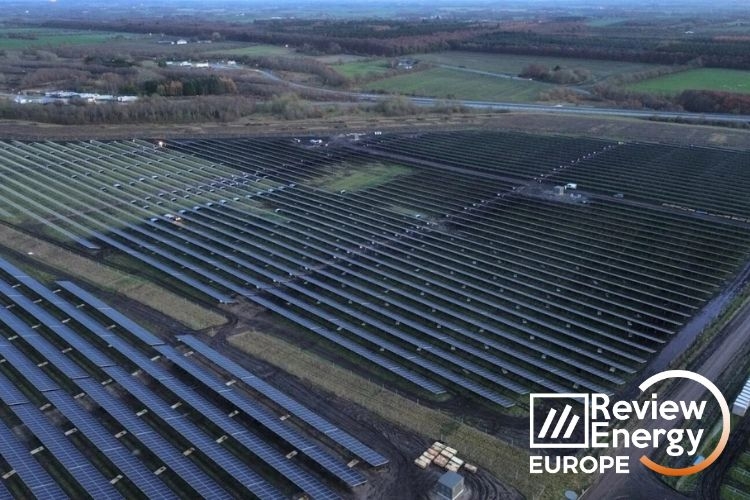
With the grid connection of the 148 MW Glejbjerg Solar Park and the commissioning of the 200 MWh battery energy storage system at Kvosted Energy Park just before the new year, European Energy has reached 2.1 GW of grid-connected renewable capacity in Denmark. The portfolio spans utility-scale solar PV, wind power and battery energy storage systems (BESS), and now represents more than 20% of Denmark’s total onshore renewable energy capacity.
European Energy’s grid-connected portfolio in Denmark comprises more than 40 projects developed, acquired and commissioned between 2013 and 2025, reflecting a long-term development and asset management strategy in the country. Projects are distributed across Denmark, and the company currently manages around 2 GW of the installed capacity.
The milestone comes at a time when Denmark’s power system faces growing demand. According to the Danish Energy Agency, national electricity consumption is expected to double by 2040, underlining the need for a significant expansion of renewable generation and system flexibility to support the green transition.
“We have a strong development portfolio across Denmark, supported by solid local partnerships. Projects only contribute to the green transition when they are successfully built and brought into operation. Reaching this milestone demonstrates our ability to deliver, and we look forward to continuing to support local and national climate and energy targets,” says Maja Rasmussen, Country Manager for Denmark at European Energy.
In parallel with the development of new renewable assets, European Energy will focus in 2026 on upgrading existing projects through the integration of battery systems. These upgrades are designed to increase operational flexibility, allowing renewable assets to store electricity and deliver power during periods of low solar and wind generation, thereby supporting grid stability as renewable penetration increases.
The integration of battery storage into existing generation assets forms part of European Energy’s broader strategy to continuously adapt projects to evolving system needs and market conditions, ensuring long-term operational and economic performance across its Danish portfolio.
“Bringing assets from development into stable operation requires close coordination across engineering, construction and asset management,” says Poul Jacobsen, EVP and Head of EPC at European Energy.
“Our experience in Denmark shows that assets can continue to evolve after commissioning, including through battery integration and other technical upgrades. This ongoing optimisation supports both long-term operations and the economic performance of the portfolio.”
A key contributor to the recent capacity increase is the Glejbjerg Solar Park, which was connected to the Danish grid in late 2025 following the completion of final technical checks. The project adds 148.2 MW of installed solar capacity and strengthens European Energy’s operational platform in Northern Europe, adding another utility-scale asset supported by a power purchase agreement (PPA) and suited for long-term ownership.
The Glejbjerg Solar Park comprises 238,368 photovoltaic modules and 572 inverters, with an expected annual electricity production of approximately 153 GWh. The project achieved commercial operation date (COD) at the end of 2025 after a consistent construction process, reducing technical risk and positioning the asset for stable long-term operational performance.
Alongside solar expansion, the battery system at Kvosted Energy Park provides a total storage capacity of 200 MWh. The system plays a key role in enhancing the flexibility of European Energy’s Danish portfolio, enabling better integration of variable renewable generation into the power system.
European Energy continues to develop, build and operate renewable energy projects in Denmark, with a focus on long-term operations, system optimisation and close cooperation with local stakeholders and municipalities, as the country accelerates its transition towards a low-carbon energy system.