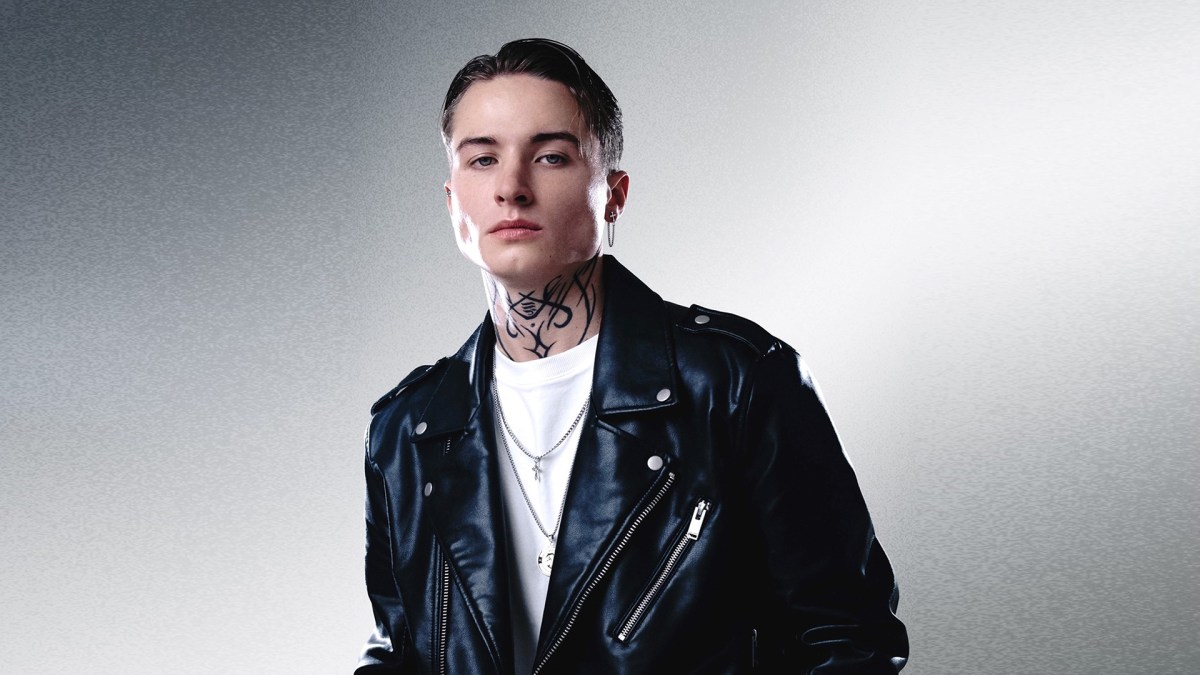
Ahead of their participation at Selecţia Naţională 2026, Rory got to have a chat with Emforia about their song “Tipare”. They are hoping to represent Moldova at Eurovision 2026 with the track, and will perform the song at the Selecţia Naţională final on January 17th.
Tell us about yourself! Why did you decide to become a singer, and what are some highlights of your career so far?
Singing was never a decision — it was always an impulse, a creative urge that followed me since childhood. I simply loved to sing. I grew up listening to many different genres of music, absorbing everything from pop to rock to underground sounds.
Music became my therapy — my way to express emotions I couldn’t always put into words. Even back in school, I wrote poetry, later combining it with guitar chords, turning my verses into songs. Creativity for me is not something I force — it flows naturally, almost instinctively.
About a year and a half ago, life connected me with people who truly believed in me. I joined a co-production journey with Anton Ragoza, founder and former member of SunStroke Project (Eurovision 2017 Kyiv — 3rd place), and Iuri Ribac, producer and expert in stage concepts, directing and choreography, who was also the choreographer and stage director for Moldova’s 2017 Eurovision performance and many others.
What made you decide to take part in Selecţia Naţională this year?
Selecția Națională is an incredible stage to tell a story and be truly heard. Our song “Tata” was already written — it has a special place in my heart. Not using the opportunity to share it here would have been a missed chance to deliver its emotion and meaning to people.
This is not just a contest — it is a bridge between the artist and the audience. I believe everyone who feels the song deeply can find a part of themselves in it.
You say on your Spotify bio that you want to “take people out of their comfort zones” with your music. Do you think Moldovans are ready for a song with quite fresh and contemporary beats, as much Moldovan music that has broken through into the international music scene is more traditional?
I wouldn’t say that only traditional music defines Moldova’s culture abroad. Moldova already had modern breakthroughs: Dan Balan with his global hits, Carla’s Dreams — “Eroina” — these were fresh, contemporary sounds.
What our team does now is a chance to show a new musical face of the country. Our style is Dance / Pop / Electro, and we don’t claim it is the most unique sound in the world, but it is an honest experiment that we ourselves always missed in the local market. Moldova can sound different too — and this is Moldova as well.
What was the songwriting process for “Tata” like?
The idea for “Tata” came from Iuri when he heard about my personal story with my father. Later we realized that Anton and even Iuri himself had their own, very different but emotionally strong father stories — and this only strengthened our belief that the song needed to be honest.
We wrote it very fast, almost as if all the stars aligned in that moment. Everyone contributed — both to the lyrics and the musical line.
It’s a dialogue-song. A feeling-song. It carries pain but also light. If you close your eyes and feel the rhythm — you can feel it even without words.
What is the meaning behind your song?
The song is about accepting pain from the missing attention of our fathers, forgiving without excuses, and understanding that sometimes their silence is their own wound — not our fault.
Everyone will hear it differently — the key is to feel it through your own emotions.
Can you give us any hints as to what we can expect from the live performance?
I can’t reveal everything, but I can share the core idea: the stage will feature emotional images — “memory anchors” that tell a story familiar to many from childhood. It will not be just a song, but a visual emotion brought to life.
The song is performed in Romanian, and it is very important for us that the visual storytelling makes it understandable and deeply felt even without translation.
We are creating the performance in a way that allows the audience to grasp the meaning through imagery, atmosphere, and movement, even if they don’t understand the lyrics. Our goal is for the story to be **clear to the heart and the eyes, not only the ears.
This will be more than a musical number — it will be an emotion you can see and experience, where the visuals become a bridge capable of conveying the depth of the song, even with your eyes closed and your heart open.
Have you listened to the other competing songs in Selecţia Naţională? Do you have a favorite?
Yes, I listened to many songs, and I truly wish success to every artist.
But I don’t choose favorites — my principle is to respect every participant brave enough to tell their story on this stage.
Do you have a favorite Eurovision song or memory?
Yes, absolutely!
I admire Loreen for both of her winning performances, and Slimane — “Mon Amour” — for me, those were some of the strongest and most emotional numbers that touched not only hearing but the heart.
Finally, what would you like to say to people discovering your music for the first time through Selecţia Naţională?
Music is a language that never asks for explanations, yet always finds its way into the heart. If you felt even one note or one line — then this song has already become yours too.
Don’t be afraid to be yourself, feel deeply, and dream loudly — this is how new rhythms, new stories, and new inner strength are born.
Thank you for listening with your heart. Welcome to my musical world — where emotions have no limits and you can dance even where it hurts.
Who is Bacho?
Bacho is the stage name of Edgar Bacioi, a 21-year-old singer-songwriter from Moldova. His unique style blends modern music trends with elements of folk music. He first shot to fame as part of the Moldovan delegation at Eurovision 2023, and honed his craft into creating “Semafoare”, which was submitted to TRM to represent the nation in Eurovision 2025. After Moldova eventually withdrew, Bacho worked together with other well-known Moldovan artists, and has since become one of the most current artists in the country. His song for Eurovision 2026, “Tata” is written by Bacho himself, as well as Covalenco Ghennadi, Iuri Rîbac and Anton Ragoza, who was part of the SunStroke Project.
Moldova’s Eurovision journey
Moldova is relatively new to the Eurovision Song Contest, joining in 2005. Their debut entry, Zdob și Zdub, finished in 6th place, which had remained their highest scoring entry up until 2017. They were dethroned by returners Sunstroke Project and the song ‘Hey Mamma’, which finished in 3rd place. At the close of voting, Moldova received 374 points.
After representing Moldova in 2007, Natalia Barbu returned to Eurovision in 2024 with the song “In the Middle”. She received 20 points in the first semifinal, ultimately placing thirteenth and missing out on the grand final.
What do you make of our interview with Bacho? Do you think they could go on to represent Moldova? As always, please let us know what you think by getting involved in the comments below. Also, be sure to follow ‘That Eurovision Site’ on Facebook, Instagram, Twitter, TikTok, Threads, tumblr, and Bluesky for more information about Eurovision 2026!
News Source: That Eurovision Site
Photo Credit: Bacho
Post navigation