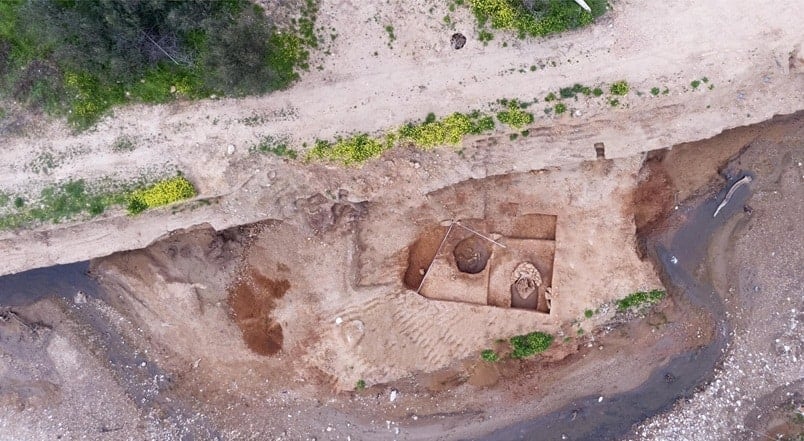
The Ministry of Culture noted that the level of care and the architectural complexity of this burial are exceptional for the period. Credit: Ministry of Culture
Archaeologists have discovered an unusually sophisticated Early Bronze Age burial in Rafina, offering rare insights into the funerary rites and social hierarchies of Attica from over 4,000 years ago.
The find dates to the Early Helladic period (roughly 3200–2000 BC).
An architectural marvel in clay found in Rafina
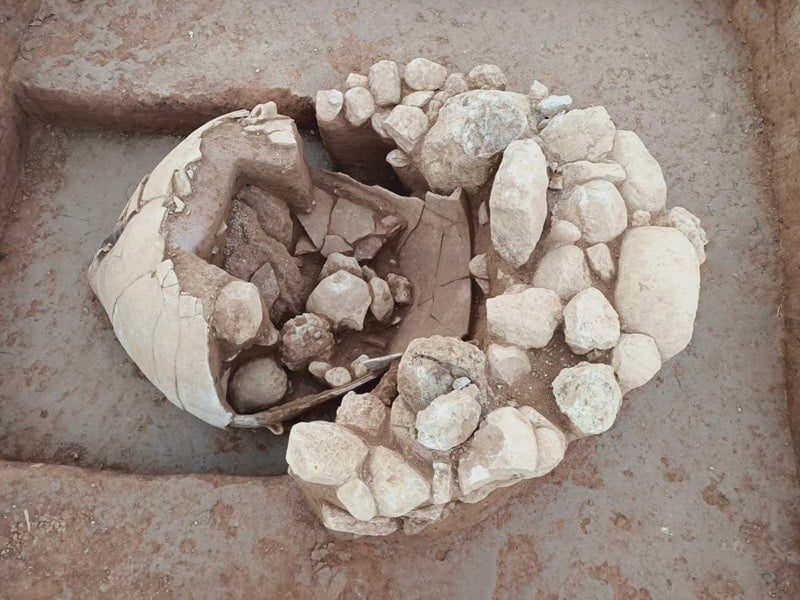
The vessel was found meticulously placed within a pit. Credit: Ministry of Culture
The centerpiece of the find is a massive pithos (a large clay storage jar) measuring 1.74 meters in height. The vessel was found meticulously placed within a pit carved into the southern bank of a stream.
Beyond its sheer size, the pithos features:
Artistic relief: Characteristic rope-like relief patterns encircling the neck and handles.
Structural integrity: Horizontal handles positioned at its widest point to facilitate placement.
The “pseudo-doorway”: In a rare architectural flourish, the mouth of the vessel was sealed by a semicircular wall of river pebbles. Two large stones, interspersed with smaller slabs, were arranged to form a symbolic entrance—complete with jambs and a threshold—simulating a permanent home for the deceased.
The interior: ritual and status
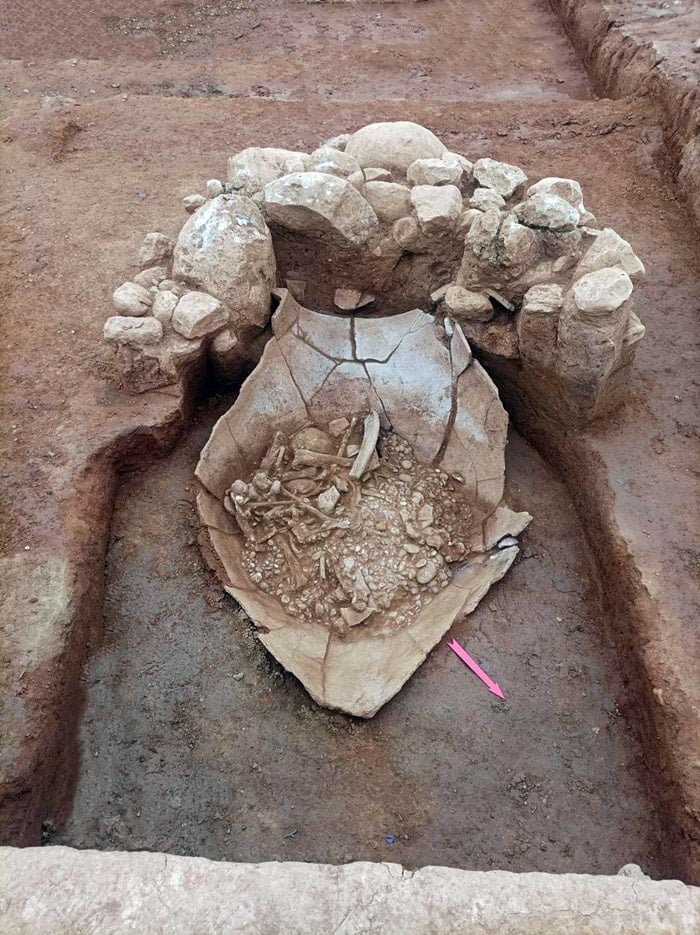
Skeletal remains were found in the burial. Credit: Ministry of Culture
Upon opening the vessel, archaeologists found the skeletal remains of two individuals resting on a carefully prepared bed of sand and river pebbles. The remains were covered by large stones that occupied nearly the entire interior space, a practice likely intended to protect or ceremonially “seal” the occupants.
The “grave goods” discovered alongside the remains suggest that these individuals held a high social status within their community. The cache included:
Bronze tweezers (indicating personal grooming and access to precious metals).
Obsidian points (highly valued volcanic glass used for tools or weaponry).
Fine pottery and a small stone slab.
Historical significance
The Ministry of Culture noted that the level of care and the architectural complexity of this burial—particularly the “doorway” construction—is exceptional for the period.
It suggests a deeply rooted belief in the afterlife and a high degree of communal effort invested in honoring the dead.
Related: Healing Sanctuary and Sacred Secrets Found at Ancient Greek City of Tenea