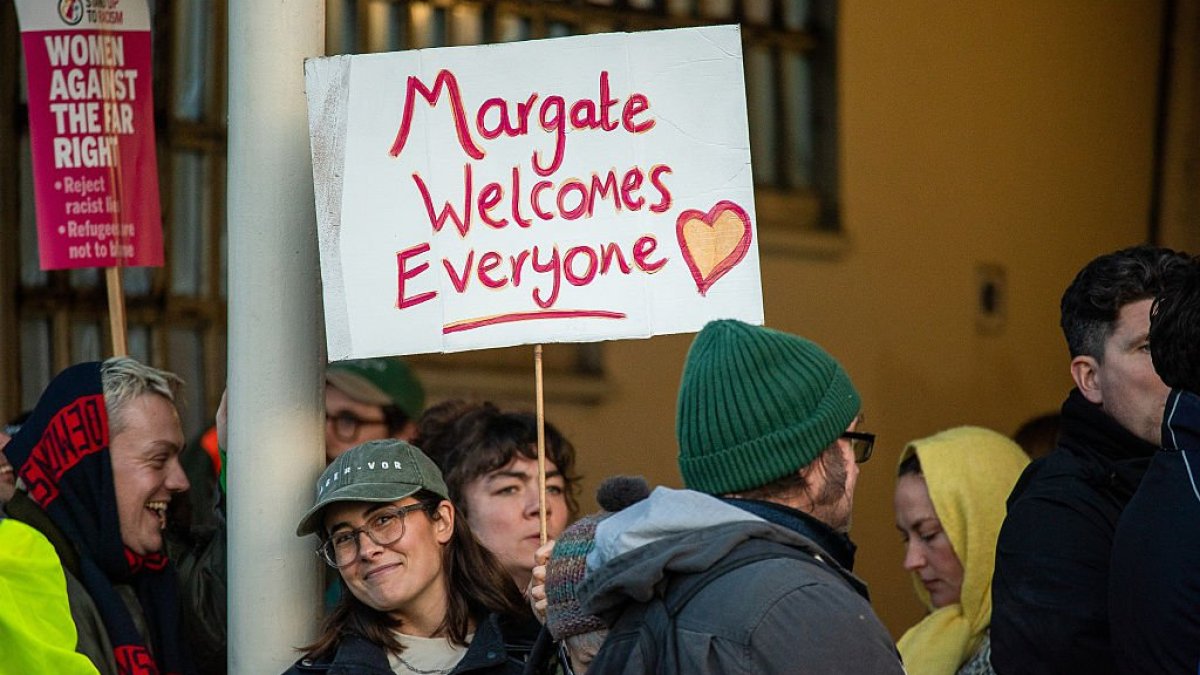
A new pilot scheme will look to purchase existing new-build housing and renovate derelict properties to help solve the asylum accommodation crisis
“If you’ve lived here your whole life, then you should be first in the queue.”
Sheltering from the icy wind in a cafe in Margate on the Kent coast, Jess had robust views on the news that her local authority is considering joining a Government pilot scheme to provide new housing for asylum seekers.
The mother-of-two has been on a waiting list for social housing since last summer with Thanet District Council. “I’m sorry for the people coming over on the boats but you’ve got to look after your own,” she said.
New FeatureIn ShortQuick Stories. Same trusted journalism.
A few hundred yards away, Mikael offered a different perspective as he emerged from a hotel used to house asylum seekers in the seaside town’s Cliftonville area.
The Eritrean national, who arrived on a small boat crossing last year, said: “I feel safer here. I want to build a new life. I want to do something to help these people who are helping me.”
Between them, Jess and Mikael find themselves at the crux of the Government’s plan to meet its pledge to end the use of privately-owned hotels to house migrants by once more involving local authorities in the provision of accommodation for newly arrived asylum seekers.
‘Win-win’ for social housing
Under a Whitehall scheme quietly announced in recent weeks, £100m is being provided to allow district councils to buy newly built homes or renovate derelict properties which would initially be used to house asylum seekers.
The properties would be leased back to the Home Office for an expected 10-year period as asylum seeker housing to be used instead of hotels. At the end of that time, or when no longer needed, the property would revert back to the local authority to be added to its social housing stock.
 Margate contains some of the poorest council wards in England but has been boosted by investment in recent years (Photo: Ben Stansall/AFP)
It was confirmed last week by The i Paper that five councils either directly run by Labour or via a coalition – Thanet, Brighton and Hove, Hackney, Peterborough and Powys – are keen to take part in the scheme.
They argue that it offers a “win-win” by slashing the cost to the taxpayer of Britain’s eye-wateringly expensive hotel-based asylum accommodation system, while also ultimately boosting the supply of council-owned homes.
The waiting list for social housing in England last year stood at over 1.3 million – an increase of three per cent on 2023 and a 10-year high. According to one study, that figure could reach two million by 2034 unless building rates dramatically increase.
Separately, the Home Office is currently responsible for housing some 100,000 asylum seekers, of whom 36,000 are being accommodated in hotels at a cost of £2.1bn last year. The overall bill for housing migrants in hotels and private lets is set to balloon from £4.5bn to £15.3bn in the decade from 2019 to 2029.
According to the National Audit Office (NAO), the three main private companies providing the asylum accommodation system – Serco, Mears and Clearsprings Ready Homes – made profits between them of £383m in the five years to September 2024.
Nervousness among council leaders
But, the pilot scheme has provoked nervousness among some Labour local authority leaders that it could be interpreted as pitting the needs of two marginalised groups – those at risk of homelessness, and asylum seekers – against each other.
In Cliftonville this week, it was not hard to find individuals like Jess expressing concern that the proposals could result in asylum seekers being prioritised for housing ahead of long-term residents in Margate.
The totemic resort, which has recently seen an influx of Londoners keen on cheaper property and a less pressured lifestyle, contains two of the most deprived council wards in Kent, while Thanet as a whole features in the top 10 per cent of the most deprived districts in England.
The result is significant pressure on social housing in the area. As of May last year, the council had a waiting list of 1,904 households needing to be rehomed for reasons including homelessness, overcrowding or welfare concerns.
Latest Home Office figures showed that the Thanet area was hosting 79 asylum seekers in hotel accommodation in September – a slight reduction on the previous three months. The total number of refugees and asylum seekers in the area represents 0.37 per cent (or one in every 270) of the population.
 Nigel Farage pictured visiting Thanet last year, ahead of Reform winning control of Kent County Council in the local elections (Source: Getty)
According to local politicians who are keen on joining the pilot, juxtaposing social housing waiting lists with asylum seeker housing provision fails to compare like with like.
Helen Whitehead, deputy leader of Thanet District Council, said similar schemes have previously provided funding for accommodation that would otherwise not be available to the local authority and “produces extra housing on top of what would we could ordinarily produce”.
The council did not respond to a request to comment on the pilot scheme. But in a Facebook posting this week, Whitehead said the council was still awaiting details of the scheme from the Department for Housing, Communities and Local Government but if it worked along similar lines to previous projects it would create a “virtuous circle”.
She said: “It will allow us to support people, and provide extra council housing, as well as providing income to produce even more council housing for general usage.”
According to separate estimates, it costs about £145 per night to provide accommodation in an asylum seeker hotel. By contrast the cost of providing so-called “dispersal” accommodation, such as flats and houses, is as little as £23 per night.
Anti-migrant protests
Experts warn, however, that economic arguments in favour of local government involvement in asylum housing are vulnerable to competing political narratives.
A report last year by Soha Housing, a not-for-profit housing association, warned that political barriers represent the “toughest” challenge for the new approach.
The study, which called for a joint Government fund to allow councils to buy homes for both the asylum system and tackling local homelessness, said: “Many local authorities have been concerned about the politics of purchasing homes specifically for refugees and asylum seekers in the context of an acute national housing crisis… Government must take a joined up approach to ending the use of expensive and unsuitable transitional housing for different groups.”
 Far-right protesters march with flags in Margate shortly before Christmas (Source: Getty)
Tensions over the use of asylum hotels and the knock-on effects for communities remain high. Protests targeting migrant accommodation this summer were sparked by controversy over the Bell Hotel in Epping, where Ethiopian sex offender Hadush Kebatu had been housed.
Margate has not escaped such problems.
Last month, a 24-year-old Eritrean asylum seeker staying at a hotel in Cliftonville was jailed for nine years after he was convicted of a serious sexual assault on a lone woman walking on the Margate seafront at night last summer.
Anti-migrant protesters subsequently appeared in the town shortly before Christmas, travelling on a red double decker bus. Organisers of the demonstration, which was met by a sizable counter-demonstration, said they wanted to “remind people this is a Christian country”.
Political fault line
The potential for the pilot scheme to become a political fault line is particularly acute in Kent, where Reform UK’s control of the county council is seen as a test for Nigel Farage party’s agenda of slashing public sector costs and ending small boat arrivals.
Linden Kemkaran, Reform’s leader on Kent County Council, pledged to oppose the pilot project, albeit that county councils have no direct control over housing.
“This piles further strain onto a system already at breaking point, and onto local residents who have waited years for housing, paid into the system all their lives, and now watch homes being allocated to people who should not be here in the first place,” she said.
In the case of Thanet, publicly available figures would appear to challenge such assertions. The local authority has in the last three years dedicated at least £5m to buying housing to reduce its waiting list and plans to have acquired 400 homes for social housing by next year, with an additional 172 properties being bought specifically for homeless households.
In the last year, two-thirds of long-term residents temporarily housed outside the council area have been returned to Thanet.
Local pride in integration
Indeed, while disquiet about housing may not be hard find in places like Cliftonville, there is also an evident pride in the community’s efforts to welcome and integrate migrants housed in Margate.
Cliftonville’s eclectic high road, which in November was named by Time Out website as “one of the world’s coolest streets”, and its environs are host to several enterprises providing outreach and training for asylum seekers, including a community cafe whose premises is funded by the artist and Margate native Tracey Emin.
Other projects include an asylum seeker football team and fitness sessions provided by a migrant PE trainer on the town’s beach.
Rob Yates, Margate’s former mayor and a Green Party councillor who has been at the heart of Thanet’s efforts to reach out to asylum seekers, said there was an unanswerable case for reforming a system whereby migrants are placed in communities with minimal input or involvement from local authorities.
Your next read

He said: “You have housing officers and councillors who understand the needs of these individuals and the local resources that are available. Yet the current system actively excludes that sort of engagement and it creates division. We need to be braver and give local authorities and communities a role in this issue. They will respond positively, not least because it will be part of their job.”
For Jess, nursing a cup of tea before venturing back out into the Arctic wind whipping off the Kent coast, such arguments do not fall on deaf ears. She said: “People should be treated fairly. I don’t think people off the small boats are bad. As long as things are fair, we’d get along fine.”
A Government spokesperson stressed that the pilot would not see local authorities building new council houses for asylum seekers and that any housing purchased as part of the scheme would be in addition to councils’ social housing stock.
They said: “New council housing will not be used by asylum seekers under any circumstances. Asylum seekers are not eligible for social housing.
“This Government will close every asylum hotel. Work is well underway, with more suitable sites being brought forward to ease pressure on communities and cut asylum costs.
“We are working closely with local authorities, property partners and across Government so that we can accelerate delivery.”