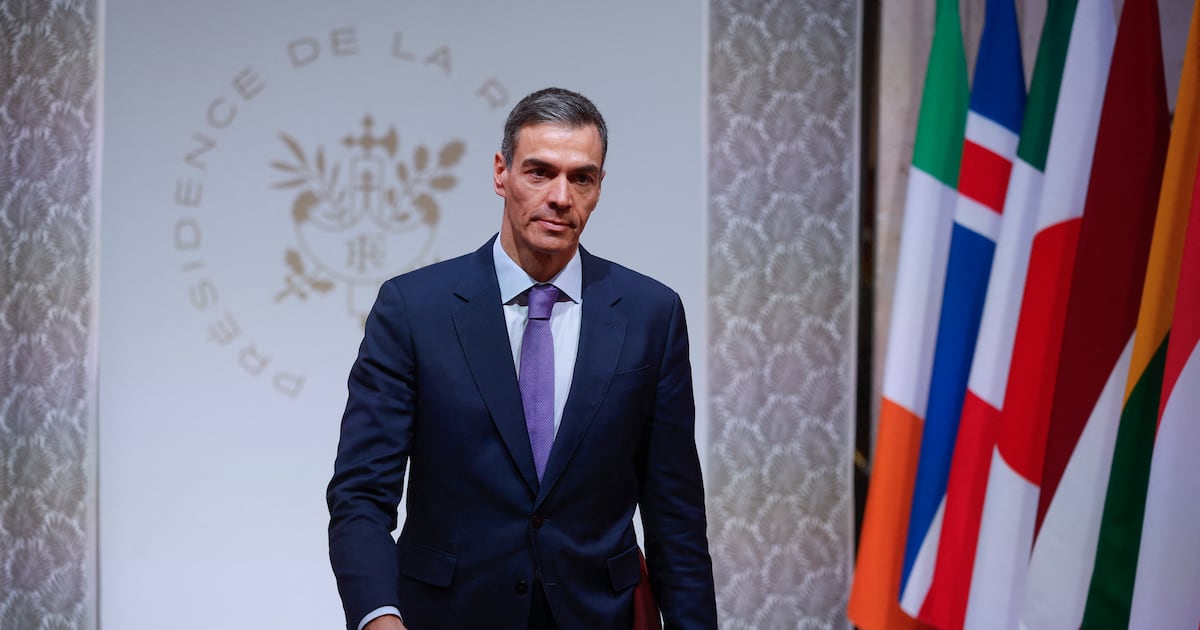
As Madrid seeks to take a leading role in the international response to the Venezuelan crisis, the fallout from it has fed into Spain’s deep political divide, with the left-wing government and right-wing opposition taking contrasting positions.
Spain’s socialist prime minister, Pedro Sánchez, has been the most outspoken European Union leader in criticising the US’s removal of Venezuelan president Nicolás Maduro, warning that it “violates international legality and pushes the [Latin American] region towards a horizon of uncertainty and warmongering”.
Foreign minister José Manuel Albares said on Monday that the intervention had set “a very dangerous precedent for the future”.
Spain was one of six co-signatories – alongside Brazil, Mexico, Uruguay, Chile and Colombia – of a statement issued on Sunday calling for “regional unity, beyond political differences, in the face of any act that puts at risk regional stability”.
Sánchez had already offered to mediate between Caracas and Washington in the wake of Saturday’s dramatic military action and his government asked to participate in the UN Security Council meeting on Monday.
Venezuela’s turmoil has become a prominent political issue in Spain in recent years, in great part because of close economic and cultural links between the two countries.
Tens of thousands of Spaniards migrated to Venezuela in the mid-20th century. The children and grandchildren of many of those migrants are among the Venezuelans who have moved to Spain in recent years to escape economic and social instability. There are now around 600,000 Venezuelans living in Spain.
Direct ties between the Venezuelan government and the far-left Podemos party, which was the junior partner in coalition with Sánchez’s socialists until 2023, brought the South American country’s politics into sharp focus for many Spaniards.
Juan Carlos Monedero, a co-founder of Podemos, was an adviser to the government of Maduro’s predecessor, Hugo Chávez.

Demonstrators against US capture of Venezuela’s Nicolas Maduro and wife Cilia Flores protest in Malaga. Photograph: Jorge Guerrero/Getty
Such connections were at the root of long-standing attacks by the political right on Sánchez and his socialists, who were frequently accused of indulging Maduro’s administration or even of collusion with it.
The socialist former prime minister, José Luis Rodríguez Zapatero, who has been involved in efforts to mediate between Caracas and the international community, has been a particular target.
The leader of the conservative People’s Party (PP), the main Spanish opposition, Alberto Núñez Feijóo, has celebrated the ousting of the Venezuelan president, saying “an evil has been defeated”.
However, he also accused the Sánchez government of “renouncing its diplomatic trump cards and its moral leadership and [failing to] face up to the tyranny of Maduro”.
The PP and the far-right Vox have maintained a close relationship with the Venezuelan opposition, including the candidate in last year’s presidential election, Edmundo González, who is in exile in Spain, and the recently anointed Nobel Peace Prize winner, María Corina Machado.
However, US president Donald Trump’s determination to sideline González and Machado and instead allow Venezuelan vice-president Delcy Rodríguez to take office has made this a more delicate and thorny foreign policy issue for the PP and Vox.
“The future is not Delcy,” Núñez Feijóo wrote on social media, as he called for elections to be held.
Meanwhile, for Sánchez this is the latest international upheaval providing an opportunity to take a bold lead and offering respite from a series of scandals at home.
His staunch support for the Palestinian people in the face of Israel’s bombing of Gaza drew a fierce response from Tel Aviv, but it underlined his status as the EU’s most prominent left-wing leader and gave him kudos among his voter base.
Sánchez’s refusal to agree to Trump’s Nato targets for defence spending had a similar effect.
Although the immediate future of Venezuela is expected to be decided in Washington, it remains a very live issue in Madrid.