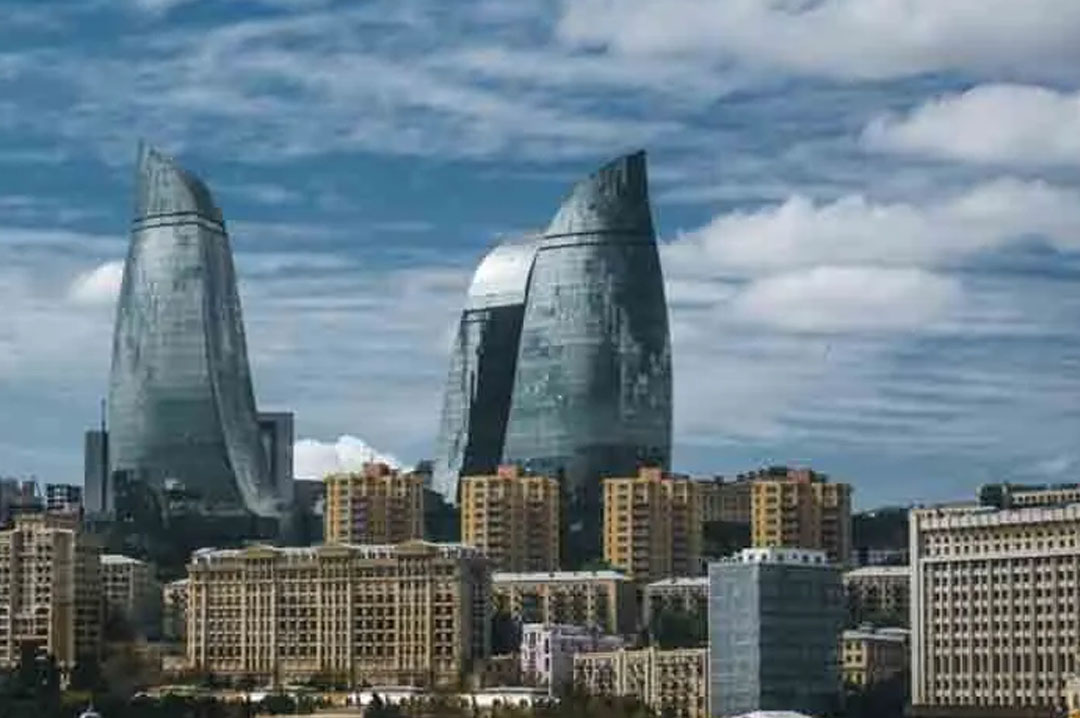
BAKU, Azerbaijan, January 8. Not long ago,
Azerbaijan was widely treated as a geopolitical margin—important
mainly for its oil and gas, constrained by unresolved conflict, and
largely reactive to the agendas of larger powers. Today, that
perception is increasingly outdated. From the Caspian Sea to
Central Asia and from the South Caucasus to Europe, Azerbaijan has
emerged as a state that not only adapts to regional change but
actively shapes it.
This shift did not happen by accident. It reflects a convergence
of post-conflict transformation, infrastructure-driven diplomacy,
and a foreign policy that prioritises strategic autonomy over bloc
politics. Under President Ilham Aliyev, Azerbaijan has turned
geography into leverage, positioning itself as a connector of
regions, energy systems, and political interests at a moment when
global connectivity itself is being redefined.
The idea that Azerbaijan could one day play such a role is not
entirely new. In the mid-1990s, when the country was still
struggling with instability and unresolved war, the late US
strategist Zbigniew Brzezinski argued that Azerbaijan possessed the
core attributes of a successful, independent state—provided it
could consolidate sovereignty and anchor itself economically.
When I interviewed Brzezinski in 1996 for my book The South
Caucasus at the Crossroads, and later spoke with him again at the
Jamestown Foundation in 2010, he consistently described Azerbaijan
as a geopolitical hinge: a country whose success or failure would
shape the wider Caspian and South Caucasus balance. Three decades
later, that assessment appears less theoretical than empirical.
From conflict resolution to strategic
reconstruction
The restoration of Azerbaijan’s territorial integrity in 2023
marked a decisive turning point. Yet what followed may prove just
as consequential. Rather than freezing the post-conflict status
quo, Baku moved quickly to integrate the formerly Armenian-occupied
territories into national and regional development plans. Airports,
highways, rail links, power infrastructure, and new urban projects
have been launched at a pace rarely seen in post-conflict
environments.
This reconstruction effort is not merely about rebuilding what
was destroyed. It is about repositioning Karabakh within
Azerbaijan’s long-term economic strategy—linking it to logistics
corridors, renewable-energy projects, and digital infrastructure.
By emphasising smart cities and green-energy zones, the government
has sought to align post-war recovery with future growth rather
than past dependency.
For external partners, the message is clear: Azerbaijan is not
only capable of restoring territories to full control, but also of
governing and developing them. That capacity matters in a region
long defined by frozen conflicts and stalled transitions.
The Middle Corridor and the new geometry of
Eurasia
Azerbaijan’s growing influence is most visible in the realm of
connectivity. As tensions disrupt traditional East–West trade
routes, the Middle Corridor—linking China and Central Asia to
Europe via the Caspian Sea and the South Caucasus—has gained
strategic importance. Azerbaijan sits at its operational core.
Through sustained investment in the Port of Alat, rail
modernisation, Caspian shipping, and customs coordination, Baku has
transformed itself from a transit country into a logistics hub.
This has elevated Azerbaijan’s relevance not only for the European
Union and Türkiye, but also for Central Asian states seeking
diversified access to global markets.
Kazakhstan, Uzbekistan, and Turkmenistan increasingly see
Azerbaijan as their principal western gateway. Joint transport
initiatives, energy cooperation, and coordinated infrastructure
planning have created what amounts to a functional connectivity
bloc across the Caspian. While not formalised as a political union,
this network has tangible geopolitical effects: it reduces
dependence on single routes, increases regional bargaining power,
and places Azerbaijan at the centre of a widening Eurasian
exchange.
Energy diplomacy beyond dependence
Energy remains central to Azerbaijan’s international profile,
but its meaning has evolved. Gas exports via the Southern Gas
Corridor have reinforced Azerbaijan’s role in European energy
security at a time of acute uncertainty. At the same time, Baku has
invested heavily in offshore wind, solar power, and future
green-energy transmission projects.
This dual approach—meeting immediate demand while preparing for
long-term transition—has strengthened Azerbaijan’s credibility as a
strategic partner rather than a purely extractive supplier. It also
explains the country’s growing visibility on global platforms,
including high-level engagement at the United Nations and the
hosting of major international forums. Such recognition reflects
not only energy capacity, but diplomatic reliability.
A foreign policy built on strategic
autonomy
Perhaps the most distinctive feature of Azerbaijan’s rise has
been its foreign policy posture. Rather than anchoring itself to a
single bloc, Baku has pursued a strategy rooted in strategic
autonomy—maintaining working relationships across geopolitical
divides. President Aliyev has engaged with a wide spectrum of
leaders, including Türkiye’s Recep Tayyip Erdoğan, Russia’s
Vladimir Putin, Iran’s President Masoud Pezeshkian, European
Commission President Ursula von der Leyen, and US President Donald
Trump. These interactions illustrate a diplomacy focused on access,
autonomy, and pragmatic influence.
This approach has allowed Azerbaijan to retain room for
manoeuvre in an increasingly polarised international system.
Relations with the European Union are anchored in energy,
transport, and regulatory cooperation, while ties with Russia
remain pragmatic without compromising independence.
Engagement with Iran has been recalibrated through economic and
regional dialogue, and relations with Türkiye and the United States
have been consolidated through defence, economic, and diplomatic
cooperation. The result is not neutrality, but strategic
manoeuvrability across competing spheres of influence.
From potential to power
Taken together, these developments suggest that Azerbaijan has
crossed a strategic threshold. It is no longer simply responding to
regional dynamics; it is helping define them. The South
Caucasus—long shaped by external competition and unresolved
disputes—is increasingly organised around initiatives originating
in Baku.
These gains, however, are not self-sustaining. Azerbaijan’s
emerging role will depend on its ability to manage complexity
rather than simply accumulate leverage—balancing connectivity with
security, economic integration with sovereignty, and regional
ambition with long-term stability. The challenge ahead is less
about expansion than consolidation: ensuring that today’s strategic
advantages translate into enduring influence.
Still, power in today’s international system is increasingly
network-based and transactional. By those measures, Azerbaijan’s
performance has been notable. What Brzezinski once identified as
potential has begun to materialise as agency: a state using
connectivity, reconstruction, and strategic autonomy to shape its
environment rather than be shaped by it.
Azerbaijan’s trajectory now poses a strategic question for its
partners rather than for Baku itself. Can international actors
engage Azerbaijan as a shaping force—one that anchors stability
through connectivity and pragmatic diplomacy—rather than viewing it
solely through inherited narratives of post-Soviet transition? The
answer will influence not only the future of the South Caucasus,
but the viability of a more connected Eurasia at a time when
fragmentation has become the global norm.