The U.S. Operation Absolute Resolve to capture and kidnap former Venezuelan President Nicolás Maduro is quite possibly one of the most unprecedented military operations to ever be carried out. While the facts on the ground are still not completely clear, we can at least establish why the Trump administration decided to remove Nicolás Maduro from power.
“Classic U.S. Imperialism”
Conventional wisdom tells us that the primary motivation was to secure American access or control over Venezuela’s oil. Oil is a major factor — but it’s actually secondary. Venezuelan oil was used by the Trump administration to sell the intervention to a skeptical political and business class. In other words, from Donald Trump’s perspective, a military operation to oust Maduro was worthwhile because American multinationals will profit from the oil bonanza that would come afterward.
But the truth is that the United States does not need Venezuela’s oil. The U.S. is, after all, the world’s largest producer of petroleum — averaging a record-setting 13.5 million barrels per day in 2025 — and a net exporter of energy supplies.
There is also no market imperative to justify an oil grab for the purpose of bringing more Venezuelan petroleum online. The global demand for oil is currently not outstripping global supply, and prices are on the decline. In fact, not only is there a glut in the international market right now, but more oil is expected to slosh around the global economy later this year. The integrity of the international oil market is safe and sound, and scarcity in global supplies of energy are nowhere near the horizon.
However, the primary motive for ousting Maduro was revealed by Secretary of State Marco Rubio in an interview he gave to NBC’s Meet the Press. “What we’re not going to allow is for the oil industry in Venezuela to be controlled by adversaries of the United States,” he said. “Why does China need their oil? Why does Russia need their oil? Why does Iran need their oil? They’re not even in this continent.”
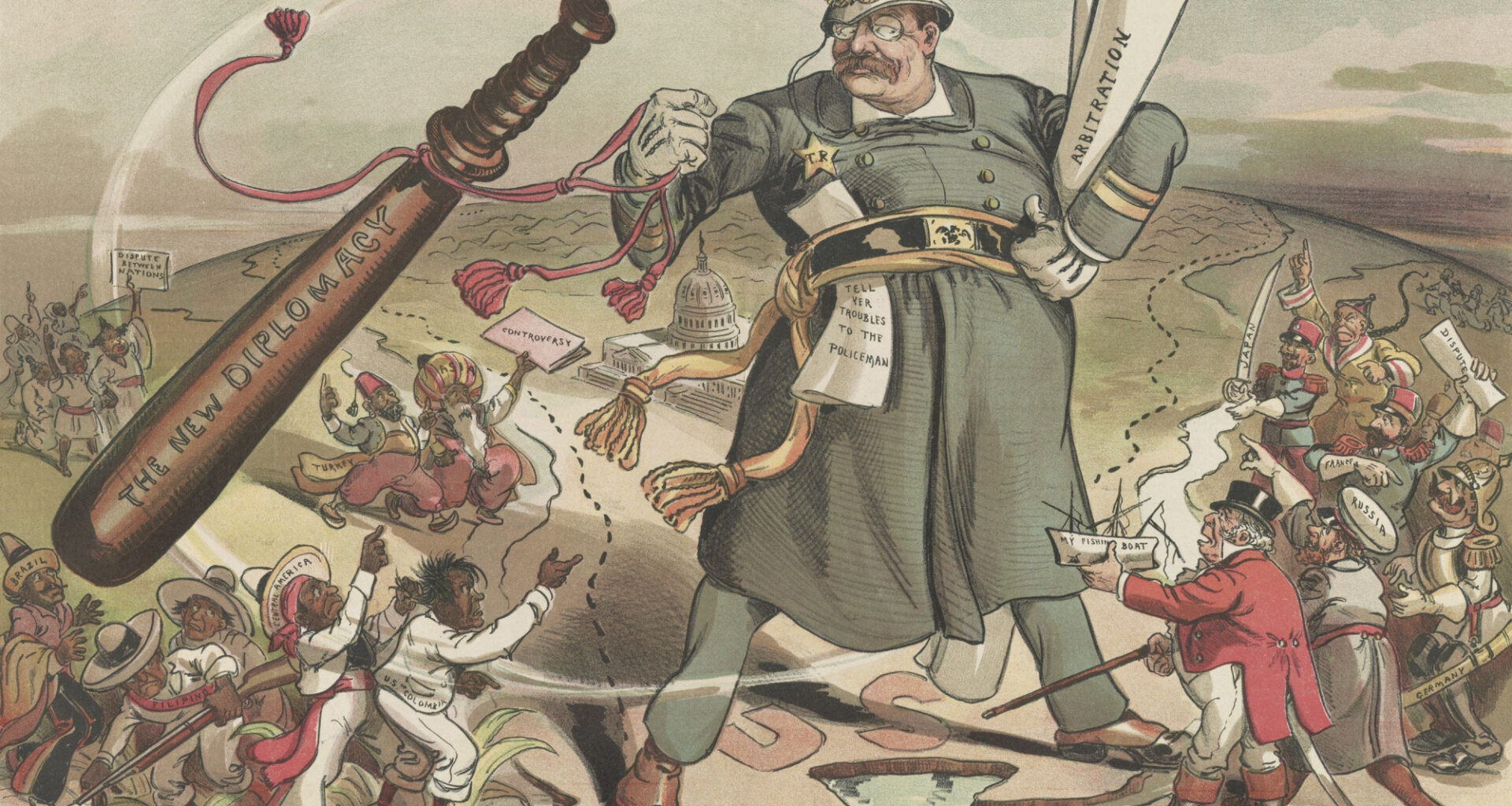
And this is the crux of Trump’s America First foreign policy — it’s a “Hemisphere First” agenda with the U.S. at the helm. The plan is for the United States to exert complete political control — and by extension economic domination — over Latin America. It’s classic U.S. imperialism. It will not tolerate uncooperative left-wing governments (democratic or not) asserting autonomy over their own resources, or perceived adversarial foreign powers from gaining influence in the region.
“A Monroe Doctrine for the 21st Century”
The National Security Strategy published by the Trump administration in November 2025 outlines their vision. It is an updated and renewed Monroe Doctrine for the 21st century where “non-Hemispheric competitors” are sidelined. The U.S. wants to reestablish itself as the premier trading and business partner for every country in the Americas. And it seeks to curtail China’s export market share and capital investment in strategic assets like the Panama Canal and oil in Venezuela.
Venezuela’s oil production collapsed to 569,000 barrels per day in 2020, but it was able to increase output past 1 million barrels per day last year thanks to special licenses granted to Chevron and joint-venture contracts with Chinese firms who developed or controlled their oil fields. Most of Venezuela’s oil exports go to China, and a smaller share of subsidized shipments depart to Cuba, another target of the Trump administration. Cuba will feel the sting of decreased petroleum imports as it puts their already vulnerable power grid on the brink — with the Trump administration hoping to slowly strangle the country.
President Trump has been transparent about wanting American multinationals to spearhead Venezuela’s economic recovery. He believes that in 18 months, they can develop its bountiful oil reserves. China can presumably still import Venezuelan petroleum — preferably developed and sold by the U.S. or jointly with Venezuela’s state-owned oil company, PDVSA — but China would not be allowed to expand its control over Caracas’ oil reserves.
But this remains to be seen. ExxonMobil and ConocoPhillips may balk at investing in the short-term because of political instability, the lack of security guarantees, and the capital expenditures needed to update Venezuela’s oil infrastructure to get energy supplies flowing from Venezuela to international markets — in particular, to U.S. markets.
“A Test Lab for the Trump Administration”
More broadly, Venezuela is a test lab for the Trump administration. They get to see how Latin America and the rest of the world reacts to their war crimes in the Caribbean and the breach of the territorial integrity of Venezuela. An inadequate international response to uphold state sovereignty as a legal norm leaves other countries and territories vulnerable to U.S. interference if they do not acquiesce to U.S. interests.
The main pretext to justify this violation of international law and state sovereignty was ostensibly to stop the flow of drugs into the United States. However, Trump’s approach to the so-called War on Drugs is built upon an intrinsic contradiction.
On the one hand, Trump has taken a bellicose approach towards alleged drug traffickers in the Caribbean and Eastern Pacific. On the other hand, Trump pardoned former Honduran President Juan Orlando Hernández, a convicted drug trafficker who’d been sentenced to 45 years for sending cocaine to the United States. And the family business of Ecuador’s current president Daniel Noboa, Noboa Trading Company, was found to have trafficked 700 kilos of cocaine to Europe in banana containers — yet Noboa is viewed by the Trump administration as a strong ally against drug trafficking.
Furthermore, the U.S. government is not afraid to fabricate lies. The Trump administration spent months painting Venezuelan President Nicolás Maduro as the head of a major drug cartel, Cartel de los Soles, only for the Justice Department to later admit that no such organization exists. Trump later falsely accused Colombian President Gustavo Petro of making cocaine and Mexican President Claudia Sheinbaum of losing control of her country to cartels, making both Colombia and Mexico his potential next targets.
Many in the Latin American left have correctly viewed Maduro’s Venezuela as a liability and an albatross around their necks. A number of countries with left-wing heads of state — Brazil, Chile, Colombia, Mexico, and Uruguay — did not recognize his presidential electoral victory in 2024. Yet they all rightly condemned the U.S. military operation on principle.
A lack of accountability allows the U.S. to behave with impunity vis-à-vis international law. It marks yet another blow to state sovereignty and the so-called “rules-based” order. The U.S. can undermine and violate the territorial integrity of every Latin American country at will — all they have to do is to accuse you of being a drug trafficker (but it is only applicable to enemies, not to allies, of the Trump administration).
That’s why more governments — and social movements around the world, including in the United States — need to speak out forcefully against this invasion and call to uphold international law.