Welcome to the online version of From the Politics Desk, a newsletter that brings you the NBC News Politics team’s latest reporting and analysis from the White House, Capitol Hill and the campaign trail.
In today’s edition, Jonathan Allen breaks down the implications of the Senate’s Venezuela vote. Plus, Henry J. Gomez reports on Vice President JD Vance’s defense of the ICE officer involved in the fatal Minneapolis shooting.
Sign up to receive this newsletter in your inbox every weekday here.
— Adam Wollner
The Senate rebukes Trump on Venezuela, but it will do little to slow him downAnalysis by Jonathan Allen
President Donald Trump’s critics are taking a victory lap after the Senate voted today to advance a resolution purporting to limit his power to use military force in Venezuela. Five Republicans joined Democrats in a procedural move that amounts to sending Trump a strongly worded letter of disapproval.
But Congress isn’t going to get in Trump’s way when it comes to military action in Venezuela or anywhere else. If the Senate ultimately passes the resolution, there is no reason to think Speaker Mike Johnson, R-La., will take it up in the House. And there is every reason to think Trump would veto the legislation in the unlikely event that it ends up on his desk.
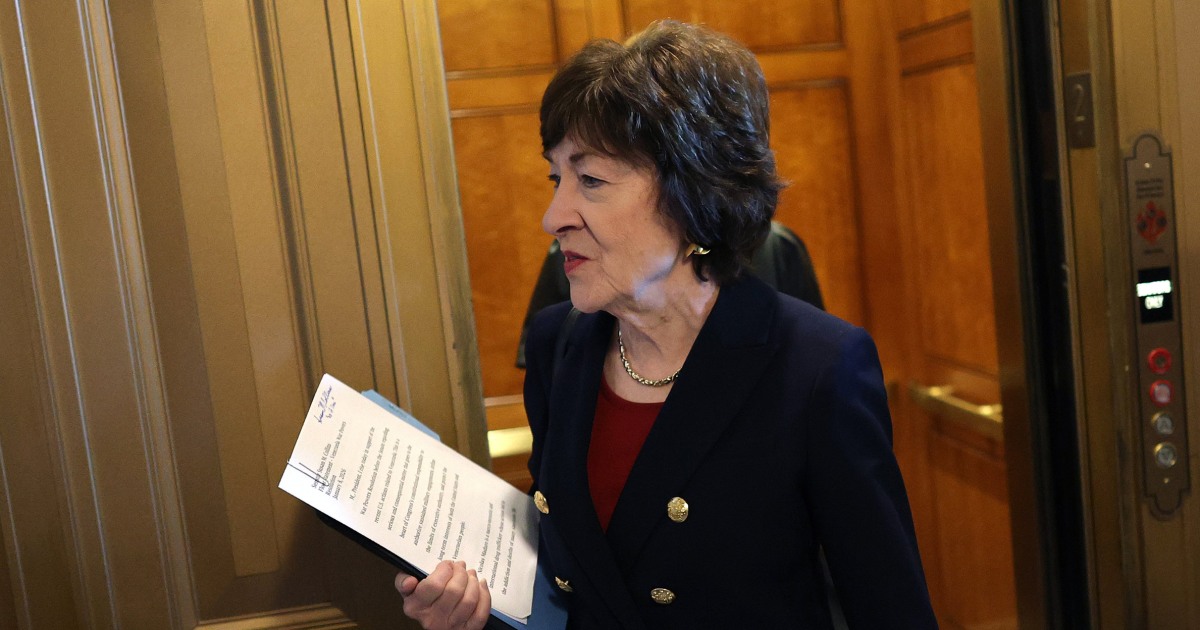
Shortly after the votes were counted, Trump took to social media to excoriate the Republicans who voted against him — Sens. Susan Collins of Maine, Lisa Murkowski of Alaska, Rand Paul of Kentucky, Josh Hawley of Missouri and Todd Young of Indiana — and say they “should never be elected to office again.” (Collins, notably, faces a tough re-election campaign this fall.)
“Republicans should be ashamed of the senators that just voted with Democrats in attempting to take away our Powers to fight and defend the United States of America,” Trump wrote on Truth Social.
Citing the Constitution, the Vietnam-era War Powers Act and a subsequent law outlining the process for Congress’ voting to remove U.S. forces from hostilities, the Senate voted to direct Trump “to terminate the use of United States Armed Forces for hostilities within or against Venezuela, unless explicitly authorized by a declaration of war or specific authorization for use of military force.”
The Constitution gives Congress the power to declare war, and some set of lawmakers invariably becomes defensive of that prerogative when they don’t agree with the military action in question. But only three current senators — Republicans Chuck Grassley of Iowa and Mitch McConnell of Kentucky, along with Vermont independent Bernie Sanders — were alive in the summer of 1942, when Congress last voted to declare war.
The War Powers Act has arguably made it much easier for a president to deploy force without a formal declaration of war. Under its provisions, the president has 48 hours to inform Congress of military action and can conduct hostilities for up to 60 days without congressional approval. In addition, it created a pathway for Congress to vote to authorize the president to go to war without a declaration — a means President George W. Bush used to launch the “global war on terror” and the Iraq War.
If Congress was serious about tying Trump’s hands — and if there were anywhere near the votes needed to override a veto — it would pass a government funding bill that prohibits the use of money for military action in Venezuela.
More broadly, Congress appears to have little appetite for taking back the responsibility and accountability for declaring war. If lawmakers wanted that, and the ballot box risk that comes with it, they would repeal the War Powers Act altogether. Vice President JD Vance articulated the view of most executive branch officials over many decades today when he said: “The War Powers Act is fundamentally a fake and unconstitutional law.”
That hasn’t been tested in the courts, and it won’t be anytime soon. As long as lawmakers want to sidestep the responsibility for making war, they’ll make speeches instead — and pass largely symbolic resolutions.
➡️ Related: New DOJ opinion offers legal justification for Maduro seizure, Trump officials tell Congress, by Ryan J. Reilly and Julie Tsirkin
Vance says death of Minnesota woman killed by ICE was ‘a tragedy of her own making’By Henry J. Gomez
Vice President JD Vance claimed that the woman fatally shot by an ICE officer in Minneapolis was “brainwashed” and suggested without evidence that she was tied to a “broader left-wing network.”
Vance, his voice at times rising in anger as he spoke and took questions in the White House briefing room, also lectured the media for its coverage of the incident while offering few details to back up his version of events.
“I’m not happy that this woman lost her life,” Vance said of Renee Nicole Good, 37, who was shot and killed during a confrontation with Immigration and Customs Enforcement officers yesterday. President Donald Trump has said Good was “resisting” orders and “viciously ran over the ICE Officer” during an immigration-related operation in the city. Officials and an eyewitness have disputed that account.
“I’m not happy that this woman was there at a protest violating the law by interfering with the law enforcement action,” Vance added. “I think that we can all recognize that the best way to turn down the temperature is to tell people to take their concerns about immigration policy to the ballot box, stop assaulting and stop inciting violence against our law enforcement officers. That’s the best way to take down the temperature. … We’re not going to give in to terrorism on this, and that’s exactly what’s happened.”
Vance’s appearance in the briefing room was rare, underscoring the administration’s eagerness to make him a point man on Minnesota. He joined White House press secretary Karoline Leavitt to discuss the administration’s response to the shooting and to an ongoing investigation involving allegations of misuse of welfare funds in the state.
Vance was critical of Minnesota Gov. Tim Walz, his Democratic opponent for vice president in 2024, and announced the creation of an associate attorney general position to tackle fraud probes in Minnesota and other states.
But he was particularly exercised about the shooting, criticizing questions about whether it was warranted. The ICE officer who shot Good, he said, nearly died six months ago after having been “dragged by a car” and required dozens of stitches in his leg.
“So you think maybe he’s a little bit sensitive about somebody ramming him with an automobile?” Vance said.
The latest from Minneapolis:
The Minnesota Bureau of Criminal Apprehension won’t be part of the probe into the shooting. Instead, the FBI will be solely responsible for the investigation.
Asked about the move, Homeland Security Secretary Kristi Noem accused Minnesota state investigators of allowing volatility and “not doing their work.”
Walz said he’s pessimistic that a “fair outcome” will come from the federal probe.
Walz also authorized the Minnesota National Guard “to be staged and ready to support local and state law enforcement” in the wake of ongoing protests. Follow live updates →
That’s all From the Politics Desk for now. Today’s newsletter was compiled by Adam Wollner and Owen Auston-Babcock.
If you have feedback — likes or dislikes — email us at politicsnewsletter@nbcuni.com
And if you’re a fan, please share with everyone and anyone. They can sign up here.