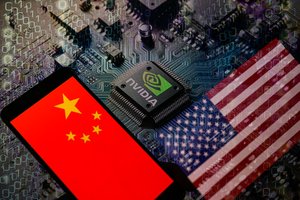
AI has become rule-change-driven. Innovation still matters, and so does surviving the next update to what counts as “allowed” — on chips, on deals, on data, on deployment. In 2026, the most valuable thing in tech is no longer a model or a GPU. It’s permission — the kind you can lose between a purchase order and a shipping label.
That permission now shows up in places executives used to treat as boring. Nvidia is requiring Chinese buyers of its H200 AI chips to pay in full up front, with no cancellations, refunds, or last-minute configuration tweaks, according to Reuters. In a few cases, collateral or commercial insurance can substitute for cash. It’s a payment term that doubles as an admission: Policy volatility has become a line item, and the invoice is due before the truck leaves the dock.
Then came the other kind of paperwork. China’s Ministry of Commerce said it would assess and investigate Meta’s acquisition of AI agent company Manus, pointing to compliance obligations around foreign investment, technology exports, and data transfers abroad. Manus is Singapore-based but has roots in China, and has said it has more than $100 million in annual recurring revenue — big enough to matter, small enough to be a useful test case.
The business problem underneath all of this keeps getting messier, showing up in the connective tissues that executives can’t model. The answer to “Can you…?” keeps changing. Can you sell U.S. chips — then ship them? Can you buy a China-linked company — and keep it? Can you train, host, and deploy across borders without waking up to a new definition of what “counts” as tech transfer? AI companies still compete on speed. They now also compete on durability — how well their plans survive the rewrites.
Chips have become paperwork
If chips were still a normal product category, Nvidia wouldn’t need to behave like it’s selling something between sanctioned equipment and BTS concert tickets. Yet the H200 trade now comes with ration math and political weather.
The Nvidia chips issue between the U.S. and China is supposedly about silicon. But it keeps turning into a permissions system with inventory attached. Nvidia CEO Jensen Huang said this week that Chinese customer demand for H200s is “high — quite high” and that the company has “fired up our supply chain” accordingly. But now, Beijing is reportedly asking Chinese tech companies to stop shopping. Chinese firms have reportedly ordered more than 1.2 million H200 chips priced around $27,000 each, while Nvidia’s inventory is closer to 700,000 units. But Chinese authorities have been directing companies to temporarily pause orders while Beijing decides what ratio of domestic to imported chips buyers should maintain. That’s demand, filtered through policy — a government shaping how much foreign advantage it wants inside its own data centers.
Nvidia’s insistence on cash up front reads differently once you remember what a rule change can cost: The company took a $5.5 billion write-down in April tied to a U.S. export ban. (And there have been more than a few export bans for the company to contend with.) In a normal market, you can misread customers and recover. In this AI one, you can misread regulators and end up eating inventory that was “strategic” only after you manufactured it.
China has been widening the perimeter below the headline battles, pushing the question down from “which chip can you buy” to “which chip can you build your national infrastructure on.” In November, Beijing issued guidance barring foreign-made AI chips from data center projects funded even partly by the state, forcing early-stage projects to remove or cancel plans to use them. At the time, Nvidia’s share of China’s AI chip market fell from 95% in 2022 to zero in 2025 — making it clear that this isn’t a theoretical future.
“If the purchase orders come,” Huang said this week at CES, “it’s because they’re able to place purchase orders.” Nvidia reportedly told Chinese clients that it aimed to begin shipping the H200 chips before the Lunar New Year holiday in mid-February, contingent on Beijing’s approval.
The U.S. side keeps moving, too, and the movement itself has become part of the risk. In early December, President Donald Trump (controversially) said the U.S. would allow exports of Nvidia’s H200 chips to China with a 25% fee on sales, under Commerce oversight. Then, the administration launched a review of advanced Nvidia chip sales to China after that announcement, showing how quickly the “allowed” category can become conditional again. In practice, the corridor is never simply open or closed; it’s perpetually subject to redefinition.
Deals have become tech transfers
When chips become strategic infrastructure, ownership starts looking strategic, too. China’s Commerce Ministry framed its interest in the Meta–Manus transaction around foreign investment, technology exports, and data moving abroad — the language of sovereignty, delivered through compliance. Manus being Singapore-based with roots in China is the key here, because it captures the modern corporate bet: that geography can be managed through incorporation, staffing, and paperwork. Beijing is signaling that those moves don’t guarantee insulation.
Meta has said that there will be no continuing Chinese ownership interest after the deal and that Manus will discontinue services and operations in China. Even if that’s enough to satisfy politics in both the U.S. and China, it doesn’t automatically answer the question of what counts as an export when the “thing” being exported is a team, a system, and the operational know-how to build agents that can touch real workflows — strategic development, not normal software.
The broader implication is that AI acquisitions are increasingly treated less like ordinary M&A and more like capability transfer — the kind that governments want to inspect, slow, condition, or block. Europe is tightening the same screws in a more procedural register. EU lawmakers reached a provisional political agreement in December to reinforce the bloc’s foreign direct investment screening regime. And EU regulators will decide by Feb. 10 whether to clear Alphabet’s $32 billion acquisition of cybersecurity firm Wiz or open a deeper probe — a reminder that the “AI stack” includes the security layer that determines who trusts the cloud where models run.
And data has been put behind borders
The most durable rule changes don’t arrive as a single ban. They arrive as definitions, frameworks, and timelines that force companies to build today around constraints that harden tomorrow. The European Commission’s AI Act timeline is explicit: prohibited practices and AI literacy obligations began applying Feb. 2, 2025, obligations for general-purpose AI models apply from Aug. 2, 2025, and the Act becomes fully applicable Aug. 2, 2026, with some longer transitions extending to 2027. When companies asked Brussels for a delay, Reuters quoted a Commission spokesperson saying there would be no “stop the clock.” This — predictable, public, and still relentless — is the EU version of pressure.
Brussels is also aiming at the substrate AI rides on. In November, the European Commission opened market investigations under the Digital Markets Act into whether AWS and Microsoft Azure should be designated gatekeepers for cloud computing services. If cloud becomes a chokepoint under competition law, “AI regulation” stops being only about model behavior and starts looking like infrastructure governance — where deployment, logs, training data, and distribution power live.
In the U.S., the uncertainty takes a different form: who gets to write the rules. Trump’s Dec. 11 executive order directs the federal government to evaluate state AI laws that may conflict with national policy, including laws that could compel disclosures or require systems to alter outputs in ways the administration argues raise constitutional issues. That’s a push to flatten the compliance map — and it creates its own kind of volatility for companies trying to ship across 50 states (and a few territories) while federal posture shifts and people wonder, “Well, wait a second, can it shift?”
Capital, too, has joined the party. The Treasury Department’s outbound investment program created restrictions and notification requirements around certain U.S. investments in sensitive technologies, including AI, tied to countries of concern. The question of “Can you fund it?” now sits uncomfortably close to “Can you ship it?” and “Can you own it?” — the same permissions logic just showing up through different levers.
AI is becoming a rule-change economy because the people writing the rules know that they’re governing the next era of power. That turns compliance into strategy, contracts into hedges, and corporate structure into something closer to geopolitics with a cap table. The winners won’t only be the companies with the best models. The winners will be the ones that keep scaling through the geopolitical rewrites — and keep answering “Can you?” with something more substantial than a shrug.
📬 Sign up for the Daily Brief