
Company Logo
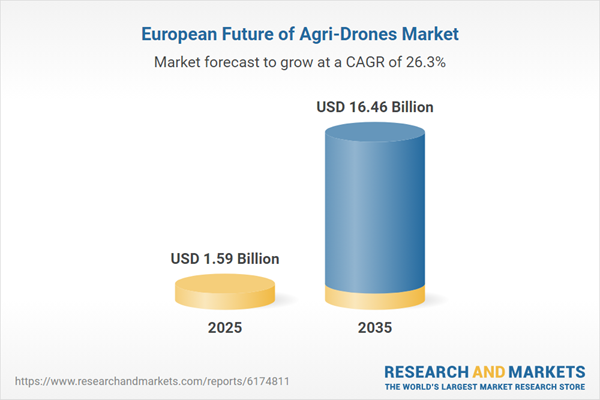
Europe’s agri-drones market is forecasted to skyrocket to $16.46 billion by 2035 at a 26.30% CAGR. Driven by rapid precision agriculture adoption, the market aligns with EU sustainability goals, addressing labor shortages and enhancing resource efficiency.
European Future of Agri-Drones Market
European Future of Agri-Drones Market
Dublin, Jan. 07, 2026 (GLOBE NEWSWIRE) — The “Europe Future of Agri-Drones Market: Focus on Agri-Drones’ Applications, Product Types, and Country – Analysis and Forecast, 2025-2035” has been added to ResearchAndMarkets.com’s offering.
The Europe future of agri-drones market is projected to reach $16.46 billion by 2035 from $1.25 billion in 2024, growing at a CAGR of 26.30% during the forecast period 2025-2035. Europe’s market for agri-drones will be influenced by the swift adoption of precision agriculture, which is being fueled by the region’s need for increased crop output and resource efficiency. Initiatives for climate-smart farming are increasing demand for drones that can detect pests early, spray adaptively, and monitor in real-time – all of which are in line with the EU’s sustainability goals.
As labor shortages worsen, automation is progressing, with autonomous drones decreasing reliance on manual labor in the field. Large-scale, coordinated farming operations are made possible by emerging technologies like swarm technology, and predictive analytics and evidence-based decision-making are improved by integration with IoT and big data platforms.
Drone activities are being formalized at the same time by Europe’s developing regulatory frameworks under the EASA, which have standardized certification and airspace usage procedures. Agri-drones are positioned as a key component of next-generation European agriculture as a result of these trends, which collectively demonstrate the convergence of technology, sustainability, and data intelligence.
Market Trends
Europe is the largest market for agriculture drones and robots, driven by strong technological adoption and supportive government policies (e.g., EU’s Robs4Crops initiative in 2021).
Rapid integration of precision agriculture and automation technologies for crop monitoring, spraying, and yield optimization.
Growing use of drones in livestock monitoring, aquaculture, orchards, and indoor farming, alongside traditional field crops.
Shift toward “Robotics-as-a-Service (RaaS)” models, enabling farmers to adopt drones without high upfront costs.
Expanding digital farming ecosystems where drones connect with IoT sensors, satellite imagery, and farm management software.
Story Continues